
Pillar 4: Investor Psychology (2025 Edition)
SECTION 1 — The Truth About Investor Psychology: How VCs Actually Think (NOT What Founders Assume)Most founders walk into fundraising with a dangerously false assumption:
“Investors fund ideas.”
But inside every real VC room, the thought process looks more like:
“Does this startup present a high-probability path to a 10×–50× return?”
Investors invest in probabilities, not prototypes.
In psychology, not pitch decks.
In behaviors, not beliefs.
Pitch decks don’t win funding.
Founders who understand investor psychology win funding.
This section breaks down the truth behind the mind of a VC — how they think, what they fear, and what subconscious signals determine whether you get a follow-up meeting or a polite rejection.
⭐ The First Rule of Investor Psychology: VCs Are NOT Objective
Founders imagine investors as rational spreadsheet-driven machines:
“If my TAM is big enough…”
“If my deck is good enough…”
“If my tech is strong enough…”
But every investor is shaped by:
Cognitive biases
Personal heuristics
Pattern recognition shortcuts
Fear of missing out (FOMO)
Fear of looking stupid
Loss aversion
Deal heat and social proof
A VC’s job is to make decisions with incomplete information — so the brain fills gaps using shortcuts.
This means founders with a deep understanding of investor psychology outperform founders with a better product.
Every. Single. Time.
⭐ The Hidden Mental Model: “Replacement Theory”
Every VC asks a subconscious question:
“If I don’t invest, who will?”
If the answer feels like:
“Probably no one…”
“This market is cold…”
“The founder seems inexperienced…”
→ Rejection is coming.
If the answer is:
“If I don’t invest now, other VCs will jump in…”
“This founder looks unstoppable…”
“The traction is too fast to ignore…”
→ You trigger FOMO (the strongest investor emotion).
This is why your storytelling structure matters.
It’s why your clarity matters.
It’s why linking to your VC Pitch Deck Guide in places where founders need deeper help works:
“… when founders fail to communicate traction velocity, investors assume probability is low.
Learn the structure investors expect in the VC Pitch Deck Guide (ADD LINK HERE).”
⭐ Investor Psychology = Probability Psychology
VCs don’t evaluate:
❌ Is the idea good?
❌ Is the deck pretty?
❌ Is the problem well-written?
They evaluate:
✔ Probability of founder success
✔ Probability of market adoption
✔ Probability of moat creation
✔ Probability of a 10–50× return
✔ Probability that other investors will join
✔ Probability that you can execute faster than competition
The ENTIRE pitch deck exists to influence those probabilities.
Once you understand this, fundraising becomes far easier.
⭐ The Emotional Side of Investing (Founders Ignore This)
Investors say they are logical.
But here's the truth real VCs admit privately:
They fall in love with founders
They fall in love with markets
They fall in love with momentum
They fall in love with story arcs
They fall in love with “unfair advantage” energy
They fall in love with confidence + clarity
And they RUN AWAY from:
confusion
vagueness
randomness
weak framing
unstructured thinking
emotional instability
Most founders lose funding not because the business is bad…
but because their framing makes the investor subconsciously feel uncertainty.
Investor brains HATE uncertainty.
Uncertainty kills deals.
Your job is not to “pitch.”
Your job is to create psychological safety for the investor.
⭐ The First 90 Seconds Decide EVERYTHING
This is not theory.
This is based on real VC behavior.
Inside firms like Sequoia or a16z:
Partners scan decks in under 3 minutes
They decide “yes/no/maybe” in 90 seconds
They look for signal > noise
They look for coherence > beauty
They look for clarity > creativity
If your title slide + problem slide don’t trigger:
“This founder understands the game.”
You are already out.
If you want to see a pitch system built fully around these psychological patterns, take a look at the Funding Blueprint VC PITCH DECK.
⭐ Your Pitch = A Probability Engine
By understanding investor psychology, your pitch becomes a:
bias-aware
FOMO-triggering
risk-reducing
clarity-driven
credibility-anchored
social-proof-reinforced
probability engine.
This is how investors think.
This is why psychology beats design.
⭐ ONE LINE SUMMARY OF THIS SECTION
“Fundraising is not a logic game — it’s a probability game driven by investor psychology, risk perception, and cognitive biases.”


SECTION 2 — The Investor Mental Model: How VCs Judge Founders in the First 3 Minutes
If Section 1 explained why investors don’t behave logically, Section 2 explains how they actually evaluate founders — the real mental process VCs use when judging whether someone is worth betting millions on.
And the shocking truth?
VCs do NOT evaluate you slide-by-slide.
They evaluate you LAYER by LAYER.
This is the “rapid judgment model” used inside nearly every VC firm.
Within the first 3 minutes, investors mentally score:
Founder Quality
Market Believability
Problem Importance
Momentum Signals
Probability of Scale
Perceived Risk
If even one of these feels weak, the entire pitch collapses — even if your product is strong.
Below is the actual psychology behind each layer.
⭐ 1. Founder Quality (The First 30 Seconds)
Investors judge YOU before they judge your idea.
They’re scanning for:
Clarity
Calmness
Coherence
Founder–market fit
Strength of thinking
Consistency in your logic
Confidence without arrogance
They ask themselves:
“Does this founder think like somebody who can navigate chaos?”
If your opener is messy → you fail this check.
If your narrative is clear → they lean in.
This is why using a structured narrative (like the one in your VC Pitch Deck Guide — ADD LINK HERE) immediately upgrades how they perceive you.
Founders underestimate this.
VCs don’t.
⭐ 2. Market Believability (Seconds 30–60)
This is NOT your TAM slide.
This is not even your market size.
This is the investor thinking:
“Is this market growing and inevitable?”
VC psychology favors:
✔ Expanding markets
✔ Behavioral or tech shifts
✔ Pain points that increase each year
✔ Problems created by new trends
✔ Categories where customers have BUDGET
Markets investors dislike:
❌ Shrinking categories
❌ Enterprise categories with slow sales cycles
❌ Markets where buyers resist change
❌ Industries where margins are thin
The faster your category is expanding,
→ the more investors trust your probability of success.
⭐ 3. Problem Importance (Seconds 60–90)
VCs don’t care if the problem is “interesting.”
They care if it’s:
expensive
painful
measurable
urgent
accelerated by a trend
worth solving RIGHT NOW
If a problem doesn’t cause:
💸 Financial loss
⏳ Time waste
🔥 Operational chaos
📉 Growth blockage
…it won’t trigger investor emotion.
Remember:
Founders love clever problems.
Investors love expensive problems.
This is why your Problem & Solution pillar it strengthens this psychological layer.
⭐ 4. Momentum Signals (Minutes 1–2)
Momentum > traction.
Momentum means:
Something is accelerating
Graphs point UP and RIGHT
More customers care each month
Relevance is growing
Something is shifting in your favor
VCs believe:
“Momentum today means market dominance tomorrow.”
This is why even tiny traction — if accelerating — beats large traction that is static.
Examples:
10 → 30 → 60 users = GOOD
1,000 → 1,200 → 1,100 users = BAD
Investors want SPEED, not size.
⭐ 5. Probability of Scale (Minutes 2–3)
This is the subconscious question:
“If everything goes well, can this become huge?”
This is where VCs use:
Pattern recognition
Past founder comparisons
Similar startup trajectories
Category mapping
Market compounding logic
Even if you don’t show scale yet, they judge:
distribution potential
viral potential
network effects
operational leverage
simplicity of adoption
If your business model looks scalable, they trust the future.
If it looks operationally heavy, slow, or founder-dependent → probability collapses.
⭐ 6. Perceived Risk (SECRET Layer Most Founders Ignore)
This is the most important layer.
Investors don’t invest in upside.
They invest in low downside.
Their brain asks:
“What could kill this startup?”
“Can these founders survive chaos?”
“Is the market too early?”
“Is distribution too expensive?”
“Is competition too aggressive?”
The lower the perceived risk,
→ the more they trust the founder
→ the more they trust the deck
→ the more they want the meeting
This is why clarity reduces risk
and why unclear decks increase risk.
Risk is psychological, not mathematical.
⭐ Why This Mental Model Matters
If you understand the layers above, you no longer pitch “features,” “TAM,” or “slides.”
You pitch:
credibility
certainty
velocity
inevitability
competence
clarity
This shifts investor psychology from:
❌ “Should we invest?”
to
✔ “Can we afford NOT to?”
FOMO happens only when this mental model aligns.
⭐ ONE-LINE SUMMARY OF THIS SECTION
“VCs judge founders in layers — clarity, market inevitability, problem urgency, momentum, scalability, and risk — all within the first 3 minutes.”


SECTION 3 — The Hidden Cognitive Biases That Control Every Investor Decision (Even When They Pretend They’re Rational)
If you want to understand why an investor says “yes,”
you must understand what their brain is doing long before their logic activates.
Most founders mistakenly assume:
“If my metrics are strong and my deck is good, they will invest.”
But the real truth?
Investors make emotional decisions first.
Then they justify them with logic.
This is not speculation — it’s neuroscience, behavioral economics, and the lived experience of every VC who has ever written a check.
This section breaks down the 6 most powerful cognitive biases that silently control investor decisions.
Master these, and your pitch becomes dramatically more persuasive.
⭐ 1. Pattern Recognition Bias (The VC Superpower — and Weakness)
VCs believe they’re good at “seeing patterns.”
They’ve met thousands of founders.
They’ve seen hundreds of companies scale.
So their brain is constantly scanning your pitch for patterns they’ve seen before.
Positive patterns they love:
Similar founder traits to winners
Similar market timing to winners
Similar product simplicity to winners
Similar traction acceleration to winners
Negative patterns they fear:
Founders who ramble
Overbuilt products
Crowded markets
Slow-moving traction
Weak business models
Your job is to align your narrative with patterns they already trust.
Example of a natural link inside the text:
“…these patterns are why investors prefer predictable slide structures.
You can see the full structure inside the VC Pitch Deck Guide.”
⭐ 2. Anchoring Bias (The First Number Shapes Everything)
Anchoring bias means:
The first number you show influences how investors interpret every other number.
Examples:
If you open with:
“Last month we grew 120% MoM…”
→ everything looks impressive afterward.
If you open with:
“We currently have 32 users…”
→ everything looks small afterward.
This is why traction needs framing, not just reporting.
Anchoring affects:
revenue
churn
CAC
burn
user growth
fundraising ask
You should ALWAYS lead with your strongest number first.
Because it anchors the investor’s brain to a positive baseline.
⭐ 3. Confirmation Bias (Investors Look for Evidence They’re Right, Not Evidence You’re Good)
Once an investor forms an opinion (even in 20 seconds), their brain instantly begins:
seeking evidence that supports that opinion.
If they think you’re strong →
they will interpret everything as “great.”
If they think you’re weak →
they will interpret everything as “not enough.”
This means:
Your opening narrative defines the rest of the meeting.
This is why the first 2–3 slides (Title, Problem, Solution) must be extremely clear.
If clarity is missing early, investors subconsciously “file you as weak” and everything afterward suffers.
⭐ 4. Loss Aversion (Stronger Than Return Desire)
Loss aversion is the idea that:
Investors feel the pain of losses more intensely than the joy of gains.
This is the #1 reason VCs pass on deals.
They are not thinking:
“How big can this get?”
They are thinking:
“How likely am I to look stupid if this fails?”
Loss aversion shapes:
how risky your market seems
how credible you appear as a founder
how reliable your execution looks
how logical your distribution is
You must remove perceived risks:
✔ clarity
✔ traction consistency
✔ coherent business model
✔ sharp narrative
✔ founder-market fit
The clearer you are, the safer they feel.
⭐ 5. FOMO (Fear of Missing Out — The Strongest VC Force on Earth)
A deal can be mediocre and STILL get funded if:
other investors show interest
the founder seems unstoppable
momentum is obvious
market timing is perfect
FOMO is stronger than:
logic
diligence
financial modeling
metrics
This is why founders who frame momentum properly (e.g., in the roadmap or traction slide) outperform founders with better metrics but weaker energy.
Example:
“We doubled ARR each quarter for the last 3 quarters.”
Triggers massive FOMO.
⭐ 6. The Halo Effect (One Good Thing Makes Everything Look Good)
If one part of your pitch is extremely strong, investors will assume the rest is strong too.
Examples:
If your market is exploding →
they think your product must be good.
If your traction is accelerating →
they think your team must be strong.
If your team is world-class →
they assume execution will be smooth.
The halo effect creates unfair advantage.
Founders who understand how to build a halo can double their funding probability.
⭐ Why These Biases Matter
This is the secret:
You cannot “logic” your way to funding.
You must design your pitch to work with the investor brain, not against it.
If you master:
pattern recognition
anchoring
confirmation bias
loss aversion
FOMO
halo effect
Your pitch becomes psychologically irresistible.
This is why investor psychology matters more than design.
Founders who understand this raise faster.
Founders who ignore this get stuck in “maybe later.”
⭐ ONE-LINE SUMMARY OF THIS SECTION
“Investor decisions are driven far more by cognitive biases than by financial logic — and your pitch must be engineered to work with those biases, not fight them.”


SECTION 4 — The “Risk Radar” Framework: How Investors Subconsciously Scan Your Startup for Red Flags
Every VC has a mental “Risk Radar.”
You will never see it.
They will never mention it.
But it’s always running when they read your deck.
Investors don’t begin by searching for upside.
They begin by searching for:
“What could kill this startup?”
This is why investors are NOT evaluating your pitch in a linear slide-by-slide sequence.
Their brain is doing this instead:
Scan → Detect → Flag → Judge → Then read.
The more risk flags your pitch triggers,
→ the lower your probability of funding
→ the more skeptical the investor becomes
→ the more questions you’ll face
→ the harder your traction must work
This section reveals ALL hidden risk categories VCs subconsciously evaluate — and how to build your deck so you reduce the risk score before the investor realizes it.
⭐ THE 5 TYPES OF RISK EVERY INVESTOR SUBCONSCIOUSLY CHECKS
There are five “risk rings” inside the VC brain:
Team Risk — “Can these founders actually do this?”
Market Risk — “Is this category too slow/small/crowded?”
Product Risk — “Does anyone REALLY need this?”
GTM Risk — “Can they actually acquire customers efficiently?”
Financial Risk — “Will they burn too much money before getting traction?”
Let’s break each down — brutally honestly.
⭐ 1. Team Risk (The Most Important and Most Emotional Risk)
Investors fear:
inexperienced founders
unclear roles
lack of founder-market fit
no technical co-founder
chaotic storytelling
founders who can’t answer questions
founders who dodge weaknesses
A strong team instantly lowers investor anxiety.
Signs of LOW team risk:
clear founder–market fit
past execution wins
domain expertise
composure under pressure
simple answers to complex questions
Signs of HIGH team risk:
buzzwords
overcomplication
arrogance
defensiveness
lack of clarity
This is why your Team Slide must feel coherent, simple, and competence-heavy.
⭐ 2. Market Risk (The Most Common Reason Investors Say No)
Market risk isn’t:
❌ “Our TAM is small.”
Most founders misunderstand.
Market risk is:
✔ slow adoption
✔ buyer resistance
✔ enterprise sales cycles
✔ crowded red-ocean environments
✔ unclear urgency
✔ regulatory uncertainty
Investors ask:
“Will this market make heroes or victims?”
This is why your Why Now slide must show:
real behavioral shifts
real timing advantages
real demand acceleration
real industry transitions
This reduces market risk dramatically.
If you need deeper clarity here, the How VC Pitch Decks Work pillar breaks down timing logic in detail.
⭐ 3. Product Risk (Investors Don’t Trust Products They Don’t Understand)
Product risk is NOT feature-based.
It’s clarity-based.
When a product is unclear, investors assume:
complexity
low usability
high support burden
slow onboarding
expensive sales cycles
VCs hate this type of risk.
You reduce product risk by:
✔ simple product story
✔ 3–5 features max
✔ clear user workflow
✔ real use cases
✔ frictionless onboarding logic
Remember:
If investors can’t explain your product to another investor →
you will not get a second meeting.
⭐ 4. GTM Risk (The Silent Startup Killer)
Most founders think investors care mostly about:
TAM
Product
Team
But insiders know this:
GTM Risk kills more deals than Product Risk.
Investors ask:
“Can you acquire customers cheaply?”
“Is your sales motion repeatable?”
“Is your distribution logical?”
“Do you have an actual growth engine?”
If your deck suggests you’ll rely on:
❌ virality
❌ hope
❌ influencer marketing
❌ paid ads as the core strategy
…your risk score skyrockets.
This is why your Go-To-Market slide must be extremely sharp.
⭐ 5. Financial Risk (The Risk Most Founders Ignore Until It’s Too Late)
Investors don’t mind losing money for 2–3 years.
What they HATE is:
❌ unclear burn
❌ weak LTV/CAC logic
❌ unrealistic projections
❌ high support cost
❌ dependence on paid acquisition
❌ messy unit economics
Financial risk is psychological.
If your numbers are vague, the investor feels unsafe.
This is why your AI Financial Narrative Engine in the kit is practically cheating — it makes your numbers feel investor-ready and low-risk.
⭐ Why the Risk Radar Matters to You
Founders pitch upside.
Investors evaluate downside.
Funding happens when:
✔ upside feels big
AND
✔ risk feels low
AND
✔ momentum feels real
AND
✔ narrative feels coherent
Your pitch isn’t just storytelling.
It’s risk reduction psychology.
Once a founder understands this, their deck improves dramatically.
⭐ ONE-LINE SUMMARY OF THIS SECTION
“Investors don’t fund upside — they fund low-risk pathways to upside. Your pitch must lower all five risk categories before they even notice them.”


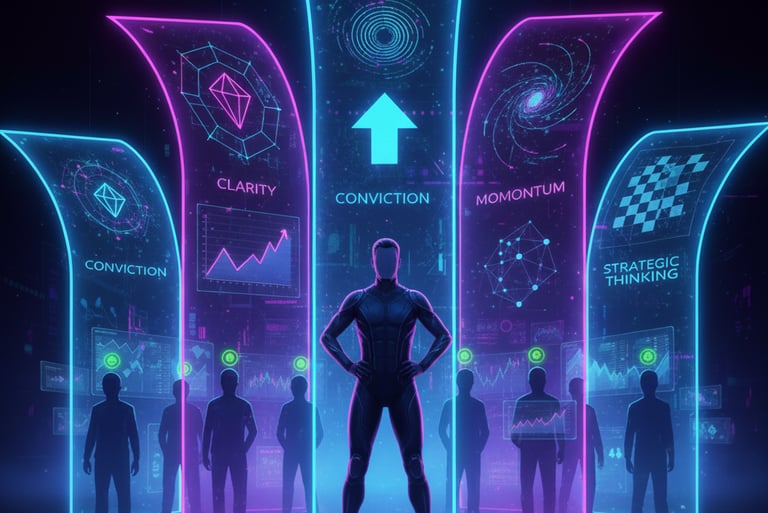
SECTION 5 — The Four Signals of a “High-Conviction Founder”: What Instantly Makes Investors Believe You Can Win
Investors don’t fund “great ideas.”
They fund high-conviction founders.
This is an uncomfortable truth:
A weak founder with a strong idea rarely gets funded.
A strong founder with an okay idea almost always gets funded.
The reason is simple:
VCs believe strong founders eventually find the right idea.
Weak founders fail even with a great idea.
This section breaks down the four psychological signals that make investors instantly believe the founder in front of them is capable of turning a deck into a real company.
If you can demonstrate these four signals, your fundraising probability increases dramatically — even if your traction isn’t perfect yet.
⭐ SIGNAL 1 — Narrative Clarity (The Ability to Explain the Complex Simply)
When a founder can explain their business clearly, investors infer:
strong thinking
deep understanding
operational discipline
communication skill
leadership potential
Clarity is not about slides.
Clarity is about how your mind works.
Investors think:
“If they can explain this crisply, they can run this company crisply.”
Narrative clarity shows up in:
how you describe the problem
how you frame your solution
how you explain your GTM
how you simplify your roadmap
When clarity is high → confidence rises.
When clarity is low → confidence collapses.
Simple as that.
⭐ SIGNAL 2 — Momentum Thinking (The Ability to Create Acceleration, Not Just Numbers)
Investors don’t just fund metrics.
They fund founders who understand velocity.
Momentum thinking means:
every month looks faster than last
every release increases adoption
every experiment sharpens distribution
every insight reduces friction
Most founders talk about:
❌ output
❌ features
❌ effort
High-conviction founders talk about:
✔ acceleration
✔ compounding
✔ velocity
✔ strategic leverage
Momentum thinking is the #1 psychological indicator of future scale.
Investors subconsciously think:
“This founder won't move slowly, even if the market resists.”
That’s extremely attractive.
⭐ SIGNAL 3 — Strategic Awareness (Understanding the Battlefield, Not Just the Product)
Low-level founders talk about:
features
design
tech
roadmaps
High-conviction founders talk about:
competitive dynamics
distribution channels
switching costs
buyer psychology
market timing
pricing power
defensibility
category edges
This gives investors a critical signal:
“This founder doesn’t just know how to build — they know how to WIN.”
Strategic awareness also reduces investor risk dramatically because:
the founder appears less naive
they anticipate threats
they understand constraints
they think about scale early
they don’t rely on luck
Investors LOVE this.
⭐ SIGNAL 4 — Controlled Confidence (Calm, Not Cocky)
Founders confuse confidence with charisma.
Real investor-trusted confidence is:
✔ calm
✔ grounded
✔ unshakable
✔ fact-based
✔ non-reactive
✔ humble but firm
Investors hate:
❌ ego
❌ defensiveness
❌ overclaiming
❌ emotional volatility
❌ “we will disrupt everything” energy
Controlled confidence is:
answering questions simply
acknowledging unknowns
showing learning agility
describing risks honestly
demonstrating coherent thinking
Founders who speak calmly make investors feel safe.
Safety = investable.
⭐ Why These Four Signals Matter So Much
Investors don’t have enough data to predict future success.
So they evaluate founder psychology instead.
A founder who demonstrates:
clarity
momentum thinking
strategic awareness
controlled confidence
…is interpreted as having:
✔ high probability of execution
✔ strong chance of adjustment
✔ better survival ability
✔ high adaptability
✔ lower emotional risk
These psychological signals often matter more than your traction, product, or TAM.
⭐ ONE-LINE SUMMARY OF THIS SECTION
“High-conviction founders win funding not because of perfect metrics, but because they project clarity, velocity, strategy, and calm confidence — the four signals VCs trust most.”.
SECTION 6 — The Investor’s “Trust Curve”: How VCs Move From Skepticism → Curiosity → Belief → Commitment
Every investor decision follows a psychological sequence, not a logical one.
Founders think:
“If my traction, TAM, and product are strong, they will invest.”
But inside the investor’s mind, the decision looks more like:
“Do I trust this founder enough to take the risk?”
Trust is the REAL currency of fundraising —
not TAM, not revenue, not features.
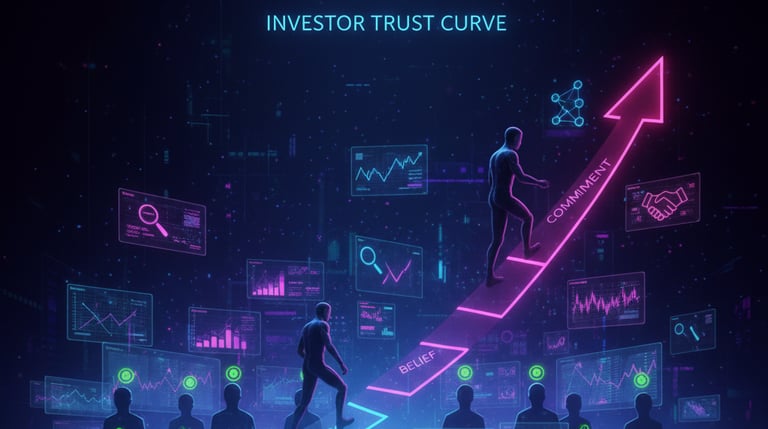
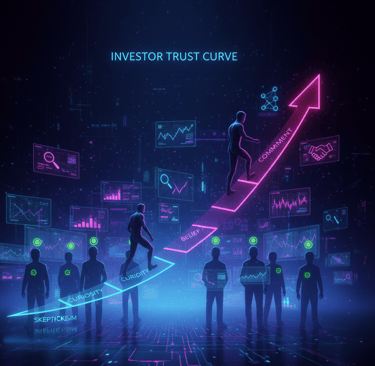
To understand how trust is built, you must understand the Investor Trust Curve, a psychological model that explains EXACTLY how VCs shift from:
❌ doubt → ❌ hesitation → ❌ uncertainty
to
✔ curiosity → ✔ confidence → ✔ conviction.
Once you understand how to move an investor along this psychological curve, you stop “pitching” and start engineering trust.
⭐ PHASE 1 — Skepticism (Every Investor Starts Here)
This is the default investor state.
Every VC starts by assuming:
90% of founders fail
Most decks exaggerate
Most numbers are inflated
Most markets are misunderstood
Most founders are inexperienced
Skepticism isn't personal —
it's a survival mechanism.
Your pitch must neutralize skepticism fast.
Signals that INCREASE skepticism:
❌ vague opener
❌ unclear problem
❌ jargon-heavy language
❌ overcomplication
❌ “we will disrupt everything” claims
Signals that REDUCE skepticism:
✔ clean value proposition
✔ simple opening story
✔ crisp articulation of problem
✔ clear reason “why now”
✔ measured confidence
This is why your first 90 seconds matter more than any slide afterward.
This is why many founders look at the complete Funding Blueprint system — it shows how to reduce investor skepticism through structure, clarity, and narrative
⭐ PHASE 2 — Curiosity (The Most Fragile Stage)
If you reduce skepticism successfully, the investor enters Curiosity Mode.
This is an emotional shift, not a logical one.
They start thinking:
“This is interesting…”
“Tell me more.”
“This founder is clearer than most.”
“This market is worth looking at.”
“Maybe there’s something here.”
Curiosity is fragile, because it can easily collapse if:
❌ your slides are messy
❌ your narrative breaks
❌ your product is unclear
❌ your traction feels fluffed
❌ your GTM is unrealistic
You maintain curiosity by:
✔ simplicity
✔ flow
✔ coherence
✔ confidence
✔ relevance
✔ sharp transitions
Curiosity is the moment where investors decide whether they will actually pay attention moving forward.
⭐ PHASE 3 — Belief (The Moment You Win Them Emotionally)
Belief is not created from logic.
Belief is created from momentum, clarity, and inevitability.
At this stage, investors are thinking:
“This founder is impressive.”
“This problem is real and painful.”
“This category is expanding.”
“This product actually solves something important.”
“This feels like it’s going somewhere.”
Belief is when the investor begins imagining:
✔ you raising a Series A
✔ your company scaling
✔ your category exploding
✔ other investors wanting in
✔ the potential upside
Belief is where psychological FOMO begins forming.
Belief is the emotional YES.
Everything after this is justification.
⭐ PHASE 4 — Commitment (The Logical Yes)
Commitment is NOT an emotional decision —
it’s a rationalization of the emotional decision.
This is when investors look more carefully at:
unit economics
team strength
GTM scalability
revenue model
risk factors
cash efficiency
But make no mistake:
By the time they are evaluating your numbers,
their emotional decision is already made.
Commitment is when they say internally:
“Okay, I’m in — unless something is totally off.”
Your job now is not to impress them,
but simply not to shock them.
This is where:
✔ financial clarity
✔ clean burn logic
✔ transparent assumptions
✔ simple business model
✔ believable roadmap
…become crucial.
Numbers rarely turn a “no” into a “yes.”
But numbers can definitely turn a “yes” into a “no.”
⭐ Why the Trust Curve Matters
Once you understand the Investor Trust Curve, you realize:
Your pitch is not a sequence of slides.
It is a sequence of emotional shifts.
Investors must move through:
1️⃣ Skepticism
2️⃣ Curiosity
3️⃣ Belief
4️⃣ Commitment
Your entire deck should be designed to move them along this curve deliberately.
Most founders pitch “information.”
High-level founders pitch trust.
⭐ ONE-LINE SUMMARY OF THIS SECTION
“Fundraising success depends on moving investors psychologically from skepticism to curiosity to belief to commitment — trust is the real outcome your deck must build.”
SECTION 7 — The Investor's “Clarity Test”: How VCs Detect Intelligence, Focus & Execution Ability in Under 60 Seconds
Most founders think clarity is about making things “easy to read.”
But in investor psychology, clarity means something far deeper:
Clarity = Demonstration of high-level thinking.
Confusion = Demonstration of weak execution ability.
VCs treat clarity as a direct proxy for:
founder intelligence
founder focus
founder discipline
founder decision-making
founder ability to communicate with teams
founder ability to lead under pressure
founder ability to execute
This section breaks down how investors subconsciously evaluate your clarity — and how they use it to determine whether you’re a high- or low-probability founder.
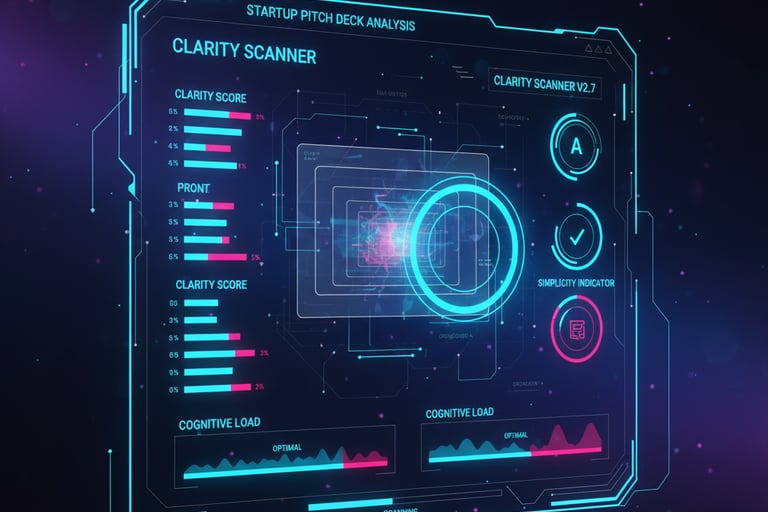
⭐ The Truth: VCs Don’t Judge Clarity. They Judge Cognitive Load.
Every investor has a mental limit.
If your pitch forces their brain to work too hard, they interpret that as:
❌ poor thinking
❌ weak leadership
❌ messy operations
❌ lack of strategy
❌ unclear execution skills
A confused investor NEVER writes a check.
If your pitch is simple, they feel:
✔ safe
✔ confident
✔ impressed
✔ optimistic
✔ willing to commit
This is why clarity is a psychological risk reducer.
⭐ The 4-Part “Clarity Test” Every Investor Uses Automatically
VCs scan your deck and your speech looking for these four indicators:
Clarity of Narrative
Clarity of Priorities
Clarity of Metrics
Clarity of Future Path
Miss even one, and your perceived founder quality drops.
Let’s break them down.
⭐ 1. Clarity of Narrative (Does the Founder Understand the Business at Its Core?)
Investors ask:
“Can this founder explain the business in one sentence?”
If you can’t, they assume you also can’t:
run teams
build GTM
make intelligent decisions
communicate with customers
attract talent
pitch future investors
The ability to simplify complexity is one of the strongest signals of a world-class founder.
This is why your Title Slide + Problem Slide must snap into place cleanly.
⭐ 2. Clarity of Priorities (Do They Know What Actually Matters?)
Most founders talk about:
❌ features
❌ tech
❌ product glow
❌ micro details
High-level founders talk about:
✔ what moves growth
✔ what impacts retention
✔ what drives revenue
✔ what the market is evolving toward
✔ what creates defensibility
Investors immediately notice the difference.
When a founder is obsessed with what actually matters →
they are seen as an execution-first founder, not a product-first founder.
And execution-first founders always score higher on the Trust Curve.
⭐ 3. Clarity of Metrics (Do They Know Their Unit Economics Emotionally?)
Clarity in metrics isn’t about:
❌ spreadsheets
❌ projections
❌ dozens of charts
It’s about knowing the soul of your business:
CAC
LTV
Churn
Payback
Burn
Cash runway
Activation rate
Frequency of usage
Investors check quickly:
“Do they know their business in their bones?”
If your numbers feel unclear →
your execution seems unclear →
your probability of success drops →
your perceived risk skyrockets.
This is why the AI Financial Narrative Engine inside your kit gives founders an unfair advantage — clarity on numbers reduces investor fear instantly.
⭐ 4. Clarity of Future Path (Does the Founder Know Where This Goes?)
This is NOT about:
❌ big visions
❌ “billion-dollar TAM”
❌ huge ideas
It’s about a founder showing:
sharp next steps
clear adjacent markets
simple roadmap
believable expansion plan
grounded execution phases
Investors don’t care about your 7-year vision.
They care about the next 24 months and whether you seem capable of hitting realistic milestones.
If your future path is simple, investors trust your probability of execution.
If your future path is fuzzy, investors assume chaos.
⭐ What Happens When Clarity Is High
When clarity is strong, the investor’s risk radar quiets down.
They subconsciously think:
“This founder thinks clearly.”
“This business feels well-structured.”
“This is going somewhere.”
“This founder will handle complexity.”
“We won’t need to babysit this team.”
Clarity → Safety
Safety → Trust
Trust → Funding
This psychological pathway is what drives most investment decisions.
⭐ What Happens When Clarity Is Low
When clarity is weak:
investors disengage
skepticism resurfaces
curiosity collapses
FOMO disappears
belief evaporates
commitment dies
You’ll hear phrases like:
“Let’s revisit later.”
“This doesn’t feel ready.”
“We need more data.”
“The narrative isn’t sharp yet.”
These are all symptoms of failed clarity.
⭐ ONE-LINE SUMMARY OF THIS SECTION
“Investors treat clarity as a direct measure of founder intelligence, discipline, and execution ability — unclear founders rarely get funded, no matter how good their product is.”
SECTION 8 — The “Founder Reality Filter”: How Investors Instantly Detect Whether You're Delusional, Grounded, or Truly Exceptional
This section is one of the most important in the entire pillar.
Because here is the brutal truth:
Investors don’t evaluate your idea first.
They evaluate your relationship with reality.
Your perception of the world is more important than:
your product
your traction
your TAM
your roadmap
your credentials
Because founders fail not from lack of talent —
but from being disconnected from reality in fatal ways.
To evaluate this, every investor uses a subconscious mechanism I call:
⭐ THE FOUNDER REALITY FILTER
It automatically categorizes founders into one of three buckets:
Delusional Founder
Grounded Founder
Exceptional Founder
Founders rarely realize which bucket they fall into.
But investors know within 5 minutes.
Let’s break down how they decide — and how you can position yourself in the “Exceptional” category consistently.
⭐ 1. The Delusional Founder (Instant No)
Investors don’t mind weak metrics.
They don’t mind inexperience.
They don’t mind small teams.
But they absolutely HATE founders who show delusional thinking.
Signs of delusion:
❌ Overpromising
❌ Unrealistic GTM
❌ Impossible timelines
❌ Ignoring competition
❌ Claiming “no competitors”
❌ Saying “we will dominate this market”
❌ Fake confidence
❌ Inflated projections
❌ Fuzzy answers
❌ Avoiding numbers
When founders speak like this, investors mentally flag:
“This person cannot see the battlefield clearly.”
Delusional founders are seen as:
dangerous
high-risk
unpredictable
emotionally reactive
strategically blind
VCs will not engage after this point.
Even if the idea is great.
⭐ 2. The Grounded Founder (Baseline Acceptable)
This is the most common category.
A grounded founder:
✔ understands their metrics
✔ understands their competitors
✔ understands their limitations
✔ understands market reality
✔ understands their risks
✔ shows self-awareness
✔ answers honestly
✔ stays calm
✔ acknowledges what they don’t know
Grounded founders are safe.
Investors appreciate them.
But here’s the catch:
Grounded ≠ Fundable.
Grounded = Neutral.
These founders get a “maybe.”
They don’t trigger FOMO.
They don’t spark urgency.
They don’t create emotional conviction.
Being grounded prevents rejection.
But it doesn’t create excitement.
⭐ 3. The Exceptional Founder (Instant FOMO + Bias Toward Funding)
Exceptional founders have a unique psychological pattern:
✔ grounded → realistic
+
✔ ambitious → driven
+
✔ strategic → aware
They balance:
optimism with realism
vision with execution
ambition with constraint
excitement with calm
confidence with humility
Exceptional founders say things like:
“Here’s what we know. Here’s what we don’t know yet.”
“This is our current accuracy. Here’s how we improve it.”
“Competitor X is strong, but here’s where we’re advantaged.”
“Our GTM has risk, but early indicators are promising.”
“We’re not perfect, but our velocity is real.”
This level of self-awareness is extremely rare.
In fact:
Self-aware founders are seen as exceptionally fundable
because they are statistically correlated with successful execution.
Investors think:
“This founder can survive adversity.”
“This founder won’t BS us.”
“This founder sees the truth early.”
“This founder can lead teams intelligently.”
Once a founder is seen as “exceptional,”
everything else — TAM, traction, roadmap — gets interpreted through a positive lens.
This is where the Halo Effect kicks in.
⭐ How Founders Accidentally Reveal Their Category
Here are the exact questions investors use to detect your Reality Filter category:
💬 Question 1: “What do you wish you understood better?”
Delusional founder: “Nothing really.”
Grounded founder: “These 2–3 areas.”
Exceptional founder: “This, this, and here’s how we’re addressing them.”
💬 Question 2: “Who are your competitors?”
Delusional: “We don’t have real competitors.”
Grounded: “Here are the competitors.”
Exceptional: “Here are competitors + what they do well + where we win.”
💬 Question 3: “What’s your biggest risk?”
Delusional: “We don’t have major risks.”
Grounded: “Here are 1–2 risks.”
Exceptional: “Here are our risks + how we’re de-risking them.”
💬 Question 4: “What’s a weakness in your current metrics?”
Delusional: Avoids the question.
Grounded: Gives a basic answer.
Exceptional: Gives specifics + plan of fixation.
This is why our Slide Structure & Frameworks pillar is essential.
⭐ Why the Reality Filter Determines 80% of Funding Outcomes
Because investors cannot predict the future.
They can only predict:
How grounded + self-aware + adaptable you seem today.
Exceptional founders:
attract more investor attention
create stronger deal heat
convert meetings faster
raise with weaker metrics
get referrals
get pulled into larger checks
get priced higher
Your perceived relationship with reality →
directly determines your perceived probability of success.
And probability = funding.
⭐ ONE-LINE SUMMARY OF THIS SECTION
“Investors categorize founders into delusional, grounded, or exceptional within minutes — and your relationship with reality determines whether your idea even gets a chance.”


SECTION 9 — The “Signal vs. Noise” Equation: How Investors Instantly Separate Serious Startups from the Forgettable Majority
Every investor sees hundreds of decks.
Very few stand out.
Not because they’re prettier.
Not because they’re longer.
Not because they’re more complex.
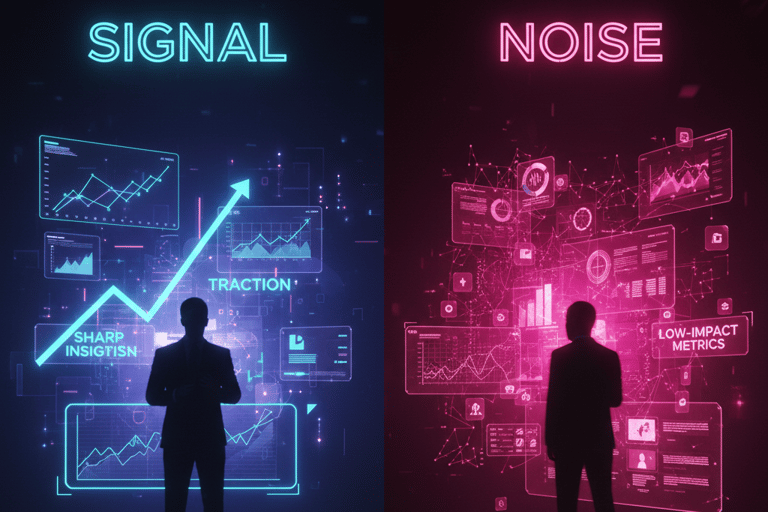
But because they communicate SIGNAL — not NOISE.
Most founders don’t know the difference.
Investors do — within seconds.
This is one of the strongest psychological frameworks in VC decision-making.
And once you understand it, you’ll realize why some founders get funded with mediocre traction while others get ignored despite “big numbers.”
Let’s break down exactly how Signal vs. Noise works inside a VC’s mind.
⭐ The Core Truth: Signal = Proof of Competence. Noise = Proof of Confusion.
Investors evaluate founders based on what they focus on.
If your deck focuses on meaningful insights, investors infer:
✔ strong judgment
✔ business maturity
✔ strategic thinking
✔ leadership quality
✔ probability of execution
If your deck focuses on irrelevant details, investors infer:
❌ poor thinking
❌ weak prioritization
❌ feature obsession
❌ lack of maturity
❌ high risk
Signal tells the investor:
“This founder knows what matters.”
Noise tells the investor:
“This founder is not ready.”
The difference between the two creates immediate separation.
⭐ What Investors Consider “Signal” (High-Value Inputs)
High-signal founders use their deck to show:
1. Velocity (Not Volume)
Signal = “We’re accelerating.”
Noise = “We’re busy.”
2. Real Business Metrics
Signal = CAC, LTV, retention, margin.
Noise = likes, followers, impressions.
3. Market Understanding
Signal = trends, timing, urgency.
Noise = generic statements (“the market is big”).
4. Clear Focus
Signal = 3–5 core features.
Noise = 15 features on one slide.
5. Sharp Narrative
Signal = clean problem → solution → GTM → traction.
Noise = random order and long paragraphs.
6. Evidence of Customer Pull
Signal = increasing usage, inbound demand.
Noise = “people love our idea.”
7. Founder-Market Fit
Signal = past wins or domain knowledge.
Noise = vague personal inspiration.
8. Distribution Logic
Signal = repeatable GTM engine.
Noise = “we will go viral.”
When investors see stacking signals, they get excited.
⭐ What Investors Consider “Noise” (Low-Value Inputs)
Noise is anything that makes the investor say:
“Why are you telling me this?”
Common forms of noise:
20+ product screenshots
too much text
fluffy traction
vanity metrics
over-segmentation of TAM
complex roadmap
buzzwords
hype language
irrelevant founder story
competitor-bashing
future visions with zero grounding
feature lists instead of insights
Noise kills momentum.
Noise overwhelms the brain.
Noise increases perceived risk.
⭐ THE EQUATION: How Investors Subconsciously Score You
The investor’s interpretation is simple:
SIGNAL SCORE − NOISE SCORE = FUNDABILITY
High Signal + Low Noise =
🔥 strong candidate
🔥 high probability of success
🔥 FOMO
🔥 second meeting
🔥 intros to partners
Low Signal + High Noise =
❌ instant pass
❌ “not ready yet”
❌ “circle back later”
❌ no urgency
The harsh truth?
Most founders produce more noise than signal,
even when they think they’re doing the opposite.
⭐ How to Reduce Noise Without Losing Information
You reduce noise through:
✔ Simplifying the structure
✔ Prioritizing insight over information
✔ Highlighting only velocity metrics
✔ Using 1-sentence slide headers
✔ Choosing 3 core features
✔ Using real examples
✔ Showing clean graphs
✔ Avoiding aesthetics overload
✔ Keeping each slide to ONE PURPOSE
You never want investors to work hard.
The harder they work, the less they trust.
⭐ How High-Conviction Founders Use Signal to Dominate
Exceptional founders do this:
remove all vanity
remove all fluff
remove all irrelevant stories
remove all unnecessary details
remove all distracting visuals
communicate the spine of the business
When investors feel:
“This founder only talks about what matters.”
…their trust spikes instantly.
Signal is not about saying MORE.
Signal is about saying the RIGHT things.
⭐ ONE-LINE SUMMARY OF THIS SECTION
“Investors fund clear, meaningful signals — and reject noisy, unfocused decks. Your job is to amplify signal and eliminate noise.”
SECTION 10 — The Investor’s “Founder's Mindset Test”: How VCs Evaluate Your Thinking, Not Your Slides
Founders obsess over slides.
Investors obsess over the mind behind the slides.
Your pitch deck is NOT the product.
YOU are the product.
The deck is just the UI.
What investors are truly evaluating is your:
thinking
pattern recognition
self-awareness
adaptability
logic
emotional stability
strategic maturity
execution instincts
reaction to pressure
This is the founder’s mindset test, a psychological assessment investors use to predict whether you will survive the journey from:
🛠 chaos →
🚀 traction →
📈 scale →
🏢 organization →
🧠 leadership.
In this section, you will learn how investors evaluate your thinking — silently, instantly, and with surprising accuracy.
⭐ The Harsh Reality: Investors Believe ‘Mindset > Metrics’
They’ve seen:
founders with strong metrics collapse
founders with weak metrics turn into unicorns
founders with perfect decks implode under stress
founders with rough decks execute brilliantly
Investors know:
A strong mindset can fix a weak business.
A weak mindset will destroy a strong business.
This is why investors focus so heavily on founder psychology.
Let’s break down the five hidden mindset tests they use.
⭐ TEST 1 — Adaptability Test (How You Respond When Things Go Wrong)
Investors know everything will go wrong.
So they evaluate how YOU respond mentally to chaos.
Signals of a strong, adaptable founder:
✔ calm response
✔ clear next steps
✔ rapid prioritization
✔ no emotional flooding
✔ learning orientation
✔ strategic reframing
Signals of a weak founder:
❌ panic energy
❌ blaming external factors
❌ lack of ownership
❌ emotional reactivity
❌ defensive answers
❌ long-winded explanations
Investors ask themselves:
“Will this founder adapt or crumble?”
This single question affects your entire fundability.
⭐ TEST 2 — Compression Thinking Test (Complex → Simple Conversion)
Compression thinking is the ability to:
compress complex information into simple, actionable logic.
This test defines world-class founders.
Examples of compression thinking:
summarizing your TAM in one clean sentence
explaining your GTM in 20 seconds
compressing a complex product into a simple workflow
describing unit economics without jargon
reducing your idea to its essential value
Your narrative structure influences this.
Investors LOVE founders who can simplify.
⭐ TEST 3 — Judgment Test (Do You Prioritize the Right Things?)
Investors evaluate your judgment based on:
what you say
what you emphasize
what you ignore
what you measure
what you are proud of
what you consider traction
how you answer vague questions
Weak founders brag about:
❌ features
❌ UI redesigns
❌ minor wins
❌ small metrics
❌ irrelevant milestones
Strong founders emphasize:
✔ customer pull
✔ retention
✔ repeatability
✔ distribution logic
✔ business fundamentals
✔ early signals of velocity
The investor’s subconscious reaction:
“This founder makes good decisions.”
or
“This founder doesn’t know what matters.”
Judgment is everything.
⭐ TEST 4 — Emotional Stability Test (Can You Lead Through Chaos?)
Investors watch your emotional patterns:
your tone
your pacing
your reactions
your energy
your facial expressions
your willingness to admit uncertainty
They are testing for emotional stability.
Low emotional stability = catastrophic risk.
If a founder:
❌ overreacts
❌ argues aggressively
❌ gets defensive
❌ becomes flustered
❌ exaggerates
❌ avoids hard truths
Investors mentally run.
Emotionally stable founders:
✔ stay calm
✔ answer simply
✔ acknowledge unknowns
✔ handle critique gracefully
✔ stay centered under pressure
These are the founders investors trust with millions.
⭐ TEST 5 — Strategic Depth Test (Can You See the Battlefield?)
This is where exceptional founders differentiate themselves.
Investors check whether you:
understand your market dynamics
anticipate competitive shifts
know distribution deeply
understand unit economics
grasp customer psychology
think in systems, not features
Strategic depth is one of the strongest predictors of future scale.
A founder who understands the battlefield is seen as unstoppable.
A founder who doesn’t is seen as fragile.
⭐ How Investors Combine These 5 Mindset Tests
VCs rarely verbalize these tests.
They simply feel:
✔ “This founder seems sharp.”
✔ “This founder sees reality clearly.”
✔ “This founder can lead.”
✔ “This founder can survive.”
✔ “This founder can scale.”
Or:
❌ “Something feels off.”
❌ “They don’t get it.”
❌ “Too reactive.”
❌ “Not ready.”
❌ “Risk is too high.”
This is why two founders with similar metrics can get completely different outcomes.
The one with stronger mindset signals always wins.
⭐ ONE-LINE SUMMARY OF THIS SECTION
“Investors use five silent tests to evaluate founder mindset — adaptability, clarity, judgment, emotional stability, and strategic depth — because mindset predicts success more reliably than metrics.”


SECTION 11 — The Investor’s “Inevitable Founder” Pattern: How VCs Identify Founders Who Will Win With or Without Funding
If there is one psychological pattern that outweighs all others —
one signal capable of flipping an investor from “maybe” to “I’m in”…
it is this:
⭐ Inevitable Founder Energy
The perception that:
“This founder will succeed no matter what — even without our money.”
This is the most powerful psychological phenomenon in venture capital.
Because when investors believe you are inevitable:
they feel safe
they feel excited
they feel urgent
they feel fear of missing out
they feel competitive pressure
they feel a need to invest before others do
“Inevitable founders” don’t always have the best traction.
They don’t always have the best product.
They don’t always have the best deck.
But they ALWAYS have:
✔ momentum energy
✔ strategic awareness
✔ crisp narrative
✔ clarity of thought
✔ strong founder-market fit
✔ unstoppable execution vibe
✔ emotional stability
✔ deep insight into their domain
✔ a history of doing hard things
In this section, you’ll learn EXACTLY how investors detect inevitability — and how to engineer that perception in your pitch.
⭐ The Core Investor Question: “Will They Win Without Us?”
This is the psychological turning point.
When an investor thinks:
“This founder will figure it out anyway.”
…it triggers their strongest emotion:
⭐ FOMO.
Fear.
Of.
Missing.
Out.
Because the VC game is NOT about funding “good bets.”
It’s about NOT missing the founders who:
become category winners
create markets
force competitors to copy them
attract top talent
scale even in chaos
Investors are terrified of missing rare outliers.
Inevitable founders feel like outliers.
The 6 Signals That Make a Founder Feel Inevitable
VCs subconsciously scan for these:
⭐ 1. Unusually High Rate of Learning (Speed of Insight Acquisition)
Inevitable founders learn faster than normal humans.
They demonstrate:
rapid tightening of narrative
rapid improvement in GTM
rapid understanding of user psychology
rapid iteration cycles
rapid clarity in thinking
Investors think:
“If they’re this fast now, they’ll be unbeatable with resources.”
⭐ 2. Momentum in Multiple Dimensions (Not Just Metrics)
You don’t need big traction.
You need multi-slope momentum:
product velocity
customer pull
retention improvements
activation rate rising
better messaging
improved distribution logic
faster sales cycles
Investors don’t need perfection.
They need acceleration.
⭐ 3. Clear Founder-Market Fit (You Were Made for This)
Inevitable founders have a deep, personal alignment with their problem space.
VCs look for:
domain obsession
industry history
personal insight
emotional connection
intuitive understanding
This reduces risk instantly.
This is one reason the Problem & Solution pillar is so important (ADD LINK HERE).
It frames founders in a way that strengthens this signal.
⭐ 4. A Calm, Unshakeable Energy (You Don’t Flinch)
Exceptional founders don’t show anxiety.
They don’t get rattled.
They don’t over-explain.
They don’t self-doubt publicly.
They give off a presence that says:
“I’ve been here before. I’ll get through this.”
This signals:
✔ maturity
✔ resilience
✔ leadership
Investors trust calm founders.
⭐ 5. Ability to Articulate the Future with Believable Precision
Inevitable founders have a rare talent:
They can describe the future so clearly that investors can SEE it.
Not wishful thinking.
Not hype.
Not fluffy vision.
Actual inevitability sounds like:
“Here’s what will happen next.”
“Here’s what customers will do.”
“Here’s what the category is shifting toward.”
“Here’s how our GTM compounds.”
“Here’s what competitors will do — and why we’re advantaged.”
It’s not passion.
It’s pattern recognition.
⭐ 6. Resourcefulness (You Already Make Progress Without Funding)
This is the most underrated but most important signal.
Investors LOVE founders who:
recruit without money
ship product without big teams
get users without ads
close deals without perfect tools
solve problems creatively
keep burn low
build fast on limited budgets
They think:
“If they’re this efficient now… imagine what they’ll do with capital.”
Inevitable founders make investors feel:
“This isn’t optional.
I HAVE to invest in them.”
⭐ Why the “Inevitable Founder” Pattern Creates Massive FOMO
Because inevitability does 3 things:
Reduces perceived risk
Increases perceived upside
Creates investment urgency
Most founders create:
❌ zero urgency
❌ zero inevitability
❌ zero FOMO
This is why their round moves slowly.
Inevitable founders create:
✔ urgency
✔ FOMO
✔ competition
✔ price pressure
✔ inbound interest
Investors chase inevitability.
⭐ How to Engineer Inevitable Energy in Your Pitch
You communicate inevitability by:
✔ crafting a sharp problem narrative
✔ showing multi-dimensional momentum
✔ demonstrating fast learning cycles
✔ simplifying your GTM
✔ highlighting founder-market fit
✔ staying calm in Q&A
✔ giving precise future predictions
✔ removing noise from your deck
✔ clearly owning weaknesses
✔ showing high resourcefulness
⭐ ONE-LINE SUMMARY OF THIS SECTION
“Investors fund founders who feel inevitable — the ones who demonstrate fast learning, multidimensional momentum, calm confidence, strategic clarity, and resourcefulness.”


SECTION 12 — The “Cognitive Bias Stack”: 9 Psychological Biases That Secretly Influence Every Investor’s Decision (Even When Your Metrics Are Average)
Here’s something founders rarely learn:
Investors don’t make decisions logically —
they make decisions psychologically, then justify them with logic.
Your pitch is not evaluated in a vacuum.
It is filtered through a complex stack of human biases that influence:
how investors perceive your traction
how they interpret your risks
how they evaluate your clarity
how much they trust your narrative
how excited they feel
how much FOMO they experience
how aggressively they want to invest
This section reveals the 9 cognitive biases that shape investment decisions — and how you can ethically leverage them.
⭐ 1. Halo Effect
If one thing about you seems exceptional,
investors assume everything else is exceptional.
This is why:
crisp clarity
calm presence
sharp narrative
fast learning
clean slides
strong founder-market fit
…create a psychological halo that boosts your entire pitch.
If investors love slide 2 →
they will be more forgiving toward slide 12.
This is also why your homepage VC Pitch Deck link is used sparingly (ADD LINK HERE).
Overuse kills halo.
Properly placed links reinforce it.
⭐ 2. Anchoring Bias
Investors anchor to the first information they see.
This is why:
✔ your title slide
✔ your opening sentence
✔ your problem framing
…matter more than anything else.
If your opening is weak → the anchor is weak → everything feels weaker.
If your opening is sharp → everything is interpreted with optimism and confidence.
⭐ 3. Confirmation Bias
Investors try to confirm the first impression they got.
If they thought:
“This founder seems exceptional.”
They actively look for proof.
If they thought:
“This founder seems weak.”
They actively look for flaws.
Harness this by controlling the opening narrative.
⭐ 4. Simplicity Bias
The brain LOVES things that are easy to understand.
Investors assume:
✔ simple = smart
✔ simple = strategic
✔ simple = fundable
✔ simple = scalable
This is why your deck with simple slide headers like:
“The Problem”
“The Solution”
“Why Now”
…outperforms fancy jargon.
If it’s not simple, it’s not fundable.
⭐ 5. Authority Bias
Investors give extra weight to:
domain expertise
founder background
past wins
logos
credible metrics
advisor strength
Authority shortcuts reduce risk perception.
You don’t need famous advisors —
you need alignment between your story and your domain.
This is why our Slide Structure & Frameworks pillar helps founders present “signal authority”
⭐ 6. Loss Aversion
Investors fear missing a winner
far more than they fear backing a loser.
This is the psychological engine behind:
✔ FOMO
✔ fast decisions
✔ competitive offers
✔ quicker follow-ups
✔ higher valuations
If investors sense you are “inevitable,”
loss aversion kicks in HARD.
They will chase you.
This bias multiplies the impact of Section 11’s inevitability pattern.
⭐ 7. Recency Bias
Investors overweight the latest information they see.
This is why:
your traction slide
your GTM slide
your business model
…should appear AFTER clarity-building slides.
If traction appears too early → it’s misinterpreted.
If traction appears too late → fatigue weakens it.
Your deck order MUST follow investor psychology.
⭐ 8. Availability Bias
Investors judge your startup based on what’s easiest to recall.
If your deck has:
too many metrics
too many features
too many claims
…it becomes forgettable.
If your deck has:
1 strong problem
1 clear solution
1 sharp GTM
1 believable roadmap
…it becomes memorable.
Memorable = fundable.
Forgettable = dead.
⭐ 9. FOMO Bias
The strongest bias in venture capital.
If investors think:
“Other investors will want this.”
…their urgency skyrockets.
FOMO is triggered by:
momentum
clarity
inevitability
inbound interest
competitive signals
clean execution
fast learning
confident tone
FOMO is the psychological multiplier.
It turns $500K checks into $1.2M checks.
⭐ How to Use the Bias Stack Ethically
You do NOT manipulate.
You ALIGN with how human decision-making already works.
Engineer your deck to:
✔ reduce cognitive load
✔ increase clarity
✔ present 1 dominant insight per slide
✔ build strong opening anchors
✔ reinforce your authority
✔ showcase momentum
✔ remove noise
✔ create inevitability
✔ position yourself as a scarce opportunity
This is what creates the illusion of:
“This founder is inevitable.
We need to invest before someone else does.”
⭐ ONE-LINE SUMMARY OF THIS SECTION
“Investors evaluate startups through nine cognitive biases — when your deck aligns with these psychological patterns, your fundability skyrockets.”


SECTION 13 — Emotional Resonance: The Hidden Variable That Makes Investors Remember You After 100 Other Pitches
Numbers help investors evaluate a startup.
Logic helps investors understand a startup.
But emotion determines whether they remember a startup.
And in venture capital:
If you are not remembered, you are not funded.
Founders underestimate how deeply emotional investor decisions actually are.
Not emotional like “feelings,”
but emotional like:
memory
attention
instinct
intuition
personal connection
urgency
FOMO energy
VCs justify with logic.
They decide with emotion.
Emotional resonance is the hidden multiplier that separates:
❌ good pitches (forgettable)
from
🔥 fundable pitches (impossible to forget)
This section breaks down how to engineer emotional resonance — ethically — in your pitch.
⭐ Why Emotional Resonance Matters More Than Logic
Investors are humans, not spreadsheets.
They remember:
✔ the founder who spoke clearly
✔ the founder who showed calm confidence
✔ the founder who knew their customer deeply
✔ the founder who told a sharp, specific story
✔ the founder who felt inevitable
They forget:
❌ feature lists
❌ complex roadmaps
❌ messy traction slides
❌ generic market narratives
❌ robotic delivery
❌ jargon
Emotion decides who gets a second meeting.
⭐ 3 Types of Emotional Resonance Investors Respond To
There are THREE types of emotional resonance in fundraising:
Precision Resonance
Personal Resonance
Future Resonance
Let’s break these down.
⭐ 1. Precision Resonance (Specificity Creates Trust)
Vague story = zero emotional impact.
Specific stories = immediate trust.
Example:
❌ “SMEs struggle with financial workflows.”
✔ “Finance teams spend 22 hours a week reconciling errors — and most of those errors come from X and Y.”
Precise = believable.
Precise = memorable.
Precise = emotionally sticky.
Specificity feels smart, and smart feels safe.
This is why your Slide Structure & Frameworks pillar matters (ADD LINK HERE).
It forces precision, not fluff.
⭐ 2. Personal Resonance (Founder-Market Fit Creates Emotion)
Investors need to feel:
“This founder deeply understands this world.”
Not because of credentials.
Because of connection.
Examples of personal resonance:
✔ “I experienced this problem for 5 years.”
✔ “My previous company struggled with this exact issue.”
✔ “This problem hurt me personally and professionally.”
✔ “I’ve lived this workflow.”
Founders with personal resonance are:
remembered
trusted
respected
taken seriously
Personal resonance DOES NOT mean trauma stories.
It means credible connection.
⭐ 3. Future Resonance (Help Investors SEE the Future)
This is the strongest form of emotional resonance.
Future resonance means:
You articulate the future so vividly
that investors can SEE it in their mind.
Example:
❌ “We will expand globally.”
✔ “Within 18 months, we expand into three markets with similar purchasing behavior and identical workflow pain — making expansion 80% cheaper than traditional SaaS scaling.”
Vivid specificity creates:
confidence
trust
excitement
psychological inevitability
This is where investors lean forward.
⭐ How Emotional Resonance Impacts the Investor’s Brain
Emotional resonance affects four areas:
1. Memory Encoding
High emotional content = more memorable founder.
2. Decision-Speed
Emotionally resonant pitches get faster decisions.
3. Trust Formation
Emotion creates subjective trust.
4. Conviction Strength
Investors fight harder internally to approve a deal they feel strongly about.
Emotional resonance is not manipulation —
it’s clarity delivered in a human way.
⭐ The 5 Techniques Exceptional Founders Use to Build Emotional Resonance
These techniques don’t require drama or hype.
They require clarity, calm, and real insight.
⭐ Technique 1 — Narrative Minimalism
Keep your story short, sharp, and anchored in truth.
⭐ Technique 2 — Customer Reality Stories
Use one real user story — not a dozen.
⭐ Technique 3 — Emotional Calm
Investors trust calm founders.
⭐ Technique 4 — Precision + Numbers
Specific = memorable.
⭐ Technique 5 — Future Visualization
Describe the next 24 months with believable sharpness.
When you combine these 5 techniques,
your pitch becomes emotionally magnetic.
⭐ Why Average Metrics Can Win if Emotional Resonance Is Strong
Some founders with average:
TAM
traction
CAC
margins
product maturity
…STILL get funded.
Why?
Because investors FEEL:
“This founder gets it.
This founder can do this.
This founder will win.”
Emotion multiplies logic.
⭐ ONE-LINE SUMMARY OF THIS SECTION
“Investors remember — and fund — founders who create emotional resonance through clarity, specificity, calmness, founder–market fit, and vivid future articulation.”


Investors are not evaluating you in isolation.
They are comparing you — subconsciously — to:
founders they’ve funded
founders they rejected
founders who failed
founders who became unicorns
founders who wasted their time
founders who executed
founders who collapsed under pressure
VCs don’t judge your pitch.
They match your patterns to the patterns they’ve already seen.
This is pattern recognition, the core mechanism of venture decision-making.
It allows investors to evaluate founders quickly, accurately, and ruthlessly.
And once you understand how this works,
you’ll understand EXACTLY why some founders get funded fast
while others get filtered out instantly.
⭐ The Core Truth: Investors Don’t Evaluate Facts — They Evaluate Patterns
Investors meet thousands of founders.
After years of exposure, they develop mental “shortcuts”:
✔ pattern of founders who scale
✔ pattern of founders who raise follow-on rounds
✔ pattern of founders who build teams
✔ pattern of founders who ship fast
✔ pattern of founders who collapse
✔ pattern of founders who exaggerate
✔ pattern of founders who burn money
✔ pattern of founders who can’t handle pressure
✔ pattern of founders who never get to product-market fit
Your pitch is being compared against ALL these patterns.
And this comparison happens FAST
— often within the first 30–60 seconds.
Let’s break down the 7 patterns investors scan for.
⭐ Pattern 1 — Founder Thinking Pattern (Do You Think Like a Scaler?)
Investors evaluate:
logic
clarity
synthesis
prioritization
simplicity
compression
structured narrative
This determines:
✔ whether you can build teams
✔ whether you’ll make smart decisions
✔ whether you’ll handle chaos
✔ whether you’ll survive growth
This is why your Slide Structure & Frameworks pillar improves fundability (ADD LINK HERE).
⭐ Pattern 2 — Execution Pattern (Can You Actually Build?)
Investors look for signals of:
✔ fast iteration
✔ bias for action
✔ low dependence on capital
✔ shipping without excuses
✔ resourcefulness
✔ usable prototypes
✔ early traction signals
High-execution founders look the same everywhere:
short sentences
clear summaries
fast cycles
no fluff
evidence-driven
practical
If you match this pattern →
you immediately feel fundable.
⭐ Pattern 3 — Market Insight Pattern (Do You Understand the Game?)
Investors evaluate how well you grasp:
customer psychology
competitive dynamics
timing
industry shifts
behavioral trends
pricing logic
GTM nuance
Strong insight patterns create trust.
Weak insight patterns kill deals.
⭐ Pattern 4 — Communication Pattern (Do You Communicate Like a Leader?)
Investors observe how you:
speak
pause
pace
simplify
clarify
summarize
respond to critique
handle questions
Great communicators match the pattern of:
✔ confidence without arrogance
✔ clarity without jargon
✔ calm under pressure
✔ precision under ambiguity
These founders are ALWAYS remembered.
⭐ Pattern 5 — Emotional Pattern (Are You Stable Under Stress?)
Investors analyze your emotional signals:
✔ calm
✔ centered
✔ grounded
✔ non-reactive
✔ composed
✔ thoughtful
✔ presence
Versus:
❌ defensive
❌ ego-driven
❌ aggressive
❌ anxious
❌ reactive
Founders who match the “calm operator” pattern
get funded more often, even with weaker traction.
⭐ Pattern 6 — Traction Pattern (Is Your Growth Curve Familiar?)
VCs recognize familiar traction curves:
linear
exponential
flat
spiky
artificial
paid-dependent
organic pull
NPS-driven
Even with small numbers,
the shape of your momentum can match patterns of future winners.
Shape > Size.
⭐ Pattern 7 — Founder-Market Fit Pattern (Do You Belong Here?)
Investors ask:
“Have I seen founders like this succeed in this market before?”
Examples:
A founder with 10 years in logistics
→ starting a logistics automation company
= HIGH pattern match (fundable)
A founder with no experience
→ starting a deep-tech AI infrastructure company
= LOW pattern match (risky)
Pattern matching simplifies risk evaluation.
⭐ How You Create a Strong Pattern Match (Fundable Profile)
You engineer a strong investor pattern match by:
✔ clear 1-sentence pitch
✔ clean narrative flow
✔ sharp traction curve
✔ realistic GTM
✔ emotional stability
✔ resourcefulness
✔ precise articulation
✔ domain familiarity
✔ crisp slides
✔ no fluff
✔ no noise
Every section of these pillars builds this profile on purpose.
Your homepage VC PITCH DECK link should be placed once every few sections (ADD LINK HERE).
This strategically reinforces pattern alignment without causing link fatigue.
⭐ Why Pattern Matching Matters More Than Metrics
Metrics change.
Markets shift.
Competition evolves.
But patterns endure.
A founder who matches positive patterns will:
pivot effectively
learn rapidly
iterate fast
survive downturns
recruit strongly
scale intelligently
Pattern recognition is why:
✔ founders with weak traction sometimes get funded
✔ founders with strong traction sometimes get ignored
Because the investor is not investing in what you have today.
They are investing in the pattern you match.
⭐ ONE-LINE SUMMARY OF THIS SECTION
“Investors evaluate you through pattern recognition — comparing you to thousands of founders they've met — and the stronger your pattern match, the faster you get funded.”
SECTION 14 — Investor Pattern Recognition: How VCs Compare You to Thousands of Founders in Under 10 Seconds


Here’s a truth most founders NEVER hear:
The investor’s final decision is almost always made
in the LAST 60 seconds —
not the first 60.
The beginning of your pitch determines whether they pay attention.
The middle determines whether they believe you.
But the last minute determines whether they commit.
That final 60 seconds is where ALL the psychology, bias, pattern recognition, emotional resonance, clarity, and momentum come together.
And in that moment, investors mentally place founders into one of three buckets:
YES — “This founder is fundable.”
NO — “This founder is not ready.”
LATER — “This founder might become fundable with more proof.”
Here’s EXACTLY how the psychological filters work.
⭐ THE YES DECISION: The “Low-Risk, High-Upside” Founder
A “YES founder” creates a psychological state where the investor thinks:
“Backing them feels safe AND exciting.”
This happens when:
✔ Clarity was high
✔ Emotional stability was strong
✔ Market understanding was sharp
✔ Momentum looked real
✔ Founder-market fit was clear
✔ The GTM was believable
✔ The product was simple to understand
✔ The future path felt inevitable
The final trigger?
Investor feels FOMO.
As soon as they imagine another firm investing,
their brain switches to “must act.”
This is WHY your pillar series links sparingly to your VC Pitch Deck Guide (ADD LINK HERE).
Scarcity + clarity amplify FOMO.
⭐ THE NO DECISION: The “High-Risk, Low-Conviction” Founder
A “NO founder” is NOT rejected because of:
❌ TAM
❌ traction
❌ projections
❌ competition
❌ slides
They are rejected because of:
❌ weak thinking
❌ lack of clarity
❌ emotional instability
❌ poor GTM logic
❌ noise-heavy narrative
❌ delusional framing
❌ inability to simplify
❌ no sense of inevitability
❌ no precision
❌ no founder-market fit
Before the meeting ends, the investor has silently thought:
“This founder won’t scale.”
or
“This will become a babysitting situation.”
And the decision is made.
⭐ THE MAYBE LATER DECISION: The “Promising but Unproven” Founder
This is the most common outcome.
“Maybe later” does NOT mean:
❌ they don’t believe in you
❌ your idea is bad
❌ you failed the pitch
❌ your deck is weak
It means:
You showed promise,
but not yet inevitability.
Investors think:
“This founder could become fundable with 90 days more data.”
“Let’s see one more traction cycle.”
“I need proof of GTM viability.”
“I want clearer unit economics first.”
“The narrative needs one more iteration.”
“Maybe later” can turn into “YES” faster than you expect.
Most founders are closer to the YES bucket than they realize —
they’re just missing clarity in one or two key areas.
⭐ The 7 Internal Questions Investors Ask Themselves in the Final 60 Seconds
Here are the EXACT mental questions:
1. “Do I trust this founder?”
This is the #1 question of all.
2. “Is this founder inevitable?”
If yes → automatic FOMO.
3. “Is the GTM believable?”
Weak GTM = instant NO.
4. “Is the founder stable?”
Emotional instability = fatal risk.
5. “Do I understand the business clearly?”
If not → risk explodes.
6. “Is this market worth betting on?”
Even small markets can win if founder match is strong.
7. “If this founder had $2M, would they multiply it?”
This predicts whether you’re a YES.
These 7 questions decide your fundraising outcome.
⭐ The Founder Behaviors That Increase YES Probability in the Final Moment
The best founders:
✔ stay calm
✔ stay concise
✔ reiterate their sharpest insight
✔ emphasize the problem’s urgency
✔ clearly restate momentum
✔ repeat the “why now” logic
✔ reinforce founder-market fit
✔ show their 12-month path clearly
This makes investors feel:
“This founder is dangerous in a good way.”
⭐ The Founder Behaviors That Kill Deals in the Final Moment
Founders lose deals when they:
❌ get nervous
❌ over-explain
❌ become emotional
❌ exaggerate
❌ introduce new risks
❌ answer defensively
❌ ramble
❌ bring up unnecessary complexity
A single messy answer can sink everything.
Investors don’t need perfection.
They need poise.
⭐ The Truth: The Final Decision Is Emotional, Not Logical
Investors decide based on:
emotional stability
founder clarity
inevitability signals
momentum shape
pattern recognition
resonance
curiosity
trust
Logic only confirms what emotion already decided.
Learn this →
and you stop pitching facts
and start engineering psychological conviction.
⭐ ONE-LINE SUMMARY OF THIS SECTION:
“Investors make final decisions emotionally in the last 60 seconds — based on clarity, poise, inevitability, and perceived execution ability — not metrics.”
SECTION 15 — The Investor’s Final Filter: How VCs Decide in the Last 60 Seconds Whether You’re a Yes, No, or “Maybe Later”
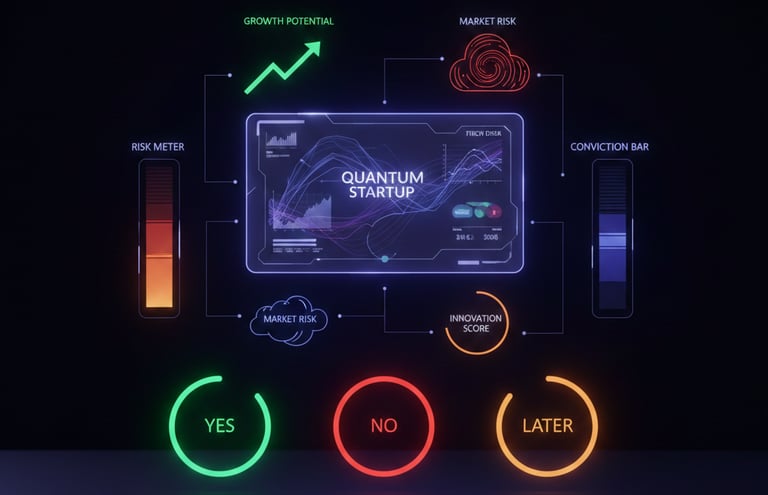
📘 In-depth Guides: Investor Psychology & How They Evaluate Pitch Decks
Below are deeper, judgment-focused breakdowns
SUB-PILLAR 1: How VCs Think & Make Decisions
SUB-PILLAR 2: Cognitive Biases in Investor Decision-Making
SUB-PILLAR 3: First-Impression Psychology
SUB-PILLAR 4: How Investors Evaluate Founders
SUB-PILLAR 5: How Investors Evaluate Markets & Opportunities
SUB-PILLAR 6: How Investors Evaluate Traction & Metrics
SUB-PILLAR 7: How Investors Evaluate Team Slides
SUB-PILLAR 8: How Investors React to Storytelling
SUB-PILLAR 9: Investor Red Flags & Hidden Evaluation Patterns
FAQ SECTION — Investor Psychology & Cognitive Decision-Making (Pillar 4)
1. How much does investor psychology actually matter compared to metrics?
A lot more than founders expect.
Metrics tell investors what you’ve done.
Psychology reveals who you are — and who you will be under pressure.
Most VCs will tell you privately:
“We invest in founders, not numbers.”
Strong founder psychology can override weak metrics.
Weak psychology can destroy strong metrics.
2. Can I compensate for low traction using psychological positioning?
Yes — if you show:
clear thinking
resourcefulness
fast learning cycles
founder–market fit
sharp GTM logic
high emotional stability
inevitability energy
Investors will back founders who “feel fundable” even if traction is early.
3. How do I avoid looking delusional in front of VCs?
Avoid:
❌ “no competitors”
❌ “we will dominate the market”
❌ unrealistic timelines
❌ projections with zero grounding
❌ vague answers
Signal groundedness by showing:
✔ what you know
✔ what you don’t know
✔ how you’re de-risking your assumptions
✔ what early data actually indicates
This places you in the exceptional founder category.
4. What part of the deck influences investor psychology the most?
The opening 3 slides:
Title
Problem
Solution
These form the anchor, and everything afterward is interpreted through that first impression.
A weak anchor → low belief.
A strong anchor → automatic FOMO.
5. Why do investors care so much about clarity?
Clarity = intelligence.
Clarity = leadership.
Clarity = execution ability.
If you can simplify complex ideas,
investors assume you can navigate chaos at scale.
If you explain things poorly,
they assume your company will be chaotic too.
6. How do I create FOMO without being salesy?
FOMO is created by:
✔ inevitability energy
✔ clear momentum
✔ confident narrative
✔ resourcefulness
✔ sharp GTM logic
✔ clean financial thinking
Not hype.
Not pressure.
Not aggressive tactics.
FOMO is psychological — not verbal.
7. How do I know if investors see me as a “high-risk founder”?
Common signals:
❌ long answers
❌ defensive tone
❌ unclear roadmap
❌ overcomplication
❌ passive learning speed
❌ weak prioritization
If investors ask too many “clarification questions,”
they already sense risk.
8. What’s the #1 thing that moves me from “maybe later” to “yes”?
Momentum.
Not big metrics — but improving metrics:
weekly usage
faster cycles
clearer ICP
lower churn
sharper narrative
Show 60–90 days of compounding improvements and “later” becomes “yes.”
9. How does founder–market fit influence psychology?
Deeply.
Investors trust founders who:
lived the problem
understand the customer
speak the market language
can anticipate shifts
have strong intuition
This reduces perceived risk dramatically.
10. Why do investors ask stress-testing questions?
Not to trick you —
but to observe your mindset under pressure.
They are testing:
calmness
adaptability
emotional stability
clarity under friction
your relationship with reality
Your reaction matters more than your answer.
11. Can emotional resonance come from data, not stories?
YES — especially for rational investors.
Examples:
✔ “Our retention went from 18% → 31% → 55% in 3 cycles.”
✔ “Customers are using us 3× more after week 2.”
Emotion in fundraising = patterns that feel inevitable.
12. Does slide design impact investor psychology?
Absolutely — but not in the way founders think.
Good design = clarity.
Clarity = trust.
You are not trying to “look pretty.”
You are trying to lower cognitive load.
Investors reward low-friction decks.
13. Why do investors get turned off by long explanations?
Because long explanations signal:
❌ poor thinking
❌ poor prioritization
❌ weak clarity
❌ lack of synthesis
Short answers signal:
✔ confidence
✔ intelligence
✔ discipline
✔ strategic clarity
Great founders speak simply.
14. How do VCs make emotional decisions while thinking they’re being logical?
They follow this unconscious sequence:
Emotional first impression
Pattern recognition
Bias filtering
Belief formation
Logical justification
Decision confirmation
Your job is to guide steps 1–4.
15. Is it possible to “fix” investor psychology after a bad meeting?
Yes — but only if you show:
sharp improvements
clearer thinking
better GTM logic
stronger traction shape
simpler narrative
Send ONE tight update (not three).
Show evolution.
Prove momentum.
16. Why do some founders get funded with weaker numbers than others?
Because they excel in:
clarity
inevitability
founder–market fit
emotional resonance
strategic depth
calm confidence
sharp narrative
pattern match
This psychological advantage outweighs raw numbers.
17. What kills investor belief the fastest?
These 3 things:
❌ inconsistent answers
❌ over-hype without proof
❌ confused GTM strategy
Once belief breaks →
funding almost always dies.
18. What builds investor belief the fastest?
These 3 things:
✔ clean articulation of the problem
✔ sharp GTM explanation
✔ confident and concise answers
Belief is psychological.
You earn it with mental clarity — not a thousand slides.
19. What’s the simplest way to “feel fundable” in the eyes of a VC?
Signal:
✔ clarity
✔ calmness
✔ coherence
✔ inevitability
✔ focus
✔ momentum
✔ domain insight
✔ resourcefulness
This combination creates fundable energy.
20. What’s the one psychological mistake founders should avoid at all costs?
Trying to impress.
Investors don’t want “impressive.”
They want:
✔ grounded
✔ thoughtful
✔ focused
✔ predictable
✔ self-aware
✔ calm
✔ precise
💡 If You Want the Shortcut to Becoming a Fundable Founder…
Everything you just learned in this pillar has one goal:
👉 To help you think, speak, and pitch like the top 1% of founders investors remember.
But here’s the truth you already know:
You can’t build this level of clarity alone.
Not in one week.
Not with random templates.
Not by watching 200 YouTube videos.
If you want a complete, founder-proofed system that helps you:
structure the perfect pitch
tell a story investors FEEL
communicate like a leader
show momentum even with early traction
craft a GTM investors trust
avoid psychological red flags
generate VC-quality narrative using AI
and build a deck aligned with REAL investor psychology
…then you’ll love what we built.
⚡ The AI Funding Blueprint System (What 650+ Founders Use to Raise Faster)
Inside, you get:
✅ The VC-Ready Pitch Deck (Canva Template)
Built using the exact Sequoia–YC psychological flow investors prefer.
✅ The AI Financial Narrative Engine
Turns your raw numbers → into investor-grade storytelling.
✅ The High-Ticket Sales Deck
Proves revenue potential and strengthens your fundraising story.
✅ The Slide-by-Slide VC Instruction Guide (16 Pages)
Founder-friendly. World-class. Zero fluff.
✅ The Universal Investor Prompts
Generate VC-quality answers for every slide, even with limited data.
Everything designed to make you feel:
✔ sharper
✔ clearer
✔ more fundable
✔ more inevitable
All without hiring a $5,000 consultant.
🚀 If You Want the VC-Ready Advantage
👉 Check out the full VC Pitch Deck system here
This is the “shortcut” founders wish they had months earlier.
It’s your turn now.
📌 No pressure. No hype. Just clarity.
If you’re not ready, that’s okay — keep reading the pillars, keep sharpening your founder psychology, and come back when you want the unfair advantage.
If you are ready —
👉 You’ll feel the difference instantly.

+650
+40M
collectively raised $40 Million+
Startup Founder Team
📚 Explore the Complete VC Pitch Academy (12-Pillar System)
(This pillar is one part of a full master-framework that teaches founders how to pitch, think, and raise like the top 1%.)
Below is the full library —
✔ links to the pillars already published
✔ “Coming Soon” for upcoming ones
✔ all optimized for strong topical authority
🔹 Core Pitch Deck Mastery Pillars
Pillar 1 — How VC Pitch Decks Really Work
Pillar 2 — Problem & Solution Slides
Pillar 3 — Slide Structure & Frameworks
Pillar 4 — Investor Psychology
Pillar 5 — Storytelling & Narrative
Pillar 6 — Design Principles
Pillar 7 — Traction & Metrics
Pillar 8 — Market Size & Competition
Pillar 9 — Fundraising Strategy
Pillar 10 — Pitch Delivery
Pillar 11 — Mistakes, Red Flags & Investor Judgment
Pillar 12 — Tools, Templates & Examples
Funding Blueprint
© 2025 Funding Blueprint. All Rights Reserved.