How Investors Evaluate Team Slides: The "Jockey" Audit

Beyond the logos: Master the 'Jockey' audit VCs use to evaluate team slides. Learn to prove founder-market fit, execution velocity, and leadership gravity in 45 seconds.

PILLAR 4: INVESTOR PSYCHOLOGY

12/20/20254 min read

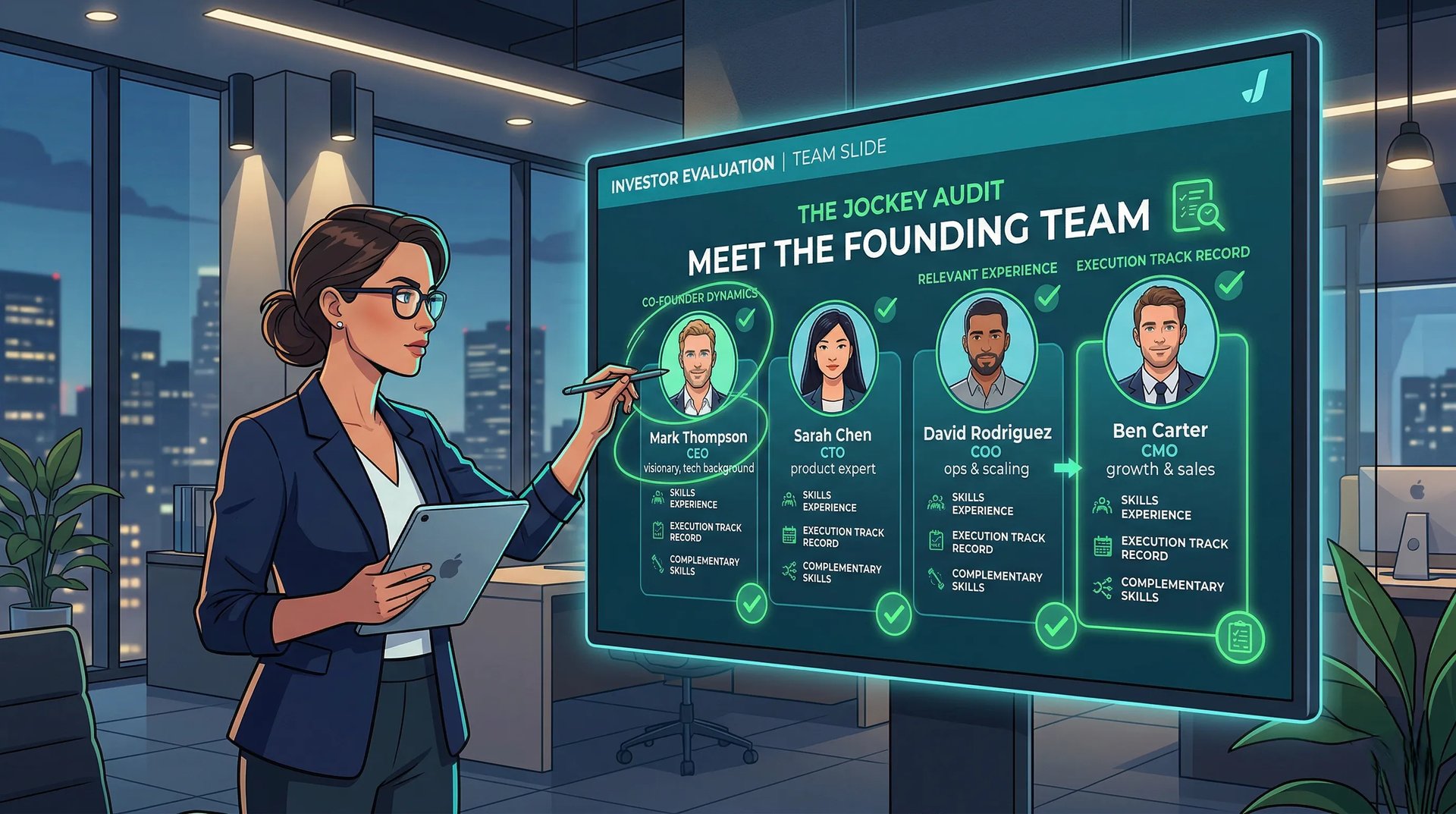
Venture capitalist performing a 'Jockey' audit on a startup pitch deck team slide.

How Investors Evaluate Team Slides: The "Jockey" Audit

In the early-stage ecosystems of London, New York, and San Francisco, the business model is a hypothesis, but the team is a fact. At the Seed and Series A stages, the product will pivot, the market will shift, and your assumptions will be pulverized by reality. The only thing I am actually underwriting is your ability to navigate that chaos.

The brutal truth? The Team Slide is the most "lied about" slide in the deck. Founders fill it with advisors they’ve met once and logos of companies they barely worked for. Behind closed doors, VCs aren't looking for a list of prestigious universities; we are looking for Relevant Velocity and Founder-Market Fit.

This sub pillar is part of our main Pillar 4 — Investor Psychology

The "Jockey" Red Flag Audit

The Red Flag The VC Signal

"Logo Bait" Advisors :- Signals a lack of real network or the inability to get experts actually "on the court.

Co-CEO Titles:- Signals fear of conflict, decision paralysis, or an inability to define leadership.

No "Hiring Gravity":- If early hires are all junior/generalists, it signals weak leadership or an inability to recruit top-tier talent.

Zero Shared History:- A "paper team" assembled for the raise suggests high risk of co-founder fallout.

The VC Lens: Screening for the "Mercenary vs. Missionary"

When I’m sitting in an Investment Committee (IC) meeting, I’m performing a psychological audit of the founders. I am looking for three specific signals:

  1. Complementary Skillsets (The Trio): I want to see the "Hacker" (Tech), the "Hustler" (CEO), and the "Designer" (UX). If you have three "Product" founders and zero "Sales" DNA, I see a high-risk engineering project, not a business.

  2. Earned Secrets: Do you have a deep, unfair understanding of industry friction? If you're building Fintech, I want to see years in the trenches of banking, not just a few white papers.

  3. The "Magnet" Factor: Can you recruit? If your first three hires came from Stripe, Google, or Goldman, it tells me you have the leadership gravity to attract world-class talent to a risky startup.

Fundraising in London vs. San Francisco: Team Expectations

In the US (SF/NY), we lean into "Aggressive Ambition." We want the founder who is "healthily delusional"—the one who convinces us they can build a $100B company. If you aren't swinging for the fences, SF investors assume you’re just building a "feature" for someone else to buy.

In London, the expectations shift toward "Commercial Maturity." UK investors want to see that the CEO understands the P&L as well as the product. They are screening for a "Safe Pair of Hands" that can navigate a more conservative capital market. If you pitch an SF-style "burn-to-win" strategy in Mayfair without a deep operational team, you’ll be laughed out of the room.

Why Canadian VCs Value "Pragmatic Resilience"

Canadian VCs (Toronto/Vancouver) operate in a "Capital Efficient" ecosystem. They look for founders who have a track record of doing a lot with a little. They value "Pragmatic Resilience"—the ability to reach milestones without the massive capital infusions common in the Valley. A team that has bootstrapped to their first $100k in ARR is viewed with immense respect in the Canadian market because it proves the founders can survive the "Trough of Sorrow" without a safety net.

The "Trench" Report: The $10M "Logo" Disaster

Last year, a New York founder pitched us. His team slide was impressive: Ex-Apple, Ex-Stanford, Ex-McKinsey. On paper, they were the "A-Team." During due diligence, we realized none of them had ever worked together before. They were a "paper team" assembled just for the fundraise. When we pushed them on their GTM (Go-to-Market) strategy, they argued amongst themselves in the room. There was no Institutional History. We passed. Six months later, the co-founders split, and the company folded. A team of champions is not a champion team.

Semantic Depth: Screening for "Scale" and "Coachability"

The "Hiring Bar" Test

If your first five hires are all "Junior" or "Generalists," it signals you are afraid to manage people who know more than you. If you have a "Principal Engineer" from a successful scale-up, it signals that you are building a High-Performance Culture.

Coachability vs. Conviction

We often "stress-test" founders during the pitch by challenging a metric.

  • The Red Flag: Becoming defensive or dismissing the feedback.

  • The Signal: Acknowledging the risk and providing data-backed reasoning for your choice.

  • The VC Thought: "I can work with this person for the next decade."

Expert FAQ

Is being a solo founder a red flag for VCs?

In SF, yes—there is a bias toward the "Two-Brain" theory. In London and Canada, it’s more accepted if you have a strong "Director-level" team. To counter the bias, show a Recruitment Roadmap to prove you aren't a single point of failure.

What is the most important part of the team slide?

The Relationship Span. VCs want to know how long the founders have worked together. "Worked together for 4 years at Stripe" is a massive trust signal that you won't kill each other when the bank account hits zero.

Should I include advisors in my pitch deck?

Only if they have skin in the game. If they aren't investors or don't have a specific operational role (e.g., "Intro to 5 Fortune 500 pilots"), delete them. VCs view "Logo Bait" advisors as a sign of founder insecurity.

How do I handle a team with no "Big Tech" logos?

Focus on Relevant Velocity. If you’ve grown your current startup 20% MoM for 6 months, nobody cares that you didn't go to Stanford. Results are the ultimate pedigree.