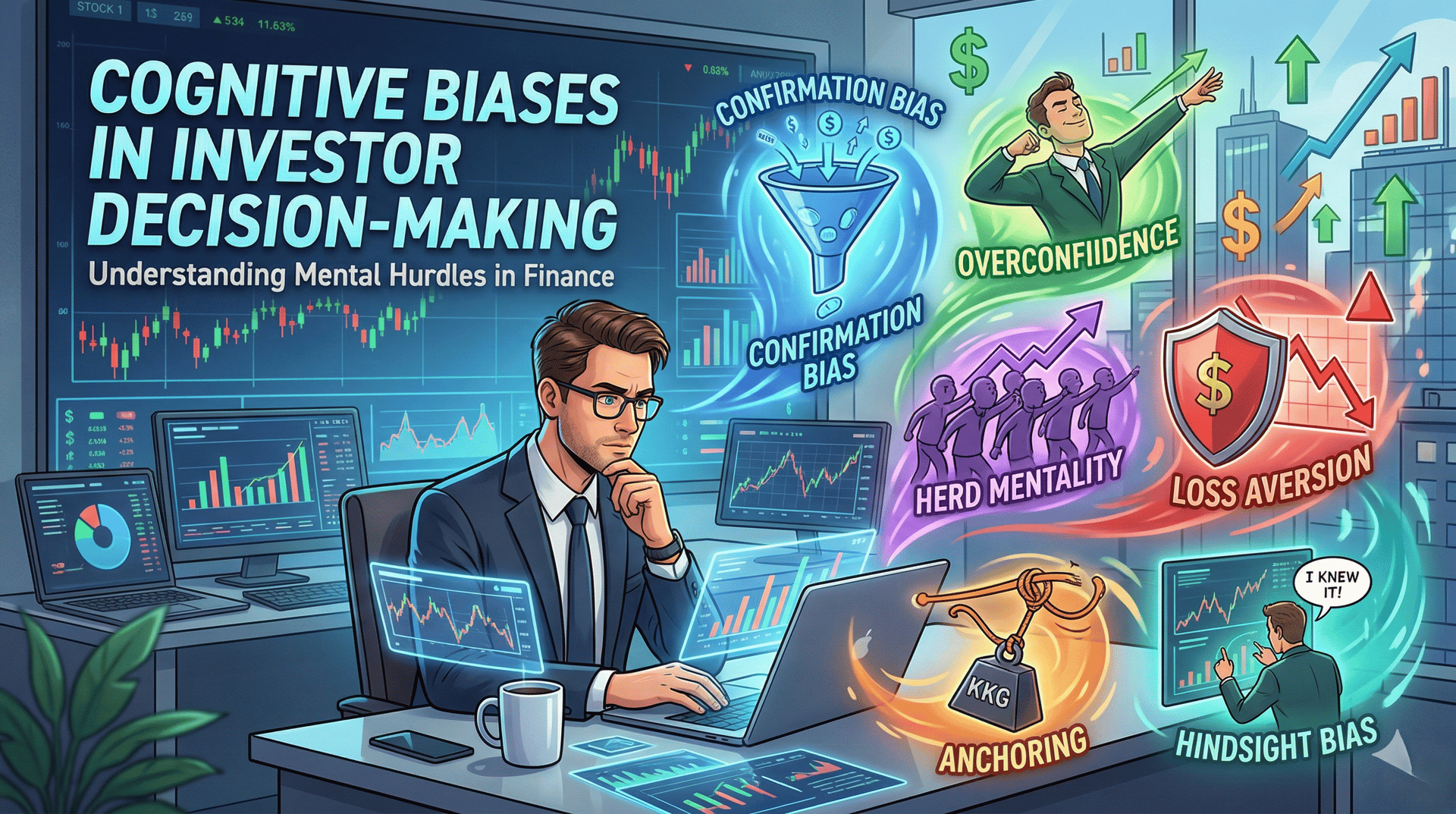
Cognitive Biases in Investor Decision-Making
Master the 5 cognitive biases that control VC decisions. From Anchoring to FOMO, learn how to design your pitch deck to work with investor psychology, not against it.
PILLAR 4: INVESTOR PSYCHOLOGY
12/18/20255 min read


Cognitive Biases in Investor Decision-Making
If you think VCs are purely rational actors crunching spreadsheets, you’re deluded. We are as prone to mental shortcuts as anyone else. In the high-pressure environments of New York, London, and Toronto, the speed of the deal flow forces us to rely on heuristics—mental "hacks" that help us process information quickly.
The brutal truth? Your pitch deck is a manipulation of these biases. If you aren't intentionally structuring your slides to trigger positive cognitive shortcuts, you’re leaving your fundraise to chance. Behind closed doors, we don't just "analyze" your business; we "feel" the momentum, and that feeling is often a direct result of the biases you’ve triggered in our brains.
This sub pillar is part of our main Pillar 4 — Investor Psychology
The VC Lens: The War Between Logic and Instinct
Investors like to talk about "investment theses," but most decisions are made in the first 5 minutes of a meeting. We spend the remaining 40 minutes looking for data to justify our initial gut reaction. This is Confirmation Bias at work.
The hidden risk is The Halo Effect. If a founder has one "shining" attribute—perhaps they were a top engineer at Stripe or sold a previous company to Google—we tend to assume they are brilliant at everything, including sales, operations, and finance. In SF, the Halo Effect is king. In London and Canada, investors are more prone to Pessimism Bias—they look for the one thing that could go wrong to avoid the "embarrassment" of a failure.
The "Trench" Report: The $15M "Social Proof" Trap
I once sat in an IC (Investment Committee) meeting for a Series A deal in London. The company’s metrics were average. The product was decent but not revolutionary. However, the founder mentioned that a Tier-1 Silicon Valley fund was "poking around" and that two prominent angel investors had already committed.
The consequence? The room’s IQ dropped by 50 points. Suddenly, we weren't looking at the high churn rate; we were looking at the "Signal" from other investors. This is Herding Behavior. We issued a term sheet that afternoon because we were terrified of the Opportunity Cost of missing out on a deal that "smarter" people liked. It was one of the worst investments we ever made. Social proof is the most powerful—and dangerous—bias in the valley.
The Tactical Framework: The "Bias-Trigger" Sequence
To win the room, you must architect your deck to hit these three psychological triggers in order:
1. Anchoring (The Valuation/Metric Play)
The first number you mention becomes the anchor for everything else.
The Fix: Lead with your strongest growth metric. If you say "We grew 50% last month," every subsequent 10% growth slide feels like a continuation of excellence.
The VC Thought: "This is a high-growth asset."
2. Availability Heuristic (The "Why Now" Play)
People overestimate the importance of information that is recently available or vivid.
The Fix: Connect your problem slide to a recent, massive news event or industry shift (e.g., "The AI Act just passed, making our compliance tool mandatory").
The VC Thought: "This is timely and urgent."
3. Loss Aversion (The FOMO Play)
The pain of losing is twice as powerful as the joy of gaining.
The Fix: Don't just show the upside. Show the Market Erasure—how the current incumbents are losing billions and why the "window" to capture this market is closing.
The VC Thought: "If I don't fund this, I’m going to watch a competitor return 100x on it."
Semantic Depth: The Mechanics of "Fluency" and "Framing"
We also screen for Cognitive Fluency. If a deck is easy to read, we assume the business is easy to run. If your structure is jarring, we experience "Cognitive Friction," which our brains translate as "Risk."
The "Simplicity" Bias
In New York, where speed is everything, we favor the Less-is-More approach. If your "Solution" slide is a complex diagram with 15 arrows, we assume the product is "high-friction."
The Standard: High-authority decks use Assertion Headers. If I can understand your entire business by reading only the top 12 lines of your slides, you have high fluency.
Framing Effects and Net Revenue Retention (NRR)
How you present data changes how we perceive risk.
Noise: "40% of our customers churn after year one." (Focuses on loss).
Signal: "60% of our customers are retained as lifetime advocates with a 110% Net Revenue Retention." (Focuses on gain). Even though the data is the same, the Framing Bias ensures the second version moves you toward a term sheet. We look for Negative Churn—where expansion revenue from existing customers outweighs the revenue lost from those who left.
The "Sunk Cost" Fallacy in the Data Room
Once an investor spends significant time in your data room, they develop an "Endowment" feeling toward the deal. They’ve invested "Work Equity." This is why getting an Associate to spend hours on your model is a winning strategy—it makes it harder for them to say "no" later because they have already "sunk" time into the due diligence.
Hyperbolic Discounting and the "Ask"
VCs are prone to valuing immediate rewards over future gains. This is why we care more about your CAC Payback Period than your projected 5-year revenue. If you can show that you recoup your acquisition costs in 6 months, that is an "immediate" win that triggers a stronger cognitive "Yes" than a distant billion-dollar dream.
The Contrarian Take: Your "Flaws" Make You Human
Most founders try to look perfect. This triggers Skepticism Bias. If something looks too good to be true, we assume you’re "massaging" the numbers.
The most successful founders I’ve funded are the ones who show an "Ugly" slide. They point out a failed experiment or a month where growth dipped. This triggers the Blemishing Effect. When you lead with a small negative, it makes the subsequent positives feel much more authentic and credible.
If you show me 24 months of perfect, straight-line 20% growth, I don't believe you. I assume you're hiding the "bodies." But if you show me a dip in Q3 because you fired a bad sales lead, I trust your Q4 growth 10x more. In a world of "Vaporware," raw honesty is the ultimate "Signal."
Key Takeaways for Founders
Master the Anchor: Lead with your "Monster Metric" to set the psychological baseline for the entire pitch.
Leverage the Herd: Don't just say you’re raising; mention the "caliber" of conversations you’re having to trigger Social Proof.
Simplify for Fluency: If a GP can’t explain your business to their partner in 30 seconds, your deck is too complex.
Own the Blemish: Use one "Lesson Learned" slide to build massive credibility and neutralize Skepticism Bias.
Expert FAQ: The "Psychology of the Pass"
Q: Why do VCs always say "it’s too early"?
A: This is Status Quo Bias. It’s the safest thing to say to keep the door open without taking a risk. It is a non-confrontational way to say "I don't have enough FOMO yet." To counter this, show Velocity. If you grew 20% between the first email and the first meeting, "too early" becomes a logical fallacy.
Q: How do I handle a "Skeptical" Partner who keeps poking holes?
A: Use Attribute Substitution. If they are stuck on a technical detail, pivot to a "Proven Analog." (e.g., "We are using the same distribution model that helped Snowflake scale, but applying it to the £50B UK logistics market"). You are replacing a hard question with an easier, more familiar one.
Q: Does "Likability" really matter in an IC meeting?
A: More than we admit. Affinity Bias ensures we fund people who remind us of ourselves, our peers, or people we admire. In London, this often translates to "Professionalism"; in SF, it translates to "Obsessive Hustle." Find common ground early.
Q: What is the "Authority Bias" and how do I use it?
A: It’s why we love seeing "Ex-Apple" or "Ex-Goldman" on a team slide. It creates a shortcut for "Competence." If you don't have those logos, use Data Authority. Show that you know the unit economics and the deep-tech nuances of your industry better than any "Expert" on the planet.
Q: Is "FOMO" just a meme or a real bias?
A: It is the Regret Minimization bias. VCs are more afraid of being the one who passed on the next Google than they are of losing a single seed investment. Your narrative must emphasize that the "train is leaving the station."
Funding Blueprint
© 2025 Funding Blueprint. All Rights Reserved.