How Investors React to Storytelling: The "Biology" of a Term Sheet
Data informs, but stories sell. Master the biology of a term sheet and learn how narrative logic bypasses mental filters to trigger a 'Yes' from investors in 2025.
PILLAR 4: INVESTOR PSYCHOLOGY
12/20/20255 min read


How Investors React to Storytelling: The "Biology" of a Term Sheet
Founders often think storytelling is about "fluff" or making a deck look pretty. It isn't. In the venture capital ecosystems of London, New York, and San Francisco, storytelling is a psychological hack used to move an investor from "Analytical Skepticism" to "Emotional Conviction."
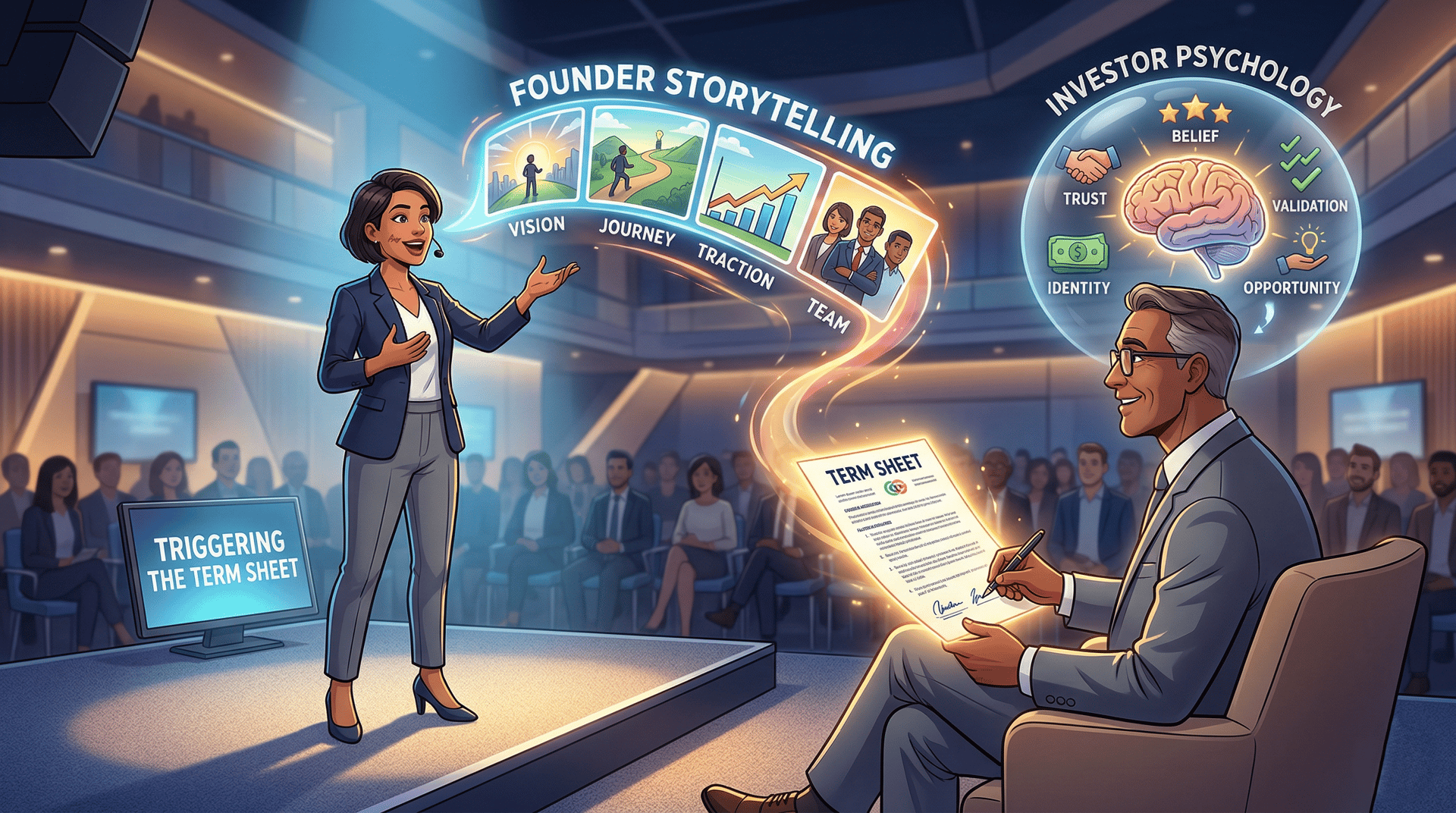
The brutal truth? A VC’s brain is wired to reject 99.9% of what it sees. When I’m sitting in an Investment Committee (IC) meeting, my "System 2" brain—the cold, calculating part—is looking for reasons to kill your deal. Storytelling is the only tool that can bypass that filter and trigger "System 1"—the intuitive, fast-acting part of the brain that creates FOMO. If you can’t tell a story that makes the future feel inevitable, your metrics will be treated as just another spreadsheet.
This sub pillar is part of our main Pillar 4 — Investor Psychology
The Post-Pitch Audit: Avoiding the Storytelling Traps
When I’m reviewing a deck after a partner meeting, I look for these four specific narrative flaws. If your story falls into these traps, the deal dies in the internal Slack channel:
The "Anecdote" Lead
The VC Reaction: "This is a niche problem for one person; it's a project, not a platform."
The Fix: Pivot to the Economic Bleed. Show that this isn't just a "frustration" for one user, but a structural inefficiency costing an entire industry billions.
The "Hero" Founder
The VC Reaction: "This person has a massive ego; they won’t be able to hire or scale a team."
The Fix: Make the Market Shift the hero. Position yourself as the expert guide who identified the trend and built the vehicle to capture it.
Over-Emotionalism
The VC Reaction: "They are using drama to hide a lack of data or weak unit economics."
The Fix: Use a Data-Backed Narrative. Tell a story where every "emotional" beat is punctuated by a metric (e.g., "This problem was so painful that 40% of our beta users paid before we even launched").
The "Flat" Ending
The VC Reaction: "This looks like a nice lifestyle business, but it's not a venture-scale exit."
The Fix: End with Inevitability. Your final slides must prove that the world must move in your direction, and the only question is whether the VC wants to own a piece of that future.
The VC Lens: The "Neurochemistry" of the Pitch
When you tell a high-authority story, you aren't just talking; you are releasing chemicals in the investor's brain that drive decision-making.
Dopamine (The Reward): Triggered when you show a massive, untapped market or a "10x" product improvement. This is the "greedy" part of the brain that wants a win.
Oxytocin (The Trust): Triggered when you share a "Blemish" or a raw "Lesson Learned." This creates a bond between the Jockey (Founder) and the Investor.
Cortisol (The Urgency): Triggered by the "Big Change" or the "Problem" slide. This makes the investor feel that if they don't act now, they will lose out to a competitor.
Fundraising in SF vs. New York: Narrative Expectations
In San Francisco, we want the "Odyssey." SF investors are addicted to "World Domination" narratives. They want to hear how you are going to rewrite the laws of an industry. If your story feels "pragmatic" or "safe," you’ll be labeled as a "lifestyle business" founder.
In New York, the expectation is the "Efficient Machine." NYC investors have a lower tolerance for vague vision. They want a story where the protagonist is Unit Economics. The narrative should be: "We found a $10B inefficiency, we built a machine to exploit it, and here is how we pour fuel (capital) into that machine."
Why Canadian and UK Investors React to "Grounding"
Investors in London and Toronto have a built-in "BS Detector" for Silicon Valley hype. They react best to "Grounded Vision." They want to see a story where the "First Act" (Traction) is so solid that the "Third Act" (Market Dominance) feels like a mathematical certainty. If you use too much "SF Fluff" in a London boardroom, you’ll trigger Skepticism Bias. You must bridge the gap between "Ambition" and "Asset Management."
The "Trench" Report: The $5M "Problem" Pivot
Last year, a founder pitched us a SaaS tool for HR. For the first 10 minutes, he told a story about "Sarah," an HR manager who struggled with paperwork. It was boring. It was an anecdote. We were ready to pass.
The consequence? He sensed the room was cold and pivoted. He stopped talking about Sarah and started talking about the "Compliance Collapse." He showed how new labor laws in the UK and US were going to cost mid-sized firms £500k in fines per year. Suddenly, the story wasn't about "Sarah's feelings"; it was about Risk Mitigation for a $50B Industry. The story became a "Need to Have," not a "Nice to Have." He closed the round three weeks later.
Semantic Depth: The Mechanics of the "Golden Thread"
The "Big Change" Opening
Stop starting with "The Problem." Start with the Global Shift.
Signal: "For 20 years, X was true. But because of [AI/Regulation/Remote Work], Y is now the new reality."
VC Thought: "I’ve noticed that shift too. This founder is ahead of the curve."
The "Enabling Tech" (The Magic Gift)
In every great story, the hero gets a "Magic Gift" to defeat the monster. In your deck, that is your Proprietary Tech.
The Error: Explaining the "How" before the "Why."
The Fix: Show the "Magic" (e.g., a 2-second demo) then explain the "Code" in the Appendix.
The "Inevitability" Conclusion
The final slide shouldn't just be "Thank You." It should be the Future State.
Signal: "In 5 years, every firm in this sector will use a tool like ours. We are just the ones with the 2-year head start."
VC Thought: "If I don't fund them, I’m betting against the future."
Key Takeaways: The Storytelling Audit
Pivot from Anecdotes to Economic Bleed: VCs don't care about a single user's "bad day." They care about the structural inefficiency costing an industry billions. Ensure your story highlights a systemic problem, not a niche frustration.
Make the Market Shift the Hero: Avoid the "Hero Founder" trap. Position yourself as the expert guide navigating a massive, undeniable global shift rather than a lone genius with an ego.
Trigger the Neurochemical Triad: A winning story releases Dopamine (the reward of a big market), Oxytocin (trust through raw honesty), and Cortisol (the urgency of a changing world).
Bridge the Data-Narrative Gap: Never use drama to hide weak metrics. Use a Data-Backed Narrative where the story provides the context for the math, and the math provides the proof for the story.
End with Inevitability: Don't just say "Thank You." Your conclusion must prove that the world is moving in your direction and that the only choice for the VC is whether they want to own a piece of that future.
Localize Your Narrative: Calibrate for your audience. Use "Odyssey" narratives for SF (vision-heavy), "Efficiency" narratives for NYC (ROI-heavy), and "Grounded" narratives for London and Toronto (traction-heavy).
Maintain the "Golden Thread": Your pitch must be an unbroken chain of logic. If the problem you define on Slide 2 isn't directly solved by the product on Slide 4, your narrative integrity is broken.
Expert FAQ: Featured Snippet Optimization
How do VCs react to emotional storytelling?
VCs react to emotion only when it is anchored in Economics. A story about a personal struggle is a "Red Flag" if it doesn't lead to a massive market opportunity. Use emotion to build Trust in the team, but use data to build Conviction in the deal.
What is the "Golden Thread" in a pitch deck?
The Golden Thread is a single logical narrative that connects every slide. If Slide 2 (Problem) isn't directly solved by Slide 4 (Product) and scaled by Slide 7 (Market), the thread is broken. VCs screen for this consistency to measure a founder’s Strategic Depth.
Should I use "Visionary" language in my deck?
In SF and NY, yes—but only if you have the Traction to back it up. In London and Toronto, lead with "Pragmatic" language and save the "Visionary" talk for the "Third Act" of the pitch. Context is everything.
What is the most common storytelling mistake founders make?
Talking about themselves too much. VCs don't care about your "Founder's Journey" as much as they care about the Market's Journey. You are the vehicle, but the Market Opportunity is the destination.
Funding Blueprint
© 2025 Funding Blueprint. All Rights Reserved.