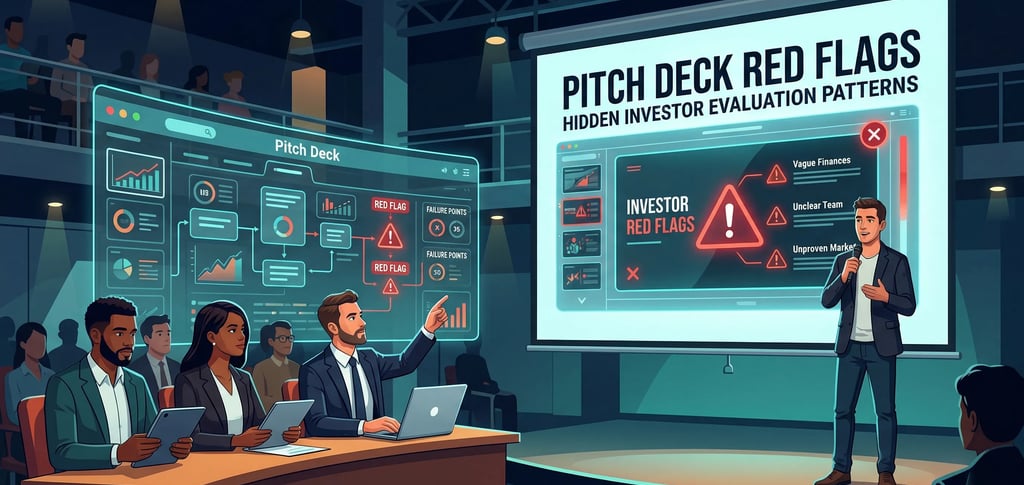
Investor Red Flags & Hidden Evaluation Patterns: The Silent "No"
Why are VCs passing on your deal? Discover the silent 'No' and the hidden evaluation patterns used in London, NY, and SF to screen for red flags in 2025.
PILLAR 4: INVESTOR PSYCHOLOGY
12/20/20254 min read


Investor Red Flags & Hidden Evaluation Patterns: The Silent "No"
In the VC hubs of London, New York, and San Francisco, most founders leave a meeting thinking they killed it, only to receive a generic rejection email 48 hours later. What they don't realize is that they triggered a "Silent Red Flag"—a pattern of behavior or a data discrepancy that signaled high risk to the investor’s subconscious.
The brutal truth? VCs are professional skeptics. We aren't looking for reasons to believe; we are looking for reasons to disqualify you so we can move on to the next 500 decks in our inbox. Behind closed doors, we use hidden evaluation patterns to judge your "Operational Grip" and "Intellectual Honesty." If you don't understand these hidden filters, you'll continue to fail without ever knowing why.
This sub pillar is part of our main Pillar 4 — Investor Psychology
The VC Lens: The "Intuition" vs. "Forensics"
When I evaluate a deal, I operate on two levels: the Intuitive Layer (The First 5 Minutes) and the Forensic Layer (The Due Diligence).
The Intuitive Layer: I am screening for "Founder Velocity." How fast do you talk, think, and react? If you are slow to answer basic questions about your churn, I assume your internal operations are just as sluggish.
The Forensic Layer: This is where we look for "The Ghost in the Machine." We look at your cap table for "Dead Equity" (co-founders who left but kept 20%) or "Exploitative Terms" from previous angel investors. These are structural red flags that can make a company un-investable.
Fundraising in SF vs. London: Hidden Cultural Patterns
In San Francisco, the biggest red flag is "Lack of Ambition." If you pitch a plan to reach $50M in ARR, we see a "small" thinker. We want to see the path to $1B. Here, "Risk" is the absence of a massive vision.
In London and Toronto, the biggest red flag is "Capital Recklessness." Investors here are obsessed with "Default Alive" status. If your deck shows you need $20M just to reach break-even, UK investors will see a "Leaky Bucket" and pass. In these markets, "Risk" is the absence of a path to profitability.
Why Investors Screen for "The Ego Gap"
The "Ego Gap" is the distance between how great a founder thinks they are and what the data actually says.
The Pattern: If a founder blames "market conditions" or "bad hires" for a dip in growth instead of taking ownership, it’s a massive red flag for Low Coachability.
The VC Reaction: "If they can't admit a mistake now, they will bankrupt us later trying to prove they were right."
The "Trench" Report: The $10M "Unit Economic" Ghost
I once sat in an IC meeting for a high-growth D2C brand in New York. Their revenue was doubling every quarter. The founder was charismatic and had a "Halo Effect" from a previous successful exit.
The consequence? One Associate did a deep dive into their LTV/CAC (Lifetime Value to Customer Acquisition Cost) and found they were using "Gross Revenue" instead of "Contribution Margin" to calculate LTV. In reality, they were losing $5 on every customer they "acquired." The founder wasn't lying; he simply didn't understand his own unit economics. We passed. The company ran out of cash four months later because they couldn't find a lead for their Series B. Ignorance is just as fatal as dishonesty.
Semantic Depth: The Mechanics of "Silent Passes"
1. The "Cap Table" Red Flag
If a founder owns less than 50% of the company before the Series A, we see a "Motivation Risk." If you’ve been diluted too early by predatory angels, you won't have enough "skin in the game" to survive the hard years.
2. The "Advisor" Red Flag
If your "Team" slide is 50% advisors with big corporate logos, we assume you are hiding a weak core team. VCs know that 99% of advisors do nothing.
The Fix: Only list advisors who have actually written a check or have a specific, documented "Value-Add" (e.g., "Opened doors to 3 Fortune 500 pilots").
3. The "Product-First" Blind Spot
If your deck is 15 slides of "Features" and only 1 slide of "Distribution," you have a Go-To-Market (GTM) Red Flag.
VC Thought: "They’ve built a great product, but they have no idea how to sell it. We aren't funding a hobby; we're funding a business."
Key Takeaways: The Red Flag Audit
Avoid the "Total Market" Fallacy: Claiming a $100B TAM without a specific "Wedge" strategy is an instant red flag for a lack of strategic depth.
The "Hiring Gravity" Test: If you can't attract senior talent from top-tier firms (Stripe, Google, etc.), VCs assume you lack the leadership "magnetism" to scale.
Kill the "No Competition" Myth: Saying you have no competitors tells investors you either don't understand the market or the market doesn't exist.
The "Metric Integrity" Audit: Any discrepancy between your deck and your raw CRM data—no matter how small—is a terminal integrity risk.
Beware of "Unit Economic Blindness": If you can’t explain your CAC Payback period or Gross Margin off the top of your head, you aren't an operator; you’re a dreamer.
Regional Calibration Matters: SF ignores high burn; London and Toronto view it as a signal of imminent failure. Know your room.
Expert FAQ: Featured Snippet Optimization
What are the biggest red flags for VCs in a pitch deck?
The biggest red flags include Vanity Metrics (cumulative users vs. active users), Co-founder Conflict (disagreements in the room), Lack of Unit Economic Depth, and Dishonesty regarding competition or traction.
Why do VCs care about "Coachability"?
VCs view themselves as partners. If a founder is resistant to feedback or defensive during the pitch, it signals they will be difficult to manage at the Board level. Low coachability is a leading indicator of startup failure.
Is high burn rate always a red flag?
Not in San Francisco, provided it is tied to High-Velocity Growth and strong LTV/CAC ratios. However, in London and Toronto, a high burn rate without a clear "Default Alive" path is a major red flag for capital inefficiency.
How do investors evaluate a founder's "Magnetism"?
Investors look at the "Team" slide to see who the founder has been able to recruit. If you can convince senior talent to leave high-paying jobs at Tier-1 companies to join your vision, you have High Magnetism, which mitigates "Execution Risk."
Funding Blueprint
© 2025 Funding Blueprint. All Rights Reserved.