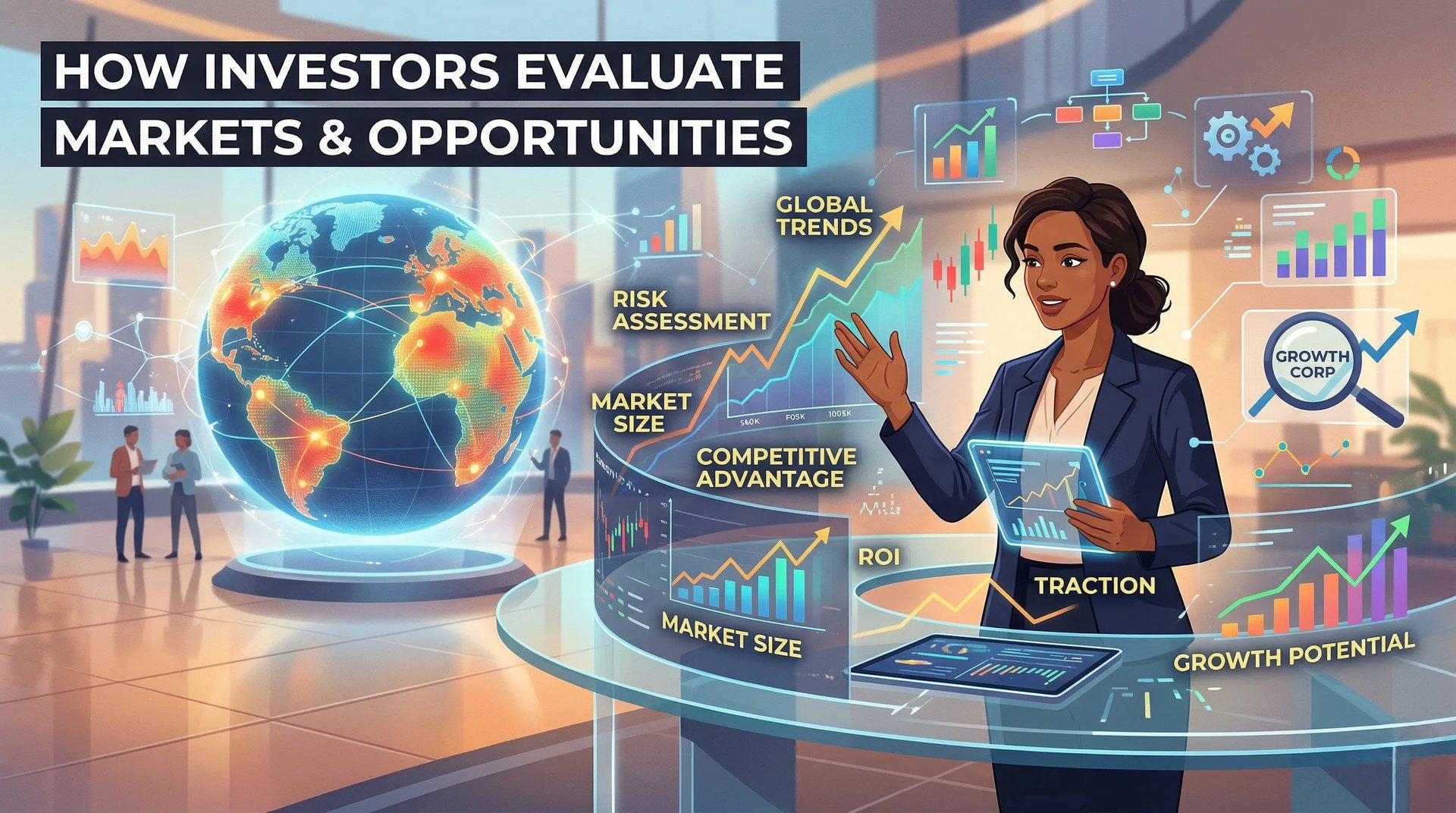
How Investors Evaluate Markets & Opportunities
Stop using top-down market charts. Learn how VCs really evaluate markets, from bottom-up sizing to the 'Why Now' catalyst that proves your opportunity is inevitable.
PILLAR 4: INVESTOR PSYCHOLOGY
12/19/20254 min read


How Investors Evaluate Markets & Opportunities
Most founders start their "Market" slide with a massive, trillion-dollar figure from a Gartner or McKinsey report. They think showing a big number proves the opportunity. To a veteran VC in London, New York, or Toronto, this is a signal that you don’t understand how venture scale actually works.
The brutal truth? We don’t care about the size of the ocean; we care about the depth of the well you are digging. A trillion-dollar market is often a "Red Ocean" of commoditized competition and shrinking margins. We are looking for Market Dynamics—the specific structural shifts, regulatory openings, or technological moats that allow a startup to capture a disproportionate share of value. Behind closed doors, we aren't evaluating "Market Size"; we are evaluating "Market Capture Velocity."
This sub pillar is part of our main Pillar 4 — Investor Psychology
The VC Lens: TAM vs. SOM and the "Wedge"
Investors evaluate opportunities through a filter of Practical Scalability. We look for three distinct layers of the market, but we weigh them differently depending on your stage:
TAM (Total Addressable Market): The theoretical ceiling. We use this to ensure the "Power Law" can apply—if everything goes perfectly, can this be a $10B+ company?
SAM (Serviceable Addressable Market): The portion of the TAM that fits your specific product type and geography.
SOM (Serviceable Obtainable Market): The "Wedge." This is the most important metric for a Seed or Series A deck. Who are the specific customers you can acquire right now with your current budget?
In San Francisco, we want to see a "Land Grab" strategy—how fast can you own the SOM? In the UK and Canada, we look for "Niche Dominance"—can you become the indispensable leader in a specific segment before expanding?
The "Trench" Report: The $1B "Top-Down" Trap
I once reviewed a pitch from a Toronto-based logistics startup. Their market slide was "classic": a $2 Trillion global logistics market, and they claimed that capturing just "1% of the market" would make them a unicorn.
The consequence? The IC killed the deal in minutes. Why? Because the "1% of the market" argument is a logical fallacy. It suggests that the founder doesn't have a targeted Go-to-Market (GTM) strategy. It implies they are waiting for the market to come to them rather than attacking a specific friction point. We funded a competitor who said: "The UK heavy-freight brokerage market is worth £5B, it is currently 90% manual, and we have signed the top 3 players." Specific beats generic every single time.
The Tactical Framework: The "Market Quality" Filter
To prove your opportunity is venture-scale, your deck must pass through these three "High-Signal" filters:
1. The "Why Now" (The Catalyst)
Markets don't just "exist"; they are unlocked.
The Fix: Identify a Structural Shift. Is it a change in the law (GDPR), a change in technology (LLMs), or a change in consumer behavior (Remote Work)?
The VC Thought: "If this had been tried 3 years ago, it would have failed. Today, it’s inevitable."
2. The "Bottom-Up" Reality Check
Stop using Venn diagrams. Use a Calculation.
The Fix: (Number of Target Customers) x (Your Annual Contract Value).
The VC Thought: "The math is grounded in reality. I can see the path to $100M ARR."
3. The "Monopoly Potential" (The Moat)
We aren't looking for a "Fair Fight." We are looking for an unfair advantage.
The Fix: Map out your Network Effects. Does your product get more valuable (and the market harder to enter) for every new user you add?
Semantic Depth: Evaluating Market "Thickness" and "Liquidity"
We use specific technical lenses to judge if a market is actually "Healthy" or just "Big."
The Concept of "Market Thickness"
In marketplaces (like Uber or Airbnb), we look for Thickness—the density of buyers and sellers in a specific geographic or categorical "Cell." If you are a marketplace, your deck must show Regional Liquidity.
Signal: "In London, our average time-to-match is 4 minutes."
The VC Thought: "They have reached a critical mass where the network effect is self-sustaining."
White-Space Analysis vs. Replacement Cycle
Is this a "Greenfield" market (nobody is doing this yet) or a "Replacement" market (replacing legacy software)?
Greenfield Risk: You have to educate the customer (High CAC).
Replacement Risk: You have to rip out an existing vendor (High Friction). Your deck must acknowledge these risks and show why your Value Prop is strong enough to overcome them.
The "Adjacent Market" Expansion Arch
We evaluate the "Optionality" of the business.
Signal: "We start with Insurance Claims (Market A), which gives us the data to dominate Underwriting (Market B), eventually becoming the full Tech Stack for Insurers (Market C)."
The VC Thought: "The initial market is the wedge, but the long-term opportunity is a platform play."
Key Takeaways for Founders
Ditch the 1% Fallacy: Never claim you only need "1% of a trillion-dollar market." It signals a lack of focus.
Master the Bottom-Up: Calculate your market size based on your actual price point and a realistic number of customers.
Highlight the Catalyst: Clearly define the "Why Now." If the market opportunity has existed forever, why hasn't it been solved?
Show the Path to Monopoly: Investors want to see how you move from a competitive "Wedge" to a dominant, high-margin "Platform."
Expert FAQ: The Market Audit
Q: What if my market is currently small but growing fast?
A: This is actually a Strong Signal. VCs love "Emerging Markets" (like AI in 2022 or Crypto in 2016). Focus on the Growth Rate of the Category rather than the current size.
Q: How do I handle "Competitor Density"?
A: Use it to prove Market Validation. If big players are entering the space, it proves there is "Blood in the water." Your job is to show why your Technical Moat makes you the only player capable of surviving the "Shark Tank."
Q: Should I mention global markets if I'm only in the UK/Canada?
A: Yes, but as a "Phase 2." US investors (SF/NY) want to see that your product has Global Portability. Show that your solution solves a universal pain point that isn't tied to local regulations.
Q: What is the biggest "Market" red flag?
A: The "Small ACV / Small Volume" Trap. If your product only costs $10/month and your target market is "small business owners," you need millions of customers to hit venture scale. That is an incredibly expensive and risky mountain to climb.
Funding Blueprint
© 2025 Funding Blueprint. All Rights Reserved.