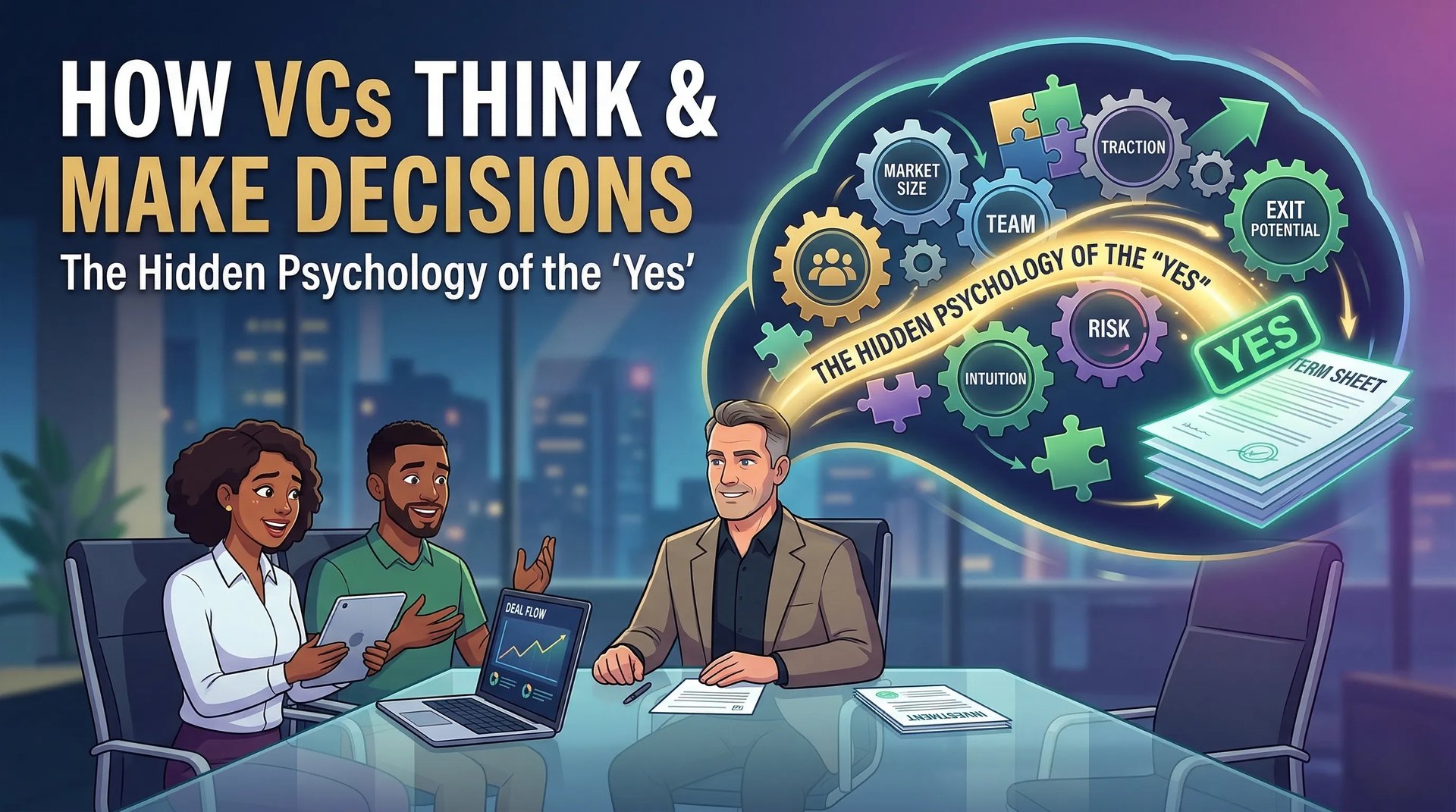
How VCs Think & Make Decisions: The Hidden Psychology of the "Yes"

Stop pitching, start aligning. Discover how VCs really think and make decisions in the IC room. Master the psychology of the 'Yes' to win your next funding round.

PILLAR 4: INVESTOR PSYCHOLOGY

12/18/20255 min read

How VCs Think & Make Decisions: The Hidden Psychology of the "Yes"

Most founders believe VCs are in the business of making money. They aren't. They are in the business of not missing out on outliers. When I’m sitting in an Investment Committee (IC) meeting in London, New York, or Toronto, my primary driver isn't just "does this business work?"—it’s "does this business have the potential to return the entire fund?"

The brutal truth? A VC is a professional "No" machine. We are incentivized to pass on 99% of deals to find the 1% that follows the Power Law. If your deck doesn't align with the specific way our brains process risk, reward, and career survival, you are just background noise. In the high-stakes tech hubs of the US, UK, and Canada, understanding the VC's internal decision-making engine is the only way to move from a "polite pass" to a term sheet.

This sub pillar is part of our main Pillar 4 — Investor Psychology

The VC Lens: The Power Law and Career Risk

To understand how we think, you must understand our constraints. VCs are not investing their own money; they are investing capital from Limited Partners (LPs) like pension funds and family offices.

  1. The Power Law: In a typical portfolio of 20 companies, 15 will fail or "zombie," 4 will provide a modest return, and 1 must provide a 50x–100x return to make the fund a success. If I can't see the "100x" in your deck, I cannot justify the investment, even if you are a "safe" profitable business.

  2. Career Risk: An Associate or Principal risks their reputation every time they champion a deal. If they bring a "dud" to the Partners, it hurts their path to Partnership. They are quietly screening for Institutional Defensibility—can they defend this deal to the Partners if it fails?

In San Francisco and New York, we look for "Aggressive Upside." In London and Toronto, the decision-making is often more "Downside-Protected." If you pitch a "conservative" 5x return in Menlo Park, you’re invisible. If you pitch a "total market takeover" in Toronto without a clear path to break-even, you’re a "high-risk dreamer."

The "Trench" Report: The $100M "Safe" Bet We Passed On

I once reviewed a Canadian e-commerce infrastructure startup. They had incredible traction: $2M ARR, 100% year-over-year growth, and they were already profitable. By any standard, it was a fantastic business.

In the IC meeting, we passed in ten minutes. Why? Because the market they served was too efficient. There were no Network Effects or High Switching Costs. We calculated that they could probably grow to a $100M exit, but they would never be a $2B company. For our fund size, a $100M exit didn't move the needle.

The founder was devastated. He thought profitability was the ultimate signal. To a VC, profitability without massive scale is a signal that you’ve stopped being a venture-backable "rocket ship" and started being a "lifestyle business." You must prove you can scale beyond the founders' reach.

The Tactical Framework: The "Commitment Ladder"

VCs make decisions in stages. Your deck must help us climb this ladder:

1. The Intellectual Hook (Signal)

Does this solve a massive, urgent problem? We look for "The Why Now." * The VC Thought: "Is this a tide that will lift all boats, or a passing fad?"

2. The Data Validation (Evidence)

Do the metrics prove that the "Hook" is real?

  • The VC Thought: "Are these founders 'playing house,' or do they have a grip on their Unit Economics?"

3. The Emotional Conviction (Trust)

Do I believe this specific team can survive the "Trough of Sorrow"?

  • The VC Thought: "Would I want to be in a boardroom with these people for the next 10 years?"

Semantic Depth: The "IC Room" Technical Audit

Behind closed doors, we use specific frameworks to decide what moves forward. If you don't use this language, you aren't "in the club."

The "Hype-to-Efficiency" Ratio (LTV/CAC Efficiency)

Instead of just looking at burn, we look at the LTV/CAC Ratio (Gross Margin Adjusted). We want to see that for every $1 you spend on marketing, you are creating at least $3 in long-term value. If your CAC is $500 and your LTV is $1,500, but your Gross Margin is only 20%, you are actually losing money on every customer. We calculate your Contribution Margin LTV to see the truth.

TAM vs. Bottom-Up Reality

We ignore your "Top-Down" market slides. We calculate the market ourselves using your ACV (Annual Contract Value).

  • The Calculation: (Number of potential customers you can actually reach) x (What you can actually charge them).

    If that number isn't north of $1B, the "Power Law" doesn't apply.

The "Default Alive" Quotient

We screen for your Runway Sensitivity.

Survival Quotient = Cash on Hand

Monthly Net Burn

If this number is less than 6 and you aren't currently closing a round, we see a "Desperation Risk." We want to see that you have the leverage to walk away from a bad deal.

The Contrarian Take: We Care About Your "Antagonists"

Most founders try to hide their competitors. This is a mistake. When I see a "Competition" slide that claims you have no rivals, I assume you are naive or the market is tiny.

VCs love to hear about your "Antagonists." We want to hear exactly why the $10B incumbent is "fat, lazy, and technologically bankrupt." We want to know why their customers hate them. Identifying a strong antagonist makes your narrative "Inevitable." It gives us a reason to fight for you. The absence of competition isn't a signal of a blue ocean; it’s a signal of a dead sea.

Key Takeaways for Founders

  • The 100x Filter: VCs aren't looking for "good" businesses; they are looking for "fund-returners." Your deck must show a path to a $1B+ valuation.

  • Operational Integrity: If your metrics (NRR, CAC Payback, Gross Margin) don't match the raw data in your CRM, the trust is broken forever.

  • Regional Nuance: SF wants the "Big Bang" vision; London and Toronto want to see the "Unit Economic Machine." Calibrate your deck to the local investor's risk appetite.

  • Anticipate the "No": Every slide should proactively answer the "How does this die?" question. Transparency about risks builds more trust than a "perfect" story.

Expert FAQ: The "IC Room" Reality Check

Q: Do VCs care about "Founder Pedigree" (Stanford/Oxford/Ex-Googler)?

A: Yes, but not for the reasons you think. It’s a De-risking Signal. If you’ve worked at a high-velocity company, you’ve seen "what good looks like." If you don't have the pedigree, you must compensate with Traction Velocity.

Q: Why do VCs ask for "Intro Calls" if they are going to pass?

A: "Option Value." We want to keep the relationship warm in case you pivot or 10x in the next six months. To stop this, create Scarcity. Mention other "active conversations" to force us to decide.

Q: What is the most common reason for a "No" after a great meeting?

A: Portfolio Fit. We might already have a company in a similar space, or the lead partner is "maxed out" on board seats. It’s often not about you; it’s about the fund’s internal "Cap Table."

Q: How do I know if a VC is actually interested?

A: Look for Speed. If they email you 20 minutes after the meeting asking for "Tier 2" data room access, they are hooked. If they take 4 days to reply, you are a "backup plan."