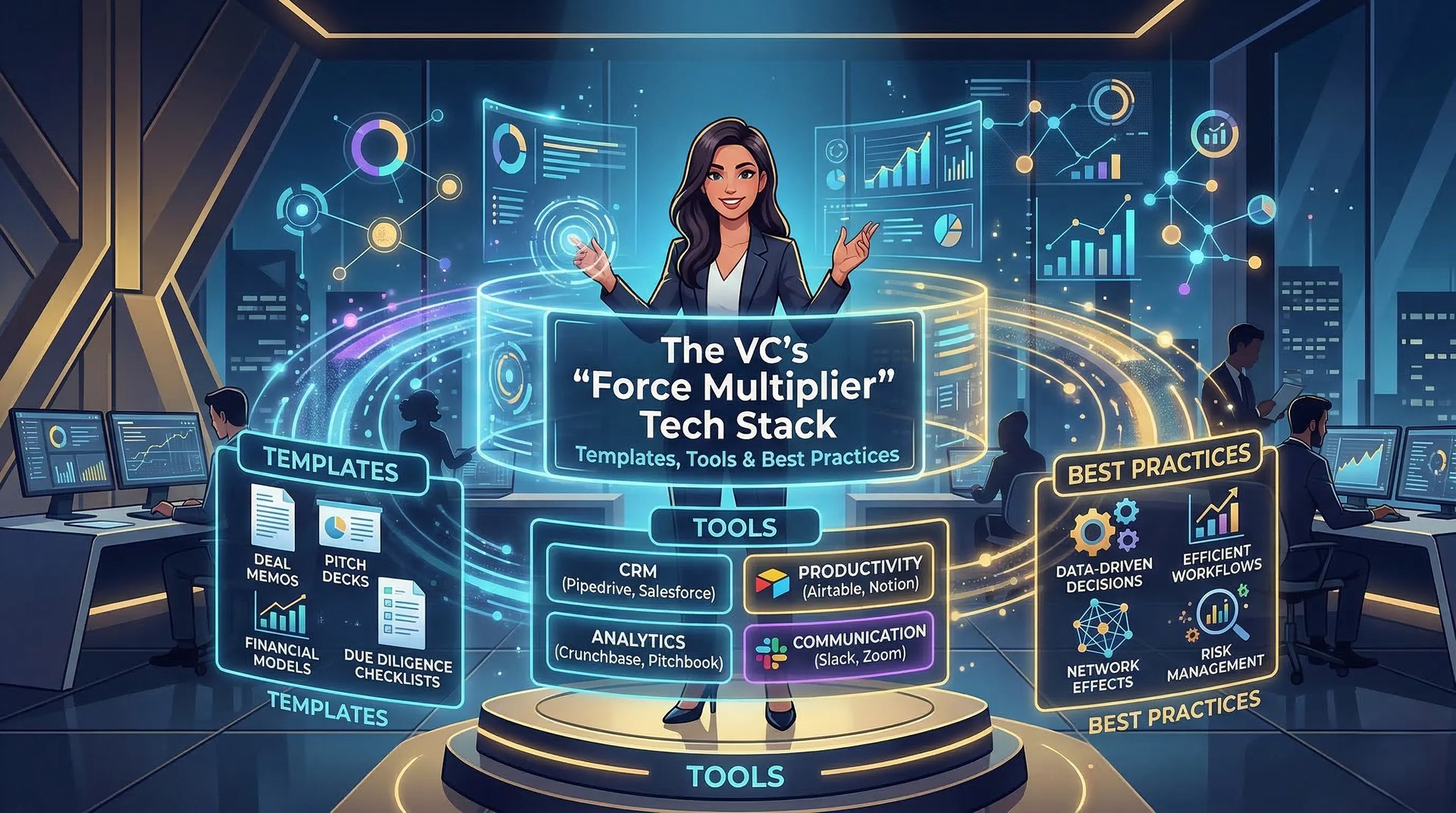
Templates, Tools & Best Practices: The VC’s "Force Multiplier" Tech Stack
Upgrade your fundraising with the ultimate VC tech stack. Discover 2025’s top pitch deck templates, AI design tools, and "force multiplier" best practices to win.
PILLAR 3: SLIDE STRUCTURE & FRAMEWORKS
12/17/20254 min read
Templates, Tools & Best Practices: The VC’s "Force Multiplier" Tech Stack
If you’re still wrestling with text boxes in a 2010 version of PowerPoint, you aren’t just wasting time—you’re signaling a lack of technical fluency. In 2025, the tool you choose is as much a part of your "Signal" as the data on the slides. VCs in London, New York, and San Francisco operate at a high velocity; we expect your stack to match that speed.
The brutal truth? A "pretty" template is the lipstick on a pig if the underlying logic is flawed, but a "messy" custom design is a deal-killer. I’ve seen founders spend $10k on a design agency only to have a deck that’s impossible to update 24 hours before a meeting. When I ask for a revision to your CAC Payback assumptions, I want to see it in my inbox in an hour, not next Tuesday.
This sub pillar is part of our main PILLAR 3 — SLIDE STRUCTURE & FRAMEWORKS.
The VC Lens: Efficiency and The "Modern Infrastructure"
When I receive a pitch, I’m not just evaluating your business; I’m evaluating your operational stack. If you use a modern, collaborative tool, I assume your internal team communications are equally efficient. If you send me a 25MB email attachment that crashes my phone, I assume your product architecture is just as bloated.
The hidden risk we look for is Static Thinking. A static PDF is a snapshot of the past. A dynamic, tracked link (DocSend/Visible) is a window into the present. In the US, we want to see that you are using AI and automation to move faster than your competitors. In the UK and Canada, we look for "Brand Integrity"—does the deck feel like it was built by someone with an obsessive attention to detail?
The "Trench" Report: The $5M "Canva" vs. "Pitch" Debate
Last year, two competing SaaS startups in Toronto pitched us in the same week. The first used a generic, overused Canva template. It was visually loud but lacked "Cognitive Ease." Every slide felt like it was fighting for attention. We spent most of the meeting trying to find the numbers hidden behind the "creative" icons.
The second founder used Pitch.com with a custom, minimalist theme. It looked like a Tier-1 McKinsey report but felt like a Silicon Valley product. More importantly, they used Visible.vc to embed live charts of their NRR (Net Revenue Retention).
The consequence? The second founder raised their $5M round in three weeks. Why? Because the tool allowed them to be reactive. Every time a partner asked a question, they updated the "Live" deck and sent a tracked link to the specific appendix slide. They didn't just pitch; they managed the process. Your tools should shorten the distance between a VC’s question and your answer.
The Tactical Framework: The 2025 "Power Stack"
To win in the current market, stop using generalist tools. Use a stack designed for the fundraising "Funnel."
1. The Creation Engine: Beautiful.ai or Pitch.com
The "So What": These tools use "Smart Slides" that auto-format. If you add a new team member or a new data point, the slide doesn't break.
The Signal: This tells me you value Design Consistency. You won't let your brand degrade as you scale.
2. The Distribution Layer: DocSend or Papermark
The "So What": Never send an attachment. Use a tracked link.
The Signal: I know you’re watching. When I see you spent 4 minutes on the "Competition" slide, I know exactly what you’re worried about. You gain Informational Symmetry.
3. The Evidence Layer: ChartMogul or Baremetrics (Embeds)
The "So What": Don't just draw a line in Excel. Embed your actual billing data.
The Signal: Radical Transparency. It’s much harder to "massage" numbers when they are pulled directly from your Stripe account.
Semantic Depth: The "Analytics" Audit
When you use a tracked link (DocSend), you get access to Slide-by-Slide Analytics. This is where the pros win.
The "Drop-off" Fix
If 80% of your viewers drop off at Slide 5 (The Market), your market narrative is too academic. You’re losing them in the "Noise."
The Fix: Move the Traction slide to Slide 3. Re-hook them with the math before they get bored of the "Vision."
The "Deep-Dive" Trigger
If an investor spends 10 minutes on the Unit Economics slide but doesn't book a meeting, they found a hole in your logic.
The Fix: Don't wait for them to email you. Send a proactive follow-up: "I noticed the unit economics slide usually generates the most questions; I’ve added an appendix slide (Slide 15) detailing our LTV/CAC assumptions over the next 18 months." This is how you "close" via the deck.
AI-Powered Generation (The 2025 Standard)
Tools like Slidebean or Prezent.ai can now generate a structure based on your URL. Use these for the "First Draft," but never the final. VCs can smell "AI-generated fluff." Use AI for the Hierarchy, but use your "Earned Secrets" for the Insight.
The Pillar Connection: Scaling the Masterclass
This sub-pillar, Templates, Tools & Best Practices, is the "Production Value" of the Pitch Deck Masterclass. You’ve mastered the "Structure," the "Narrative," and the "Metrics." This is about the Delivery.
A great engine needs a high-performance chassis. If you deliver your "Inevitability" narrative (Sub-pillar 6) via a 1990s PowerPoint file, the medium kills the message. These tools ensure that your signal is delivered at 5G speeds, with zero friction, directly to the decision-maker’s brain.
Expert FAQ: The No-BS Tool Guide
Q: Is PowerPoint dead?
A: No, but it’s for "The Big 4" and "The Old Guard." If you’re pitching a traditional PE fund in London, use PPT. If you’re pitching a VC under the age of 50, use Pitch or a DocSend link. It’s about cultural alignment.
Q: Should I use AI to write my deck?
A: Use AI (ChatGPT/Claude) to audit your deck. Paste your headers and ask: "What is the biggest logical gap here?" Do not let AI write the story. AI is great at "Noise"; only founders can provide the "Signal."
Q: How do I handle "Version Control"?
A: This is why you use a link-based system. If you find a typo 10 minutes after sending the email, you can fix it in the source file, and the link updates automatically. Sending "Deck_v2_Final_FINAL.pdf" makes you look like a hobbyist.
Q: What is the "Golden Ratio" for design?
A: 70/30 White Space. If your slide is more than 30% text, you have a "Reading Task," not a "Visual Signal." If I have to read, I’m not listening. Keep it sparse, keep it bold.
Funding Blueprint
© 2025 Funding Blueprint. All Rights Reserved.