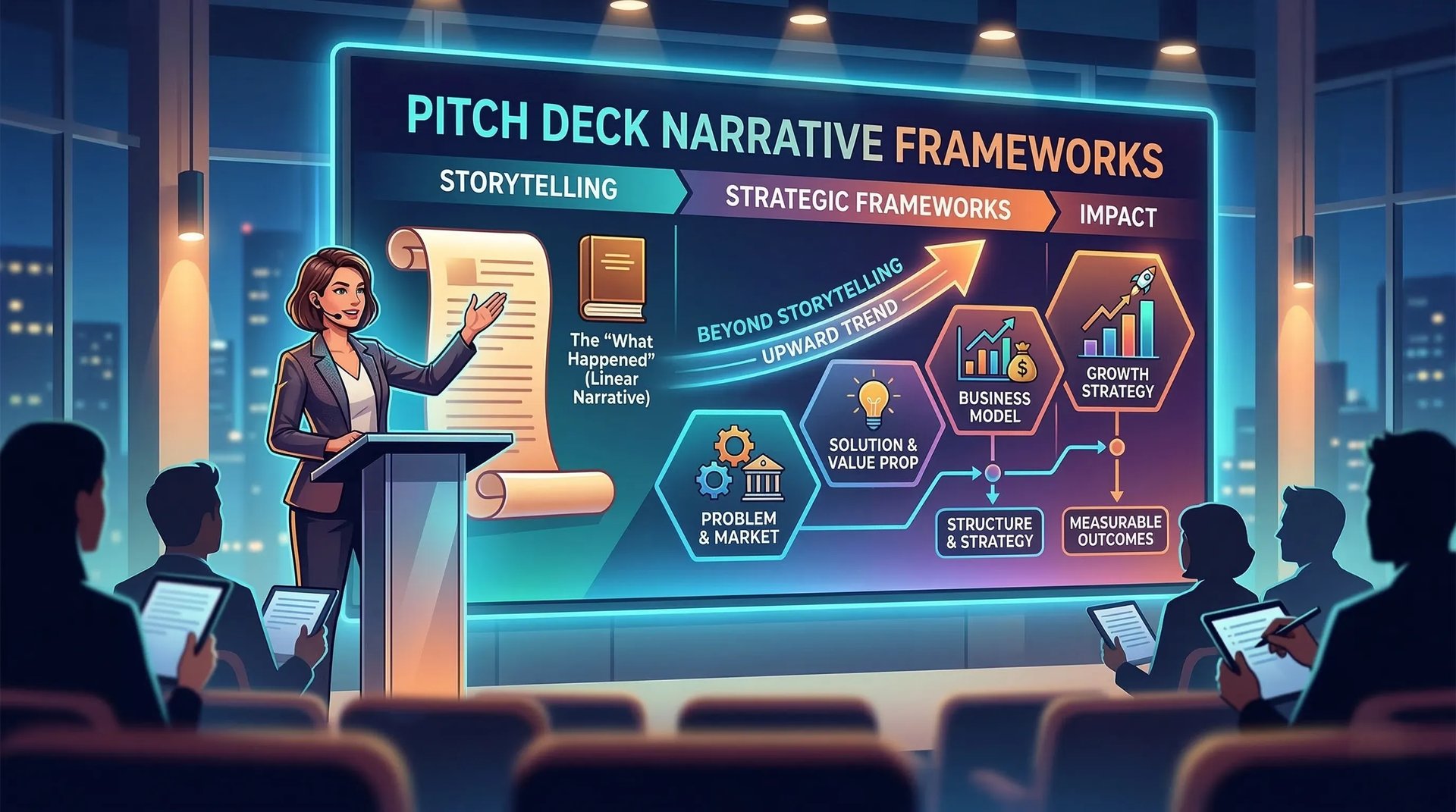
Pitch Deck Narrative Frameworks: How to Move Beyond Storytelling
VCs don’t buy stories; they buy inevitability. Learn the 3 narrative power-models (Big Change, Platform Play, ROI) to turn your deck into a category of one.
PILLAR 3: SLIDE STRUCTURE & FRAMEWORKS
12/16/20256 min read


Narrative Frameworks for Decks: The Architecture of Inevitability
Most founders treat "narrative" as a synonym for "storytelling." They spend hours crafting a "once upon a time" opening about a frustrated user, thinking they are building an emotional connection. They aren't. In a VC’s mind, an emotional appeal without a structural backbone is just noise.
The brutal truth? VCs don't buy stories; they buy the inevitability of a market shift. A narrative framework isn't about making me feel something; it’s about making me believe that your company is the only logical conclusion to a global problem. In London, New York, or San Francisco, the "Narrative" is the invisible thread that prevents your deck from being a pile of disconnected data points. If your narrative is weak, I’m looking at a spreadsheet. If your narrative is strong, I’m looking at the future.
This sub pillar is part of our main PILLAR 3 — SLIDE STRUCTURE & FRAMEWORKS.
The VC Lens: The Search for "The Inevitable"
When I sit in an Investment Committee (IC) meeting, we aren't looking for the most "creative" story. We are looking for Narrative Market-Fit. This is the psychological state where the investor feels that the trend you are riding is so powerful that even a mediocre team would succeed, but a team like yours will dominate.
The hidden risk we hunt for is The Hero’s Fallacy. This is when a founder positions themselves as the hero of the story rather than the market shift. I don't care if you "worked really hard to find this solution." I care that the $50B industry you are targeting is currently on fire and you are the only one holding a hose.
In SF, the narrative expectation is "World Domination." In London and Toronto, the expectation is "Economic Transformation." If you use a "World Domination" narrative in a conservative UK boardroom without the unit economics to back it up, you look like a dreamer. If you use a "Pragmatic" narrative in an SF boardroom, you look like a consultant. You must match the framework to the ego of the room.
The "Trench" Report: The Founder Who Talked Himself Out of $5M
I recently saw a Series A pitch for a logistics AI company in New York. The founder had incredible metrics: $3M ARR, 115% NRR, and a 4-month CAC payback. On paper, he was a "yes."
However, his narrative framework was "The Incrementalist." He spent twenty minutes explaining how his software was "slightly better" and "more efficient" than the current legacy systems. He framed the narrative around "optimization."
The IC passed. Why? Because "optimization" is a boring narrative that leads to a 2x exit. We wanted a narrative of "Disruption." If he had framed the story around "The Collapse of Legacy Supply Chains" and positioned his company as the new operating system for a post-globalization world, we would have fought over the term sheet. He had the "Signal" in his data, but the "Noise" in his narrative killed the deal.
The Tactical Framework: The 3 Narrative Power-Models
To move beyond simple storytelling, you must adopt one of these three high-authority narrative frameworks. These are the "invisible skeletons" used by the top 1% of fundraisers.
1. The "Big Change" Framework (The SF Special)
Popularized by strategic narrative experts, this model focuses on a shift in the world that makes your product necessary now.
The Structure: Name a massive change in the world -> Show there will be winners and losers -> Tease the "Promised Land" -> Reveal your product as the "Magic Gift" to get there.
Why it works: It creates Urgency. It’s not about why you’re good; it’s about why the old way of doing things is now impossible.
2. The "Better, Faster, Cheaper" Framework (The London/Toronto Standard)
This is for the pragmatic investor. It’s grounded in the Arbitrage of Inefficiency.
The Structure: Quantify the current economic waste -> Show the technical breakthrough that eliminates the waste -> Prove the scalability of that breakthrough -> Show the moat that prevents others from copying it.
Why it works: It focuses on Direct ROI. It appeals to the investor’s desire for a "safe" bet with high upside.
3. The "Platform Play" Framework (The Category King)
This is for companies that aren't just selling a product, but building an ecosystem.
The Structure: Identify a fragmented market -> Show the friction of the "Status Quo" -> Introduce the "Unified Layer" (You) -> Show the Network Effects that make you untouchable.
Why it works: it justifies a High Valuation. It moves the conversation from "revenue" to "dominance."
Semantic Depth: The Mechanics of Narrative Logic
To truly master the narrative, you have to use the language of venture-scale growth. Your narrative isn't just words; it’s the way you frame your Technical Moats and Network Effects.
The Concept of "Earned Secrets"
A great narrative is built on an Earned Secret. This is an insight you have about the market that nobody else realizes.
Example: "Everyone thinks the problem with EV charging is the hardware; the earned secret is that the problem is actually the local grid-load balancing." If your narrative doesn't contain an earned secret, you’re just another "me-too" company.
The "Flywheel" Effect
Every narrative must culminate in a Flywheel. I want to see that as you get bigger, you get stronger and harder to kill.
Data Flywheel: More users = More data = Better AI = More users.
Economic Flywheel: More volume = Lower COGS = Lower price = More volume. If your narrative is a linear path, it’s a small business. If your narrative is a circle (a flywheel), it’s a unicorn.
Addressing the "Chasm" (TAM vs. SOM)
The narrative must explain the transition from your SOM (Serviceable Obtainable Market) to your TAM (Total Addressable Market). This is the "Geographic or Product Expansion" arc.
Narrative Logic: "We are starting with high-end lawyers (SOM) because they have the highest pain, but once we own the data layer, we move to every white-collar professional (TAM)." This shows me you have a "Wedge" strategy. I hate companies that try to boil the ocean on day one. Show me the wedge.
The Contrarian Take: Kill the "Origin Story"
Most pitch coaches tell you to start with your "Origin Story." I am telling you to kill it. I don't care that you had the idea while showering or that your grandmother struggled with a specific problem. That is Narrative Fluff. Unless your origin story directly proves your Founder-Market Fit (e.g., "I spent 15 years as a Head of Logistics at Amazon and saw this $1B hole"), it doesn't belong in the first 5 slides.
Professional VCs are looking for "Commercial Athletes." We want to know why you are going to win now, not why you felt inspired then. Use that precious real estate to show me Velocity. Momentum is a better narrative than inspiration every single time.
The Pillar Connection: The Soul of the Deck
This sub-pillar, Narrative Frameworks, is the "Soul" of the Pitch Deck Masterclass. While the "Slide Order" provides the body and the "Metrics" provide the muscle, the Narrative provides the Will to Win.
A deck without a narrative is a commodity; it can be easily compared to 50 other deals on price and metrics. A deck with a narrative is a category of one. When you master the narrative, you stop "asking" for money and start "offering" an opportunity to be part of an inevitable future.
Expert FAQ: The "Insider" Directives
Q: How do I make a "boring" B2B company sound like a "Big Change" narrative?
A: Find the External Catalyst. Is it new legislation (GDPR/AI Act)? Is it a shift in labor costs? Is it the collapse of a specific incumbent? Every "boring" industry is being disrupted by an external force. Find that force and position yourself as the only solution to it.
Q: Should the narrative change for a "Down Round" or "Flat Round"?
A: Yes. The narrative shifts from "Exploration" to "Efficiency." In 2025, if you are raising a flat round, your narrative must be: "We have reached unit-economic perfection, and now we are just pouring fuel on a fire that already works." Focus on Payback Periods and Burn Multiples.
Q: Can a deck have two narratives?
A: No. You will confuse the IC. If you are a "Marketplace" and a "SaaS" company, pick the narrative that drives the highest valuation. Usually, that’s the Platform Play. One deck, one "Golden Thread," one inevitable conclusion.
Q: What if my "Earned Secret" is easy to copy?
A: Then your narrative must focus on Speed as a Moat. Your narrative becomes: "We have a 12-month head start on the data flywheel, and by the time they catch up, our NRR (Net Revenue Retention) will make us unshakeable."
Funding Blueprint
© 2025 Funding Blueprint. All Rights Reserved.