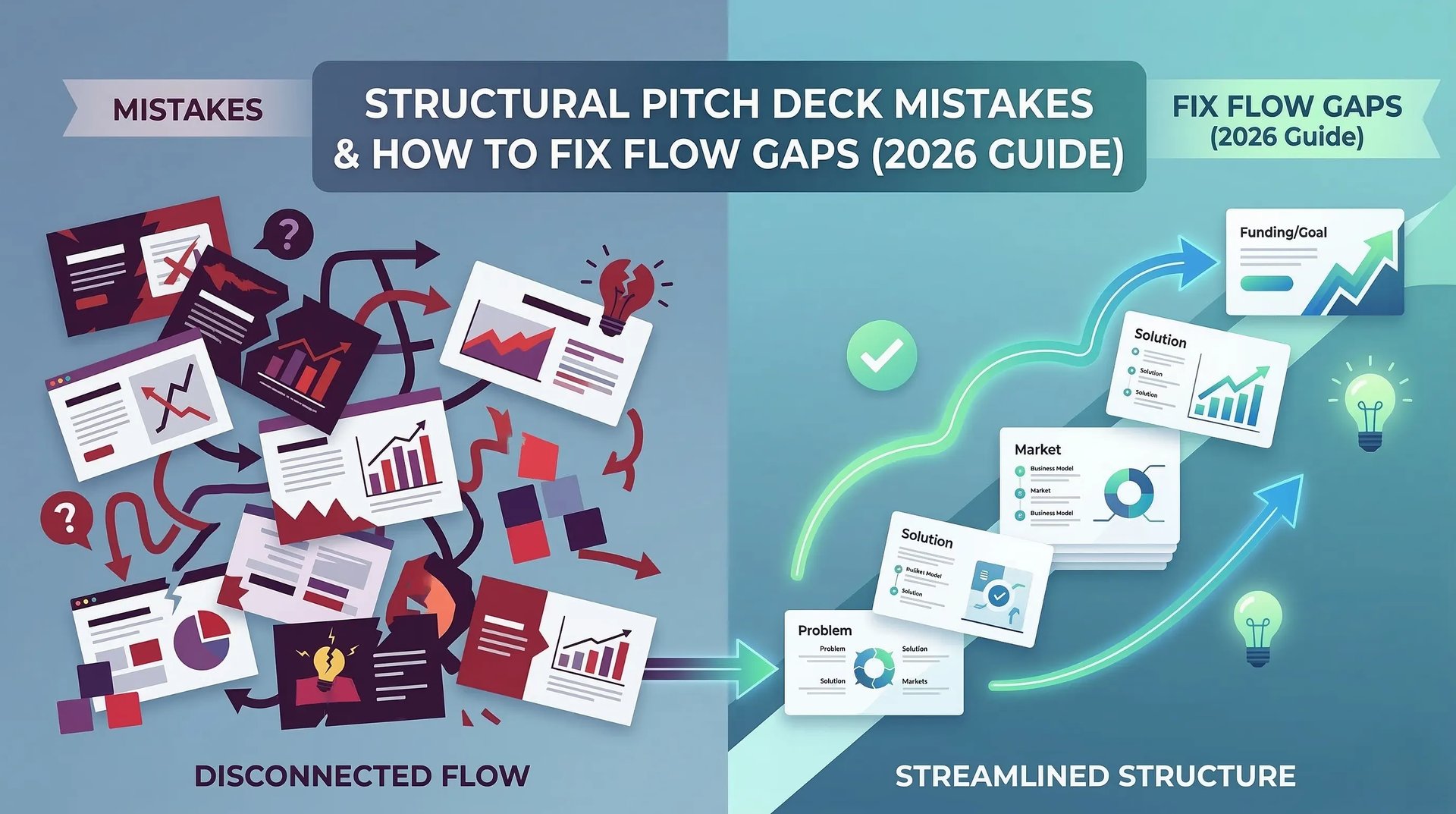
Structural Pitch Deck Mistakes & How to Fix Flow Gaps (2025 Guide)

Stop losing deals to "Narrative Friction." Learn the top 10 pitch deck structural mistakes VCs hate and get tactical fixes to build an inevitable investor logic.

PILLAR 3: SLIDE STRUCTURE & FRAMEWORKS

12/17/20254 min read

 A futuristic digital interface displaying a flowchart of pitch deck structure errors with holograph
 A futuristic digital interface displaying a flowchart of pitch deck structure errors with holograph

Structural Mistakes & How to Fix Them

If your deck feels like a chore to read, it’s not because your business is boring—it’s because your structure is broken. When I’m sitting in an Investment Committee (IC) meeting, the most common reason we pass on a technically brilliant founder is "Narrative Friction." If I have to work too hard to understand how your product (Slide 4) actually solves the problem (Slide 2), I assume you’ll be just as disorganized when it’s time to scale.

This sub pillar is part of our main PILLAR 3 — SLIDE STRUCTURE & FRAMEWORKS.

The VC Lens: The Psychology of "Cognitive Strain"

Investors are professional pattern-matchers. We see 50+ decks a week. When you deviate from a logical structure or leave gaps in your reasoning, you trigger "Cognitive Strain." This isn't just a minor annoyance; it’s a red flag. To an investor in SF, London, or Toronto, a lack of structural clarity suggests a lack of operational grip.

The hidden risk we look for is The Missing Link. This is the gap between your massive TAM (Total Addressable Market) and your actual Go-to-Market strategy. If you claim a $10B market but your "Team" slide has no one who has ever sold to that market, the structure collapses. In NY, we call this "selling a dream with a broken ladder."

The "Trench" Report: The Series B Ghost

A few years ago, a Series B fintech firm in London pitched us. They had $10M in ARR and a world-class team. But their deck was a structural mess. They led with "The Future of Banking" (3 slides), jumped to "Our 5-Year Roadmap" (2 slides), and didn't mention their current Net Revenue Retention (NRR) until the very end.

In the IC, the conversation wasn't about their growth; it was about their confusion. One partner said, "If they don't know that their current retention is their biggest asset, they’re going to waste our $20M chasing the wrong roadmap." We passed. They spent six months trying to bridge the round and eventually had to take a flat-round valuation. Structural mistakes cost you more than just time; they cost you equity.

The Tactical Framework: The "3-Step Integrity Audit"

Before you send your next DocSend link, put your deck through this filter to identify and fix structural rot.

1. The "So What?" Header Test

Read only the headers of your slides in order. Do they tell a complete, persuasive story?

  • The Mistake: Using generic category headers like "The Problem" or "Our Solution."

  • The Fix: Use Assertion Headers.

    • Instead of: "Our Traction"

    • Use: "We’ve Scaled to $2M ARR with 15% Month-over-Month Growth."

2. The "Golden Thread" Alignment

Does the "Problem" you defined on Slide 2 directly necessitate the "Product" on Slide 4?

  • The Mistake: Describing a "Macro Problem" (e.g., "The World is Getting Hotter") but offering a "Micro Solution" (e.g., "We make a better smart-thermostat").

  • The Fix: Tighten the scope. Your problem should be the specific economic pain that your product alleviates.

3. The "Resource-Milestone" Check

Does your "Ask" (Slide 11) provide enough fuel to reach the "Vision" (Slide 12)?

  • The Mistake: Asking for $5M but showing a roadmap that requires $15M to execute.

  • The Fix: Calibrate your ask to specific Value-Inflection Points. "We are raising $5M to reach $10M ARR, which positions us for a Series B."

Semantic Depth: Fixing the "Logic Gaps"

To move from an "Okay" deck to a "High-Authority" deck, you must eliminate these technical structural errors.

The "TAM/SAM/SOM" Disconnect

Most founders use a top-down Venn diagram. This is a mistake. VCs want a Bottom-Up Market Sizing.

  • The Fix: Structure your market slide as a calculation:

    SOM = (Number of Target Customers) X (Annual Contract Value)

    If your structure doesn't show this math, you haven't defined a market; you’ve identified a category.

The "Competition" Illusion

Claiming "No Competition" is a structural death sentence. It tells me you don't understand the market or the market doesn't exist.

  • The Fix: Use a Competitive Power Map. Don't just list features; map competitors based on Strategic Positioning (e.g., "Legacy/Slow vs. Modern/Agile"). Acknowledge "Status Quo" as your biggest competitor.

The "Unit Economics" Vacuum

In 2025, pitching "Growth at all Costs" is a mistake. Your structure must address Efficiency.

  • The Fix: Ensure your "Traction" slide includes your LTV/CAC Ratio and Payback Period. If you are a B2B SaaS player, your Burn Multiple (Net Burn / Net New ARR) is the most important structural signal in the deck.

The Pillar Connection: The Skeleton of the Masterclass

This sub-pillar, Structural Mistakes, is the "Correction Layer" of the Pitch Deck Masterclass. You can have the "Famous Frameworks" (Sub-Pillar 4) and the "Alternative Formats" (Sub-Pillar 7), but if your internal logic is flawed, the whole document will crumble under the weight of due diligence. Fixing these mistakes ensures that your "Signal" remains pure as it moves through the VC’s internal review process.

Expert FAQ: The No-BS Fix-It List

Q: My deck is 25 slides. Is that too long?

A: Yes. Cut it to 12. Use the other 13 slides as Appendix Slides. If a VC asks a deep-dive question, you look like a pro when you say, "I actually have a slide for that in the appendix." It proves you have the depth without cluttering the narrative.

Q: Where should I put the "Why Now" slide?

A: Right after the Problem. In the US (SF/NY), investors want to see the Catalyst. Is it a regulatory change? A technological breakthrough? If you don't explain the urgency early, we assume the problem has existed forever and isn't worth solving now.

Q: How do I fix a "Weak Team" slide?

A: Stop listing your hobbies. Focus on Relevant Velocity. Show us where you worked during a high-growth phase. If you lack experience, highlight your Advisory Board—but only if they are actually active. A "Team" slide without "Founder-Market Fit" is a structural hole.

Q: What is the biggest red flag in a "Financials" slide?

A: "The Hockey Stick" without a "The GTM." If your revenue goes from $1M to $50M in three years, but your marketing spend stays flat, your structure is a fantasy. Every dollar of revenue must be tethered to a dollar of acquisition cost.