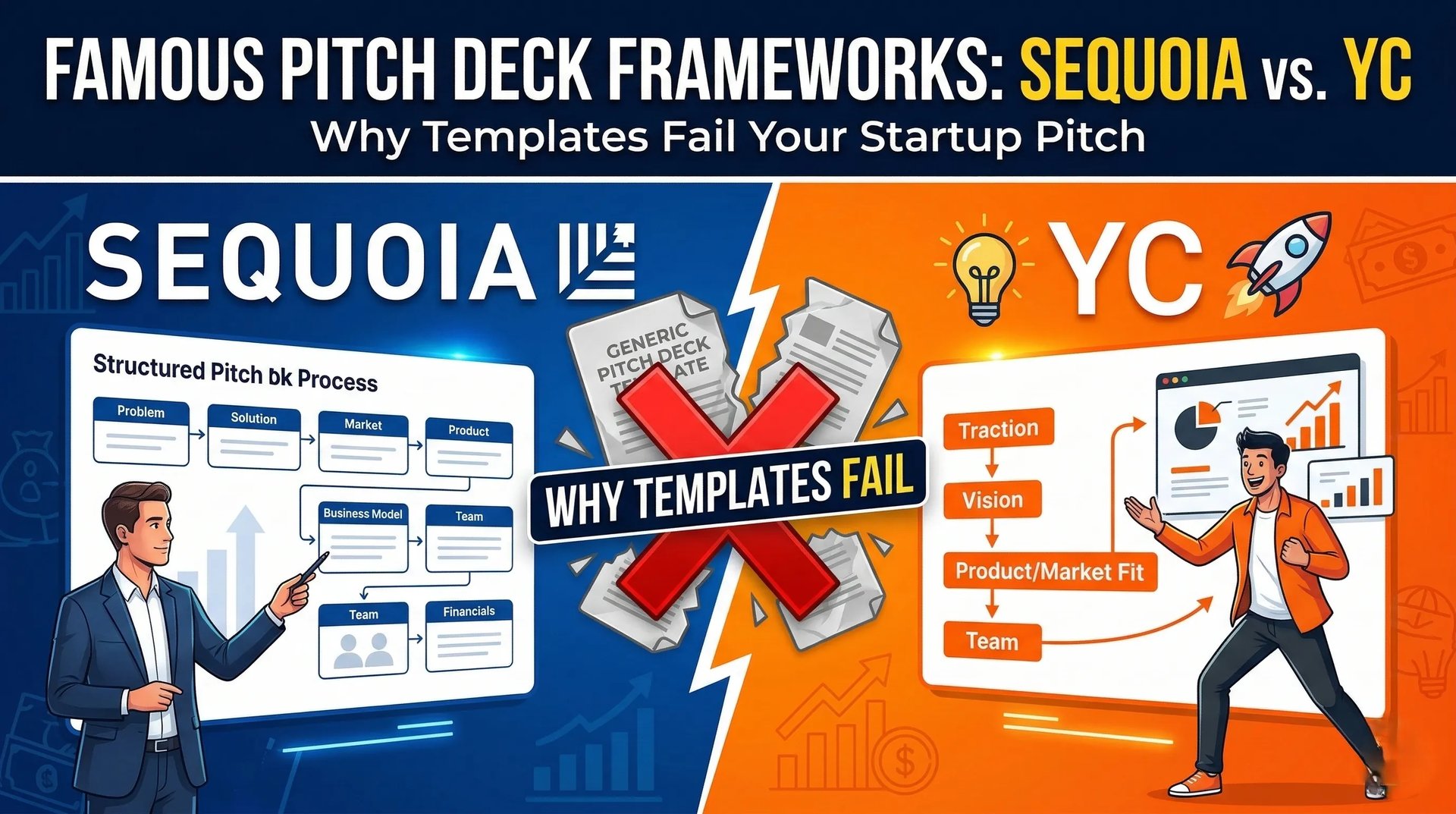
Famous Pitch Deck Frameworks: Why Templates Fail (Sequoia vs. YC)
Don’t let a generic Sequoia or YC template kill your raise. Learn how to calibrate famous pitch deck frameworks for 2025 using the "Founder-Market Fit" Matrix.
PILLAR 3: SLIDE STRUCTURE & FRAMEWORKS
12/16/20255 min read


Famous Pitch Deck Frameworks: Why "Best Practices" Can Be Fatal
Most founders treat famous pitch deck frameworks like a "paint-by-numbers" kit. They download a Sequoia or Guy Kawasaki template, plug in their data, and wonder why they’re getting ghosted by Tier-1 funds.
The brutal truth? Frameworks are baselines, not finish lines. When I’m sitting in an IC meeting in London or San Francisco, I can spot a generic template from a mile away. It signals that the founder is following a playbook rather than building a business. If your deck looks exactly like the Airbnb deck from 2008, you aren't being "classic"—you're being obsolete. The world has moved on from simple "Problem/Solution" slides; we now demand "Execution/Moat" certainty.
This sub pillar is part of our main PILLAR 3 — SLIDE STRUCTURE & FRAMEWORKS.
The VC Lens: The Psychology of Familiarity vs. Pattern Matching
Investors have a love-hate relationship with frameworks. On one hand, we need the Cognitive Ease that comes with a standard flow. If I have to hunt for your Burn Multiple or your NRR (Net Revenue Retention), I’m annoyed. On the other hand, a framework that is too rigid masks the unique "Earned Secret" of your business.
The hidden risk is The Template Trap. When you use a famous framework, you are forced into someone else’s logic. For example, the Guy Kawasaki 10-slide rule was designed for a world where people had 20-minute attention spans and used projectors. In 2025, we use DocSend and asynchronous reviews. If you follow an old framework to the letter, you might omit the very technical depth (like LTV/CAC cohorts or LLM architecture) that a modern VC needs to see to get excited.
The "Trench" Report: The Sequoia Clone That Failed
Two years ago, a Toronto-based AI startup used the "Sequoia Capital" framework to a T. They had the 10 slides, the clean font, and the "Purpose" statement at the front. It was aesthetically perfect.
But they failed to raise. Why? Because the Sequoia framework is designed for Product-Market Fit companies that are already seeing "the pull." This startup was deep-tech; they needed more slides on the "How" and the "Defensibility." By strictly adhering to a "Simple" framework, they looked like a "wrapper" company rather than a foundational tech company. They were filtered out because the framework they chose didn't match the Risk Profile of their industry. They eventually raised after throwing the "standard" framework away and building a deck that focused 40% of its weight on IP and Moats.
The Tactical Framework: The "Founder-Market Fit" Selection Matrix
Don't just pick a framework because it's famous. Pick it based on your Stage and Geography.
1. The Sequoia Model (The Gold Standard)
Sequoia’s framework is about Inevitability. It’s 10 slides that move from "Company Purpose" to "Financials." It’s designed to show that a market shift has occurred and you are the only logical winner.
The Signal: If you use this, your data must be bulletproof. There is nowhere to hide.
2. The Guy Kawasaki 10/20/30 Rule
10 Slides, 20 Minutes, 30-point font.
The Critique: This is for presenting, not for sending. If you send a 10-slide deck with 30pt font via email, you look like you’re pitching a middle-school science project.
3. The 500 Startups "Problem-First" Approach
This framework is aggressive. It spends 3 slides on the problem and "the pain."
The Signal: Great for London or Canadian VCs who are more cynical. You have to prove the blood is in the water before we believe you can build a shark.
Semantic Depth: Calibrating Metrics within Frameworks
Whichever framework you choose, the "Signal" is in the technical nomenclature you use within the slides. A "Famous Framework" is just the skeleton; the metrics are the muscle.
For B2B SaaS (The North Star Metrics)
If you're using a standard framework, your "Traction" slide better include Net Revenue Retention (NRR). If your NRR is 120%, you are in the top 1% of startups. If you only show "Total Users," I assume your Churn Rate is catastrophic.
For Market Sizing (The Bottom-Up Requirement)
Most famous frameworks have a "Market" slide. Founders often put a $100B "Total Addressable Market" (TAM) figure here. To a veteran VC, that's "Noise." I want to see your SOM (Serviceable Obtainable Market) calculated by:
SOM = (Target Accounts) X (Average Contract Value)
If you don't show the math, the framework is just a pretty picture.
The "Rule of 40"
In the current 2025 climate—especially in London and Toronto where capital is tighter—we look for the Rule of 40 in later-stage decks (Growth/Series B). Your (Growth Rate + Profit Margin) should equal 40% or more. If you use a framework that doesn't allow for this financial nuance, you aren't ready for a serious IC meeting.
The Pillar Connection: The Framework as the "Chassis"
Famous Pitch Deck Frameworks serve as the "Chassis" for our Pitch Deck Masterclass. You cannot build a high-performance vehicle without a frame, but the frame isn't what wins the race. This sub-pillar connects directly to "Slide Order & Logical Flow"—while the framework gives you the slides, the flow gives you the narrative. Mastering these frameworks allows you to "speak the language" of VC, which is the first step in earning the right to break the rules.
Expert FAQ: The "Insiders" Reality Check
Q: Is the Y-Combinator (YC) deck format still the best for Seed?
A: Yes, for speed. YC’s format is the "no-nonsense" version of the Sequoia deck. It’s perfect for New York and SF investors who want to see the product and the growth immediately. In London, you might need to add a bit more "Market Context" because UK investors aren't always as familiar with niche US tech trends.
Q: Can I combine frameworks?
A: You should. Take the Narrative Hook from Airbnb’s model (The "Story") and graft it onto the Metric Rigor of Reid Hoffman’s Series B model. A "Frankenstein" deck that is custom-built for your specific business is always better than a rigid template.
Q: Why do VCs say they hate templates but then ask for a "standard" deck?
A: We hate lazy templates. We love standard structures. We want the information where we expect it to be, but we want the insights to be unique. Think of it like a resume: the format should be standard, but the achievements must be extraordinary.
Q: What is the most "Contrarian" framework advice you have?
A: Delete the "Solution" slide. If your "Product" slide doesn't inherently explain the solution, your product is too complex. By splitting them, you often end up with a fluff slide (Solution) followed by a technical slide (Product). Merge them into a "Product-as-Solution" slide to increase your Information Density.


Funding Blueprint
© 2025 Funding Blueprint. All Rights Reserved.