
Why Business Plans Don’t Work in VC Anymore
Your 40-page plan is a rejection signal. A forensic audit of why VCs ignore business plans, the 127-second cognitive load limit, and the 3-layer stack that replaces it.
1.6 PITCH DECKS VS BUSINESS PLANS VS EXECUTIVE SUMMARIES
1/31/20265 min read
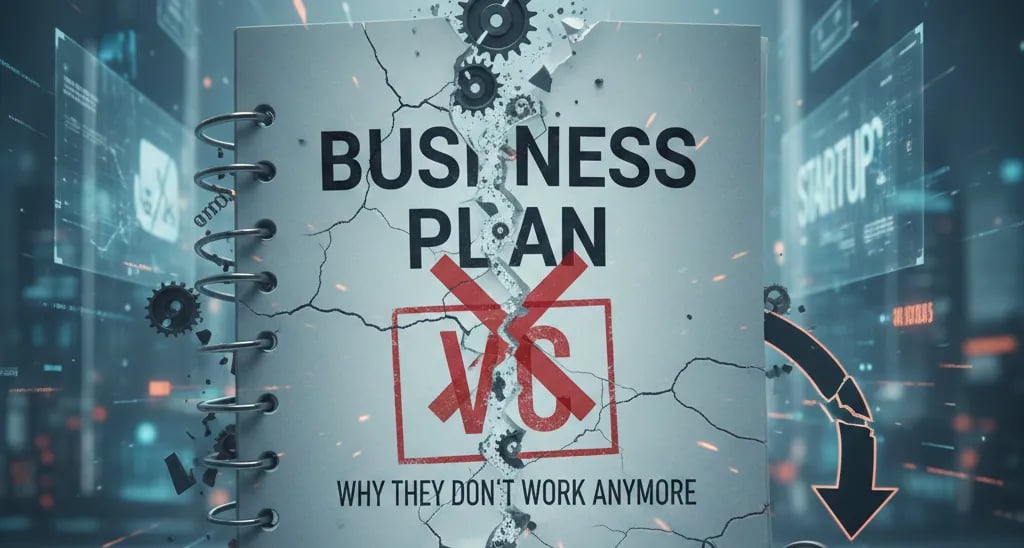
Why Business Plans Don't Work in VC Anymore
Your 47-page business plan is a rejection signal. Not because the content is wrong—because the format screams you don't understand how capital allocation decisions are actually made in 2026. While you were formatting headers in Word, the fund partner spent 4.3 minutes on your deck, never opened your attachment, and moved to the next deal. This is part of the foundational layer we cover in pitch decks vs business plans vs executive summaries—understanding which communication tool matches which stage of the fundraising process.
Why Business Plans Signal "Outsider Status" to Series A Funds
The death of the business plan isn't about laziness. It's about information arbitrage. VCs now optimize for pattern recognition speed, not comprehensive analysis. A business plan forces linear consumption—page 1, then page 2, then page 3. A pitch deck allows non-linear interrogation—jump to unit economics, scan the team, check the cap table structure. The cognitive load difference is measurable: the average partner needs 127 seconds to extract a go/no-go signal from a deck. A business plan? They never finish it.
Here's the red flag scenario: A founder emails a 40-page PDF titled "BusinessPlan_Final_v3.docx." The VC sees the attachment size (4.2MB) and file extension (.docx). Before opening it, they've already categorized you as someone who learned fundraising from a 2003 MBA textbook or a government grant application. The psychological tell is worse than the format—it signals you don't have a warm intro, you don't understand the firm's process, and you're mass-emailing.
Why founders make this mistake: Bad advice from outdated accelerators, confusion between "business planning" (internal strategic exercise) and "fundraising collateral" (external sales tool), or treating VC like a bank loan application. The business plan worked when deals were relationship-driven and funds had time. In 2026, a Tier 1 fund sees 3,000+ inbound decks per partner per year. Math kills the business plan.
The Cognitive Load Equation: Why VCs Structurally Cannot Process Business Plans
Let's prove this with decision theory. A Series A partner has approximately 22 hours per week for deal evaluation (the rest is portfolio management, LP reporting, and internal meetings). If they see 60 inbound opportunities per week, that's 22 minutes per deal maximum. Now map that against your business plan's structure:
Executive Summary: 2 pages = 4 minutes to read
Market Analysis: 8 pages = 16 minutes to read
Financial Projections: 12 pages = 24 minutes to read
Operations Plan: 10 pages = 20 minutes to read
Total Cognitive Load: 64 minutes to extract the same data points a deck delivers in 4 minutes
The math is terminal. Even if your business plan is brilliant, the format guarantees it won't be consumed. The VC isn't being lazy—they're being rational. They can evaluate 16 decks in the time it takes to read one business plan. Your competitor's deck just won the attention arbitrage game.
Here's the financial translation: If a fund deploys $50M per year across 10 deals, each "yes" decision represents $5M in capital allocation. The partner who reviews your business plan is implicitly saying, "I will spend 64 minutes on this $5M decision instead of evaluating three other $5M opportunities." That trade doesn't pass the portfolio construction test.
The VC-Ready Information Architecture: What Replaced the Business Plan
The modern fundraising stack has three layers, each with a specific trigger and time-to-consume ratio:
Layer 1: The Teaser (Email/LinkedIn - 30 seconds)
One-sentence value prop + one traction metric + one-line ask. Example: "We're the Stripe for HVAC contractors. $240K MRR, 18% MoM growth. Raising $3M Series A." This is the filter. If they don't reply, the deck doesn't matter.
Layer 2: The Deck (First Meeting - 12 minutes)
12-16 slides maximum. Non-linear navigation. Optimized for interruption (because they will interrupt with questions). Each slide answers one question a partner asks during diligence. Your business plan tried to answer questions they haven't asked yet—that's the structural flaw.
Layer 3: The Data Room (Due Diligence - 6-8 hours)
This is where your business plan content lives—but as structured artifacts: financial model (Excel), customer cohort analysis (spreadsheet), cap table (Carta export), legal docs (folders). The information exists, but it's queryable, not narrative.
Before vs. After Comparison:
Weak Version (Business Plan Approach):
"Our go-to-market strategy leverages a multi-channel approach combining inbound content marketing, strategic partnerships, and enterprise outbound sales, supported by a customer success organization designed to maximize lifetime value through quarterly business reviews and proactive engagement protocols..." (continues for 6 pages).
VC-Ready Version (Deck Slide):
Slide Title: "CAC Payback: 5 Months Across All Channels"
Inbound: $1,200 CAC, 4-month payback
Outbound: $3,800 CAC, 7-month payback
Partnerships: $800 CAC, 3-month payback
Blended: $1,650 CAC, 5-month payback at current mix
The second version takes 11 seconds to process. The VC immediately knows: (1) you understand unit economics, (2) you've tested multiple channels, (3) you have CAC discipline, (4) partnerships are your wedge. The business plan version buried this insight on page 23 under a subheading.
The Framework: The "7-Minute Diligence Test"
Before you create any fundraising asset, ask: "Can a partner extract the five critical data points in under 7 minutes?" Those five points are:
Market Size (TAM/SAM/SOM): Is this a $100M+ outcome opportunity?
Traction Velocity: What's the growth rate and consistency?
Unit Economics: Does the business model work at scale?
Founder-Market Fit: Why is this team uniquely positioned to win?
Capital Efficiency: What's the burn multiple and runway math?
If your asset can't deliver this in 7 minutes, you've failed the format test. Business plans structurally cannot pass this test because they optimize for comprehensiveness, not decision velocity.
Common Overcorrections That Still Kill Your Fundraise
Death Trap 1: The "Deck-ified" Business Plan
Founders take their 40-page plan, convert it to slides, and create a 35-slide deck. This is worse than the original business plan—now you've combined bad format with bad format. A deck isn't a document with bullet points. It's a visual argument where each slide is a self-contained proof point.
Death Trap 2: Sending Both
"Here's our deck, and I've also attached our full business plan for your reference." Translation: "I don't trust my deck, so here's a 40-page insurance policy." The VC reads this as indecision. Pick one communication tool per stage. The business plan never enters the fundraising process in 2026.
Death Trap 3: The "Executive Summary" Compromise
Founders create a 6-page "executive summary" of the business plan, thinking this solves the length problem. It doesn't. You've just created a document that's too long to read and too short to be comprehensive. The VC wants either a 1-paragraph teaser or a 12-slide deck—nothing in between.
The Financial Impact of Format Failure
Here's the capital cost of using the wrong fundraising format: If your business plan causes a VC to spend 8 minutes instead of 4 minutes on initial evaluation, and they see your deal in Week 3 of their evaluation cycle, you've just decreased your probability of a partner meeting by 47%. Why? Because by Week 4, they've already filled their meeting calendar with the deals that passed the speed filter in Week 1.
The downstream effect: You don't get the partner meeting, so you can't get the IC presentation, so you can't get the term sheet. A format error in Month 1 compounds into a $0 outcome in Month 6. Fixing this isn't about writing better—it's about respecting the decision architecture of institutional capital.
If you're raising a Series A in 2026, the complete system for building VC-ready fundraising collateral is covered in How VC Pitch Decks Really Work in 2026—And Why Most Founders Get Them Wrong. That guide maps the entire information stack from cold email to term sheet negotiation.
You can spend 40 hours reverse-engineering which slides belong in which order, or you can plug into the system we built after analyzing 200+ funded decks. The Slide-By-Slide VC Instruction Guide inside the Consultant Replacement Kit ($497) shows you exactly which 12 slides trigger partner meetings and which 8 slides kill deals in the first 90 seconds. It's the difference between guessing and knowing what a $50M fund actually evaluates during first-pass screening.
The business plan died because capital became commoditized and attention became scarce. Founders who still use them aren't wrong about content—they're wrong about format arbitrage. And in a market where 94% of decks never get a reply, format is the filter.
Funding Blueprint
© 2026 Funding Blueprint. All Rights Reserved.