
Pitch Decks vs Business Plans vs Executive Summaries (What Investors Actually Use)
Learn when investors use pitch decks, business plans, and executive summaries—and why pitch decks dominate early-stage VC decisions.
PILLAR 1: HOW VC PITCH DECKS REALLY WORK
12/10/20255 min read
Pitch Decks vs. Business Plans vs. Executive Summaries: What Investors Actually Use
If you show up to a VC meeting in Shoreditch, Manhattan, or Toronto with a 50-page printed business plan, you’ve already signaled that you are out of touch with modern venture capital. You aren't being "thorough"; you’re being a dinosaur.
The brutal truth? Nobody reads business plans, and executive summaries are just glorified email intros. In 2025, the Pitch Deck is the only document that actually moves the needle on a term sheet. The business plan is for your internal operations and your bank manager; the pitch deck is for the VC's imagination. If you confuse the two, you’ll end up with a document that is too long to be a pitch and too shallow to be a plan.
This sub pillar is part of our main Pillar 1 — How VC Pitch Decks Really Work.
The VC Lens: The Three Stages of Documentation
Investors use these three documents at different "latitudes" of the deal funnel. When I’m sitting in an IC (Investment Committee) meeting, I’m looking for Signal Density, not page count.
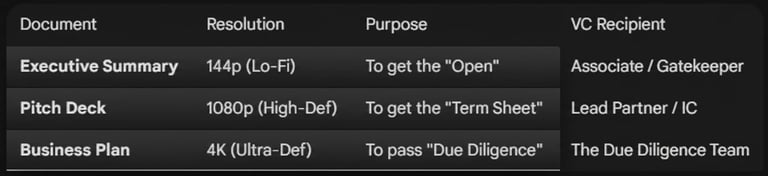
The Executive Summary (The Hook): This is the 1-page "blurb" used to get the Associate to open the deck. It is a filter.
The Pitch Deck (The Engine): This is the core of the deal. It is the narrative and data skeleton that we use to judge Founder-Market Fit and Scalability.1
The Business Plan (The Foundation): This is the "Internal Roadmap." We rarely ask to see it, but we look for its shadow in your financials and your operational answers. If you don't have one, it will show in your lack of "depth" during due diligence.
The hidden risk is The Document Mismatch. This happens when a founder tries to put "Business Plan" level detail into a "Pitch Deck." In SF and New York, this is a death sentence; it signals that you can't prioritize information. In London and Canada, investors might be more polite, but they will still tune out after slide 15.
The "Trench" Report: The $2M Lesson in "Too Much Info"
I once mentored a PhD founder from Toronto who was pitching a deep-tech robotics startup. He was brilliant, but he was terrified of being "misunderstood." He sent a Tier-1 New York fund a 45-page "Executive Summary" that was essentially a white paper.
The consequence? The fund never even opened his deck. They assumed that if he couldn't simplify his message to a one-pager, he would never be able to hire a sales team or lead a marketing department. He was "too academic" for venture. He only secured his seed round after he gutted the text and turned that 45-page nightmare into a punchy 12-slide deck and a 3-paragraph email intro. In VC, brevity is the ultimate sign of authority.
The Tactical Framework: The "Resolution" Model
Think of these documents as different "resolutions" of the same image. You must maintain all three to survive the evaluation workflow.
1. The Executive Summary: The 30-Second Sell
Stop writing 2-page documents. Your executive summary should be the body of your Email Intro.
The "So What": It must contain: The Problem, the Traction (revenue/growth), the Team (pedigree), and the Ask.
The Fix: If it’s longer than 250 words, you’re rambling.
2. The Pitch Deck: The Visual Narrative
This is the document we spend 90% of our time on.
The "So What": It is a Visual Argument. Every slide must support the thesis that your company is "Inevitable."
The Fix: 12 slides max. Use an Appendix for everything else.
3. The Business Plan: The Operational Reality
You don't send this; you "demonstrate" it.
The "So What": This is your 5-year hiring plan, your supply chain contingencies, and your detailed unit economic modeling.
The Fix: Use this to prepare for the "Q&A" phase. When a Partner asks, "How does your margin change if your AWS costs spike 20%?", your ability to answer comes from your business plan.
Semantic Depth: Technical Alignment Across Documents
To maintain authority, your numbers must be identical across all three formats. Any discrepancy—even a $5k difference in MRR—is a red flag for "Lack of Integrity."
Calibrating the "Ask"
In your Executive Summary, the "Ask" is a range (e.g., "Raising $3M-$5M"). In your Pitch Deck, the "Ask" is specific (e.g., "Raising $4M to reach $12M ARR"). In your Business Plan, the "Ask" is a Sources and Uses table.
Sources: Where the money comes from (Equity, Venture Debt).
Uses: Where the money goes (Engineering 40%, Marketing 30%, etc.).
The "LTV/CAC" Consistency
If your Pitch Deck claims a 4x LTV/CAC, your Business Plan better have the cohort data to prove it. In London and Toronto, VCs will "stress test" your assumptions. If your Business Plan shows that your CAC is subsidized by one-time organic PR, we will "haircut" your projections by 50%.
The "GTM" Depth
In the deck, the Go-to-Market (GTM) is a slide of logos and channels. In the business plan, the GTM is a Sales Capacity Model.
Calculation: (Number of AEs) x (Quota per AE) x (Ramp Time) = (Projected Revenue).
If you don't know these numbers, you don't have a plan; you have a wish list.
The Contrarian Take: The Death of the "Teaser" PDF
In New York and SF, we are seeing the death of the "Teaser PDF." Instead, high-signal founders are using The Forwardable Email. Why? Because I can't forward a PDF into a Slack channel as easily as I can forward a well-written email with an embedded DocSend link. If you make me download an attachment to see your "Executive Summary," you’ve added friction to my workflow. The best executive summary is the one I can forward to a Partner with a "Check this out" note in under 5 seconds.
The Pillar Connection: Integrating the Documentation Stack
This sub-pillar, Pitch Decks vs. Business Plans vs. Executive Summaries, provides the "Document Logic" for the entire Pitch Deck Masterclass. You’ve learned how to build the slides (Sub-pillar 3) and how the narrative flows (Sub-pillar 6). This section teaches you where those slides live in the broader ecosystem of a fundraise. Mastering the "Documentation Stack" ensures that you are providing the right level of detail at exactly the right time in the Investor Evaluation Workflow (Sub-pillar 10).
Expert FAQ: The No-BS Document Guide
Q: Do I need a formal business plan for a Seed round?
A: No. You need a Financial Model and a Strategic Roadmap. A 40-page Word document is a waste of time. Spend that time on customer discovery.
Q: Can I just send my LinkedIn profile as my Executive Summary?
A: In SF, sometimes yes—if you’re a 3x exited founder. For everyone else, no. It doesn't show your "Earned Secret" or your Traction.
Q: What if an investor asks for a "Business Plan" specifically?
A: Usually, they mean they want to see your Data Room. They want the financial model, the cap table, and the customer contracts. Give them that, not a narrative document.
Q: Should I use "Clickable" Executive Summaries (like a landing page)?
A: Yes. A 1-page Notion site that contains the executive summary and a link to the deck is a massive "Signal" of modern operational fluency in 2025.
Forensic Deep Dives: Pitch Decks vs. Business Plans vs. Executive Summaries
The Format Debate: Pitch Deck vs Business Plan: Which One Investors Prefer (and Why)
The Strategic Exception: When You Need a Business Plan (Rare, but Important Cases)
The Context Anchor: What an Executive Summary Is & How It Supports Your Pitch Deck
The Speed Mismatch: Why Business Plans Don’t Work in VC Anymore
The Visual Translation: How To Convert a Business Plan Into a Pitch Deck
The Signal Memo: What to Include in a 1-Page Investor Summary
The Asset Hierarchy: Why Pitch Decks Are More Important Than Your Website
The Narrative Priority: Why Investors Use Pitch Decks Over Financial Models Initially
The Curiosity Hook: How to Create a “Teaser Pitch Deck” for Busy Investors
The Diligence Gate: How VCs Use Pitch Decks to Decide Whether to Open Your Data Room
Recent Micro Blog:-
Executive Summary Template: The Hook Before the Deck
One Page Pitch Deck: The Executive Summary Redux

Funding Blueprint
© 2026 Funding Blueprint. All Rights Reserved.