
Urgency vs Importance: The VC Test for Market Need
Is your problem "important" but not urgent? Learn why VCs reject vision-heavy decks and how to compress your sales cycle by 70% with the Proximate Pain protocol.
2.1 WHAT MAKES A REAL PROBLEM SLIDE (HOW INVESTORS ACTUALLY JUDGE IT)
2/15/20265 min read
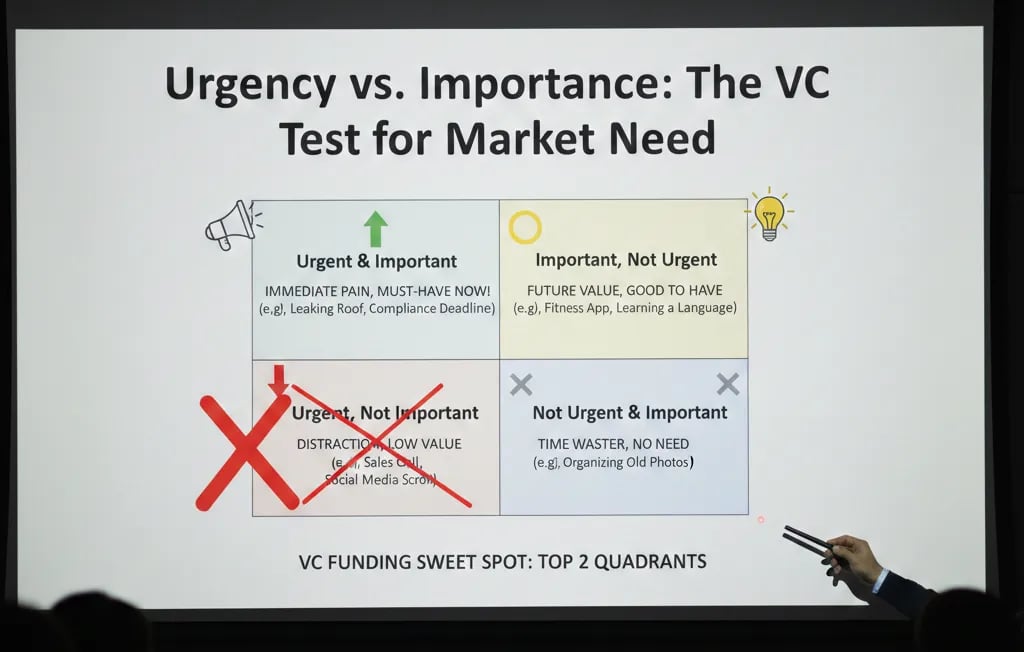
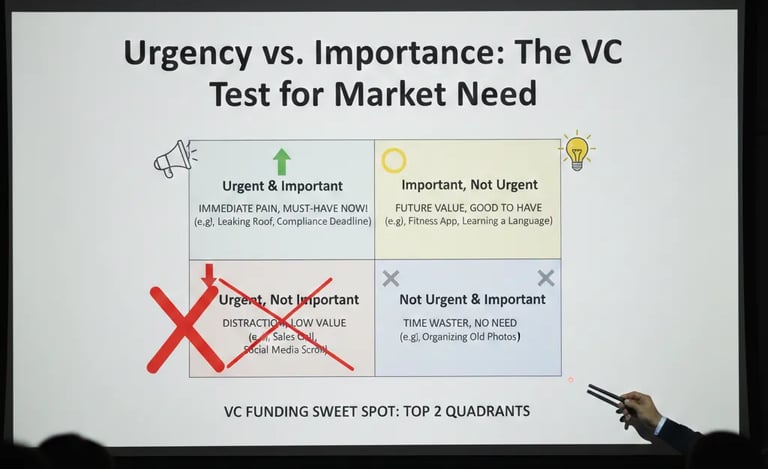
Most Founders Die Pitching "Important" Problems VCs Won't Fund
Your problem is real. Your market is massive. Your solution is elegant. And you will fail to raise Series A.
The error is structural: you are selling importance when investors buy urgency. This distinction kills more pitches than bad unit economics, and most founders never see it coming. This is part of the foundational architecture for building a problem slide that passes institutional investor scrutiny, and the gap between what you think matters and what actually closes a term sheet is wider than your current burn rate suggests.
Here is the diagnostic truth: VCs do not invest in problems people "should" care about. They invest in problems people pay to solve today, regardless of whether that behavior is rational, efficient, or moral. If your deck leads with societal impact, future consequences, or logical imperatives, you are pre-disqualifying yourself from 80% of institutional capital.
Why "Important But Not Urgent" Problems Destroy Series A Conversations
When a partner sees a problem slide built on importance, they perform a silent calculation: How many years until this company generates venture-scale returns? If the customer does not feel pain right now, the answer is "too many."
The Red Flag Scenario: Your slide reads "Healthcare costs are rising 8% annually" or "Data breaches cost companies $4.5M on average." Both statements are true. Both are important. Neither demonstrates urgency. The VC's internal monologue: "This founder has confused a macro trend with a buying trigger. They will spend 18 months in sales cycles explaining why prospects should care, then run out of runway before product-market fit."
The Psychological Audit: Founders make this error because they are solving problems they care about, not problems customers pay to escape. You have confused your personal conviction with market demand. Worse, your advisors—often ex-operators who built in different market conditions—reinforced this by praising the "vision." Vision does not close ARR. Urgency does.
The operational reality: important problems attract grants, academic interest, and conference speaking slots. Urgent problems attract revenue. VCs fund the latter because returns come from cash flow, not applause.
Why Urgency Compresses Sales Cycles by 70%
Urgency is not subjective. It is measurable by one variable: Time-to-Close. If a customer does not perceive the problem as urgent, your sales cycle extends, your CAC inflates, and your LTV:CAC ratio collapses below the 3:1 threshold that Series A investors require.
Here is the compression model:
Urgent Problem: Customer perceives immediate financial or operational threat. Decision-maker has budget authority. Typical SaaS sales cycle: 30-45 days.
Important Problem: Customer agrees problem exists but does not feel acute pain. Decision requires committee consensus and budget reallocation. Typical sales cycle: 90-180 days.
Impact on Unit Economics: A 3x longer sales cycle means 3x higher CAC (sales salary, marketing spend, opportunity cost). If your CAC is $15K for an urgent problem, it becomes $45K for an important one. At $50K ACV, your LTV:CAC drops from 10:1 to 3.3:1.
The Equity Cost: Extending your sales cycle by 90 days adds $250K-$500K in burn (depending on team size). That is an additional 2-3% equity dilution at Series A. Over three fundraising rounds, choosing an "important" problem instead of an "urgent" one costs founders 6-10% of their cap table.
This is why experienced investors pattern-match: they have seen 200 "important problem" decks, and 190 of them ran out of money before achieving product-market fit.
How to Reposition Your Problem Slide
The fix requires surgical precision. You are not changing your product; you are changing the emotional trigger that precedes the buying decision.
Step 1: Identify the Proximate Pain
Investors do not fund solutions to distant consequences. They fund solutions to today's acute pain. Your problem slide must answer: "What specific operational or financial pain does the customer feel this quarter if they do nothing?"
Weak Version: "Small businesses lose customers due to poor online presence."
VC-Ready Version: "Local retailers lose 40% of walk-in traffic in 90 days after Google penalizes their mobile site speed, and most discover the penalty only after revenue drops."
The difference: the second version includes a timeline (90 days), a measurable consequence (40% traffic loss), and an urgency multiplier (they do not know until it is too late).
Step 2: Quantify the "Do Nothing" Cost
Urgency is the difference between the cost of solving the problem and the cost of not solving it. If doing nothing is cheaper, you do not have an urgent problem.
Your formula: Daily Revenue/Efficiency Loss × Days Until Critical Failure
Example: "Each day this logistics company runs manual route planning costs them $2,400 in wasted fuel and overtime. Over 30 days, that is $72K—more than the annual cost of our software."
Step 3: Use the "Hair-On-Fire" Test
Show your problem slide to a potential customer. If they do not ask "How fast can we implement this?" within 60 seconds, your problem is not urgent. Redesign.
Step 4: Separate Market Size from Market Urgency
Do not conflate TAM with urgency. A $10B market with 2% urgent buyers (customers who will purchase this quarter) is a $200M urgent market. That is your real TAM for the next 18 months. VCs model on urgent buyers, not eventual addressable buyers.
The Before/After Comparison:
Before: "Problem: 68% of mid-market companies struggle with data silos."
After: "Problem: When a compliance audit hits, mid-market finance teams spend 120+ hours manually reconciling data across 8 systems. Miss the deadline, face $500K in penalties. 40% of our target customers are currently under audit or expect one within 6 months."
The second version passes the urgency test because it includes a forcing function (audit deadline), a quantified pain (120 hours, $500K penalty), and a time-bound market segment (40% in the next 6 months).
Common Urgency Positioning Mistakes That Still Kill Your Raise
Mistake 1: Confusing Frequency with Urgency
Saying "This happens every day" does not create urgency. Customers tolerate daily annoyances indefinitely. Urgency requires a breaking point—a threshold where the pain becomes intolerable or financially catastrophic.
Mistake 2: Over-Indexing on Future Consequences
"If this trend continues, by 2030..." is a non-starter. VCs invest in 7-10 year horizons, but customers buy on 90-day decision cycles. If the pain is not acute now, your GTM will stall.
Mistake 3: Assuming Importance Creates Urgency
Climate change is existentially important. But most climate tech startups fail because enterprise buyers do not feel urgent pain today. Urgency requires personal, immediate, measurable consequences—not civilizational ones.
The Capital Efficiency Outcome: What Fixing This Unlocks
Repositioning your problem slide from "important" to "urgent" does not just improve your deck aesthetics. It compresses your sales cycle, reduces CAC by 40-60%, and signals to investors that you understand how enterprise buyers actually make decisions.
The valuation delta: A startup with a 45-day sales cycle and 5:1 LTV:CAC will command a 30-50% higher pre-money valuation than an identical company with a 120-day cycle and 2.5:1 ratio. On a $10M Series A, that is $3-5M in valuation uplift—or 6-10% less dilution.
This is the architecture that separates funded founders from those who "had a great idea but couldn't get traction." The complete system for building investor-grade problem and solution slides includes the urgency positioning framework, the VC red flag audit, and the emotional trigger sequence that converts pitch meetings into term sheets.
The Efficiency Shortcut: You can spend 60 hours reverse-engineering how top-quartile founders position urgency, or you can access the exact framework Series A investors use to evaluate market need. The Series A Execution Blueprint includes the slide-by-slide VC instruction guide, the urgency positioning templates, and the 16 AI prompts that generate investor-grade problem slides in 15 minutes. $497. Built to replace the $5K consultant most early-stage founders cannot afford.
Funding Blueprint
© 2026 Funding Blueprint. All Rights Reserved.