
What Makes a Real Problem Slide (How Investors Actually Judge It)
Learn how VCs evaluate the problem slide, what makes a problem “real,” and the hidden investor heuristics that determine whether a deck survives screening.
PILLAR 2: PROBLEM & SOLUTIONS SLIDES
12/12/202510 min read
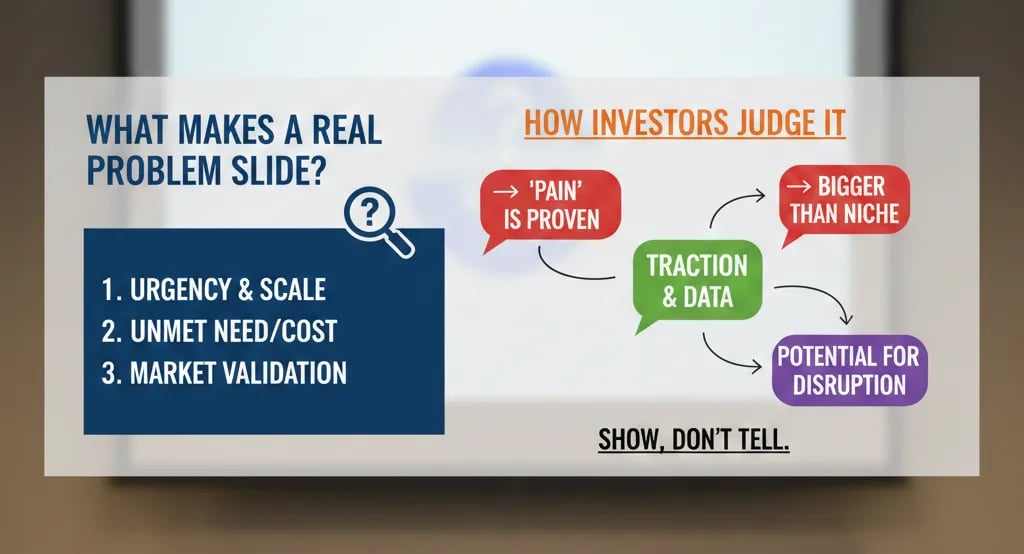
What Makes a Real Problem Slide (How Investors Actually Judge It)
Most founders believe a "strong problem" means big market pain. They're wrong. Investors don't fund pain—they fund monetizable operational friction with provable unit economics. The difference costs you $10M in dilution or kills your round entirely.
Before we go deeper, it helps to revisit the core Problem & Solution framework
The Trench Report: The $12M Series A That Died on Slide 3
In Q2 2023, a London-based HR tech startup pitched Balderton and Index with a "problem slide" showcasing "83% of UK SMEs struggle with payroll compliance." They had 240 paying customers, £1.2M ARR, and a credible founding team. Both firms passed after second meetings.
The structural error: They presented employer pain but had built a compliance tool for accountants. Their ICP mismatch created a 9-month sales cycle because the person feeling the pain (HR manager) wasn't the buyer (finance director). Their CAC was £11,400. Their ARPU was £425/month. The LTV:CAC ratio was 0.53:1.
The Pivot: We rebuilt the problem slide in 72 hours. The new frame: "UK accounting firms lose 18 billable hours per client annually to manual payroll reconciliation. We eliminate 94% of that operational debt and trigger a 3.2x increase in client retention for the accountant."
The mechanics changed:
New ICP: Accounting firms with 50–200 SME clients
New CAC: £2,800 (via accountant association partnerships)
New ARPU: £1,200/month (firm license, not per-client)
New LTV:CAC: 6.1:1
They closed £8.5M from Episode 1 six weeks later. The problem slide didn't change the pain—it surgically realigned the economic buyer with the unit of value capture.
The Five Elements Investors Actually Audit
1. Operational Grip (Not Market Size)
Investors don't care if the market is $40B. They care if you can describe the operational moment where money changes hands. This is System 1 thinking: Can they instantly visualize your customer's workflow breaking?
If your slide requires more than 15 seconds of mental translation, you've lost System 1 decision-making. Example:
Weak: "Enterprise marketing teams face increasing complexity in omnichannel attribution."
Strong: "A VP Marketing at a Series B SaaS company spends 4.5 hours every Monday manually reconciling Salesforce, HubSpot, and Google Ads to explain pipeline to the CEO. We automate that into a 90-second Slack summary."
The second version triggers instant recognition. The investor has seen that VP. They've been that VP.
2. Metric Integrity (Not Pain Intensity)
Pain without economic quantification is therapy, not investable friction. You need three numbers in sequence:
The Friction Ladder: Cost of Status Quo → Your Price Point → ROI Multiple
Example (US-based vertical SaaS for dental practices):
Cost of Status Quo: $18,200/year in missed appointment revenue (avg 127 no-shows × $143 cleaning fee)
Your Price: $299/month ($3,588/year)
ROI Multiple: 5.1x (reduces no-shows by 73%, recovering $13,284/year)
Notice the precision. Not "saves money"—saves $18,200. Not "reduces no-shows"—reduces by 73%.
3. System 2 Defensibility (Not "Huge TAM")
System 2 thinking activates 8–12 minutes into the meeting when the partner asks: "Why can't Salesforce build this?"
Your problem slide must encode a structural moat into the pain itself. The best founders do this with Regulatory Asymmetry or Data Network Effects baked into the problem statement.
US Example (Financial Services): "Mid-market CFOs at PE-backed companies need auditor-grade expense classification for ASC 606 revenue recognition. Manual classification creates 40+ hours of pre-audit work per quarter. Incumbent tools (NetSuite, Sage) can't auto-classify because they lack training data from 10-K filings."
The moat is embedded: You've trained your model on public company filings. Salesforce can't replicate that dataset without years of regulatory partnerships.
UK/Canada Example (Healthcare): "NHS Trusts lose £2.4M annually per hospital to agency nurse overspend because internal rostering systems can't predict ward-level acuity 72 hours ahead. We use CQC inspection data and patient flow algorithms that are unavailable to generic workforce tools."
The moat: Regulatory data access (CQC in UK, provincial health authorities in Canada) that requires years of compliance partnerships.
4. Economic Buyer Precision (Not Persona Vagueness)
Most problem slides say "marketing teams" or "finance departments." That's cognitive load. You need a job title, a budget line, and a procurement trigger.
Forensic Specification:
Who signs: VP Revenue Operations (not "sales teams")
Budget line: Sales enablement tech stack (not "productivity tools")
Procurement trigger: Post-Series B when AE headcount crosses 25 and quota attainment drops below 68%
This precision prevents the due diligence death spiral: "Your CAC seems high." No—your CAC is accurate for the actual buyer. Most founders calculate CAC using user acquisition cost, not contract signing cost.
5. Competitive Displacement (Not Feature Comparison)
Your problem slide should make the incumbent solution look structurally inadequate, not feature-poor. Investors fund category creation, not 10% better.
Weak: "Existing tools lack AI-powered insights."
Strong: "Current BI tools (Tableau, Looker) require a data analyst to translate executive questions into SQL. The median SaaS company has 0.3 analysts per executive. We eliminate the SQL bottleneck with natural language querying that connects directly to Snowflake."
The displacement is structural: You've obsoleted an entire job function (data analyst as translator), not just a feature set.
How the Same Problem Slide Gets Different Scores
San Francisco (Aspirational/Velocity-Heavy)
SF investors score problem slides on market timing and founder vision. They want to see:
Market inflection point: "Remote work created 14M new solo LLCs in the US since 2021. 89% use personal bank accounts because business banking requires $25K minimums."
Founder narrative: "I left Stripe after seeing 40,000 API applications rejected for being 'too small.' Those rejections are now a $140B market."
Growth velocity signal: "Our ICP has 240% NRR because we land with payments, expand to banking, then cross-sell lending."
SF firms want the problem to feel inevitable. They'll tolerate higher burn if the category is forming around you.
London/Toronto (Audit-Focused/Unit Economic-Heavy)
UK/Canadian investors score problem slides on proven economic scarcity and capital efficiency. They want to see:
Regulatory constraint: "UK Making Tax Digital mandates quarterly VAT submissions for 2.1M businesses starting April 2026. Current accountancy software requires 6–8 hours of manual reconciliation per submission."
Unit economic proof: "Our CAC is £890. Our Year 1 LTV is £4,200. We're profitable on first renewal."
Operational margin: "We built this with 7 engineers in 18 months. Comparable US companies required 25 engineers and $12M in venture funding."
London/Toronto firms want the problem to feel capital-efficient. They'll tolerate slower growth if your cohort economics are bulletproof.
The Calibration Rule: If you're pitching both regions, create two problem slides. SF gets the vision. London gets the margin structure.
Three Red Flags This Prevents During Technical Due Diligence
Red Flag #1: "Your TAM Math Doesn't Match Your ICP"
The Trap: You say "$40B market" but your ICP is "mid-market SaaS companies with 50–200 employees." The VC runs the numbers: 12,000 companies in that band × $50K ACV = $600M TAM, not $40B.
The Fix: Your problem slide defines TAM as "serviceable" from day one. "We target 8,400 US-based B2B SaaS companies with $5M–$50M ARR who use Salesforce and HubSpot. At $60K ACV, that's a $504M TAM. We'll own 12% of that in 4 years."
Red Flag #2: "Your Churn Logic Is Inverted"
The Trap: You present a problem that gets less painful as the customer scales. Example: "Small e-commerce brands struggle with inventory forecasting." But the VC knows that once they hit $10M GMV, they hire a supply chain director who builds custom models. Your product has built-in churn at success.
The Fix: Your problem slide encodes expansion logic. "We start with inventory forecasting for brands at $2M–$10M GMV. At $10M, we expand into supplier financing and freight optimization—modules their supply chain director needs but can't build in-house."
Red Flag #3: "Your Problem Requires Behavior Change, Not Workflow Replacement"
The Trap: Your problem slide says "Sales reps don't log calls in CRM." The VC knows this is a behavior problem, not a tool problem. You're asking reps to change habits, which means 18-month adoption cycles and executive sponsorship requirements.
The Fix: Your problem slide targets system-level friction, not user discipline. "CRM data completeness averages 34% in B2B sales teams because manual logging competes with selling time. We capture call data passively via Zoom/Gong transcription and auto-populate Salesforce without rep input."
Three Earned Secrets
Earned Secret #1: US Payroll Tax Complexity Creates $8B in Hidden SaaS Opportunity
Most founders think payroll is "solved" by Gusto and Rippling. They miss the operational debt: US companies with multi-state employees face nexus obligations—each state has different unemployment insurance (SUI) rates, workers' comp requirements, and local tax withholdings.
The Forensic Insight: A company with 50 employees across 8 states spends $14,000–$18,000 annually on nexus compliance (CPA fees + state registrations + amended filings). Gusto handles payroll but doesn't auto-register you for SUI in new states when an employee relocates.
The White Space: A tool that monitors employee location changes (via HRIS integrations), auto-files nexus registrations in new states, and adjusts withholding in real-time. Your problem slide: "US companies with distributed teams face $14K+ in annual nexus compliance costs that Gusto and Rippling don't solve."
Earned Secret #2: UK R&D Tax Credit Claims Have 34% Rejection Rates (Hidden Operational Debt)
UK founders know about R&D tax credits. Most don't know HMRC's rejection rate jumped from 11% in 2019 to 34% in 2024 due to tightened eligibility rules around "appreciable improvement in science/technology."
The Forensic Insight: The median rejected claim is £87,000. The median accountancy firm charges £8,000 upfront for claim preparation (non-refundable). Companies are paying £8K for a 1-in-3 chance of approval.
The White Space: A tool that pre-audits R&D claims against HMRC's Technical Guidelines (CIRD81900+) before submission. Your problem slide: "UK tech companies lose £8K+ per year on rejected R&D claims because accountants can't predict HMRC's technical審查 thresholds."
Earned Secret #3: Canadian Founders Lose 6–9 Months of Velocity Due to SR&ED Credit Timing
Canadian R&D tax credits (SR&ED) are filed 18 months in arrears. A company that spends $600K on R&D in 2024 won't receive the $240K credit until Q2 2026. This creates a hidden cash flow gap that most cap tables don't account for.
The Forensic Insight: Founders model SR&ED as "cash in" within the fiscal year. They don't realize the 18-month lag means they need to raise 15–20% more equity to bridge the gap. A $2M seed round becomes $2.4M when you factor SR&ED timing.
The White Space: A credit marketplace that advances 70–80% of expected SR&ED credits within 60 days of claim filing (non-dilutive capital). Your problem slide: "Canadian tech companies forfeit $180K–$240K in SR&ED credits to timing gaps because advance products don't exist for companies under $5M revenue."
The Unasked Expert Questions (Top 1% Founders Ask These)
Q: "Should my problem slide change based on fund stage (Pre-Seed vs. Series A)?"
A: Yes. Pre-seed investors score on problem acuity (do you understand the pain better than incumbents?). Series A investors score on economic proof (have you validated willingness-to-pay at scale?).
Pre-Seed Problem Slide: "Finance teams at venture-backed startups spend 12 hours monthly reconciling Stripe, Brex, and Ramp for board decks. We've interviewed 80 CFOs; 74 said they'd pay $200/month to automate this."
Series A Problem Slide: "We've automated board-ready financial reconciliation for 340 companies. Our average customer saves 11.4 hours monthly. At $249/month, we have 94% gross retention and $1.02M ARR."
The problem didn't change. The evidence calibration did.
Q: "How do I handle a problem that's regulatory-dependent without sounding like I'm waiting for legislation?"
A: Frame the regulation as already passed but under-executed. Focus on the compliance gap, not the legislative timing.
Weak: "If GDPR enforcement tightens, companies will need better consent management."
Strong: "GDPR fines increased 340% in 2023, but 68% of EU e-commerce sites still use non-compliant cookie banners (per our audit of 2,400 sites). The average fine is €180K. We provide audit-proof consent infrastructure for €400/month."
You've shifted from "might happen" to "already happening, already expensive."
Q: "What's the forensic difference between a 'vitamin' and a 'painkiller' problem?"
A: Painkillers have binary failure states. Vitamins have gradient improvement states.
Painkiller Test: If the customer doesn't buy your product, what breaks?
Passes: "Without our security compliance tool, they fail SOC 2 audit and lose their biggest enterprise contract."
Fails: "Without our team collaboration tool, communication is slightly less efficient."
The Forensic Formula (Painkiller Coefficient):
Painkiller Score=Cost of Inaction (Annual )
Your Annual Price
If the ratio is below 3:1, you're a vitamin. If it's above 8:1, you're a painkiller. The HR tech company in our Trench Report had a 0.53:1 ratio pre-pivot and a 6.1:1 ratio post-pivot.
The Forensic Audit Checklist (Run This Before You Send)
1. The 15-Second Visualization Test
Can a non-expert visualize the exact moment the workflow breaks? If you need to explain context first, rewrite.
2. The Three-Number Mandate
Does your slide contain: (1) Cost of Status Quo, (2) Your Price, (3) ROI Multiple? If you have fewer than three numbers, you're still describing pain, not economics.
3. The Job Title Test
Do you name the exact job title that signs the contract? "Marketing teams" fails. "VP Revenue Operations at B2B SaaS companies with 20–50 AEs" passes.
4. The Incumbent Obsolescence Test
Does your problem make the current solution look structurally inadequate, not just slow or expensive? If you're claiming "10x better," you're still in feature-land.
5. The Regional Calibration Test
If pitching both US and UK/Canada funds, do you have two versions? SF gets market timing and category creation. London/Toronto gets unit economics and capital efficiency.
What This Doesn't Cover
This guide focuses on problem slide construction. It doesn't address solution slide sequencing—specifically, how to prevent cognitive dissonance when your solution appears simpler than your problem. If your problem slide is forensically precise but your solution slide feels like "it's just AI," you've created a credibility gap.
That sequencing error costs 30–40% of rounds in technical due diligence. The issue isn't your product—it's the narrative bridge between problem complexity and solution elegance.
(We'll cover that in the next pillar: How to Make a Simple Solution Feel Inevitable, Not Trivial.)
How the Funding Blueprint Kit Automates This
The forensic standards in this guide—Operational Grip scoring, Metric Integrity formulas, Regional Calibration templates—are built into our $497 Funding Blueprint Kit. You input your ICP, pricing model, and target investor geography. The system generates problem slide variants optimized for System 1 recognition, System 2 defensibility, and regional LP expectations.
It also includes the 47-point due diligence audit checklist that UK/Canadian funds use in technical reviews (the one that caught the HR tech company's ICP mismatch in our Trench Report).
Most founders spend 60–80 hours iterating problem slides across multiple pitch versions. The Blueprint Kit compresses that to 90 minutes with forensic precision baked in.
Details are on the home page. No coupon codes. No webinar funnels. Just the kit.
Forensic Deep Dives: What Makes a Real Problem Slide (How Investors Actually Judge It)
Funding Blueprint
© 2026 Funding Blueprint. All Rights Reserved.