
5 Key Elements Every Pitch Deck Solution Slide Must Include
Stop listing features. VCs demand a "Mechanism Statement" and a "Quantified Problem Link." Discover the 5 elements that turn a product into a fundable thesis.
2.3 HOW TO FRAME THE SOLUTION SLIDE (WITHOUT OVERCLAIMING)
2/18/20266 min read
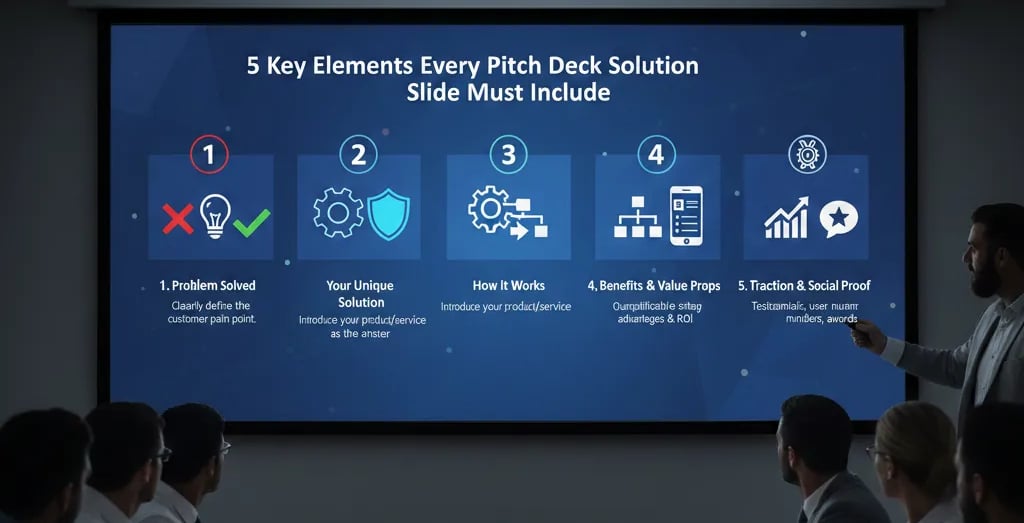
5 Key Elements Every Pitch Deck Solution Slide Must Include
$6.8M is the median Series A check size in the UK as of early 2026. A partner deploying that capital has, on average, 11 minutes of focused attention to give your deck before an internal filter decision is made. In those 11 minutes, your Solution Slide carries more decisional weight than any other single slide in the deck — more than traction, more than team, more than financials. Not because VCs are irrational, but because the Solution Slide is the first place they test whether your thinking is structurally sound. If the five load-bearing elements are missing, the rest of the deck is arguing on a cracked foundation. If you have not yet audited the problem framing that feeds into your solution, what makes a real Problem Slide and how investors actually judge it is the prerequisite layer before this diagnostic applies.
Why a "Good Enough" Solution Slide Is Quietly Killing Your Series A Process
The dangerous decks are not the obviously broken ones. A founder who submits a four-bullet feature list as their Solution Slide will get early, corrective feedback. The dangerous version is the slide that looks complete — it has a headline, a short paragraph, maybe a product screenshot — but is missing one or two structural elements that a VC needs to build conviction. That slide will not generate a hard pass. It will generate soft silence: a second meeting that never gets scheduled, a follow-up email that arrives with a politely terminal question.
The structural incompleteness is almost never intentional. Founders who have built a real product and are approaching Series A genuinely believe their slide communicates more than it does, because they are reading it with 24 months of context the VC does not have. The slide feels complete because the founder fills the gaps automatically. The VC cannot do that. What the founder experiences as a clear solution statement, the investor experiences as a series of unresolved questions that accumulate slide by slide until the meeting ends without a decision.
I have reviewed nine Solution Slides this quarter where the founding team could articulate all five elements verbally but had only embedded two or three in the actual slide. In every case, the founders assumed the Q&A would carry the rest. At Series A, that assumption is a process failure — the deck must do the work before the room does.
The psychological driver here is a form of proximity bias: the closer you are to the product, the more complete the slide appears. The fix is structural, not creative. You do not need better writing. You need a checklist that operates independently of your own familiarity with the material.
The Five-Element Audit: What a VC's Analyst Checks Against Your Solution Slide in the First Pass
Before a Solution Slide reaches a partner meeting at a top-tier US or UK fund in 2026, it typically passes through an analyst pre-screen. That analyst is running an informal five-point check. Most founders have never seen this list written down. Here it is.
Element 1 — The Specific Customer Identity Not a demographic. Not a market segment. A named, recognisable customer archetype with enough specificity to imply a sales motion. "CFOs at Series B SaaS companies with 50–200 headcount" passes. "Businesses struggling with financial complexity" does not. The analyst test: can I picture the first five sales calls from this description alone?
Element 2 — The Quantified Problem Link Your Solution Slide must carry a direct, traceable reference to the specific pain identified on your Problem Slide. This is not a repetition — it is a closure mechanism. The VC needs to see that your solution surgically addresses the exact wound you opened two slides earlier, expressed in the same unit of measurement. If your Problem Slide stated that mid-market finance teams lose 12 days per month-end close, your Solution Slide must reference that 12 days explicitly and show what happens to it. If the number changes or disappears, you have introduced a narrative gap that reads as either sloppy thinking or an overclaim you quietly walked back.
Element 3 — The Mechanism Statement (One Clause, No Feature List) The mechanism is how your product delivers the outcome — not what features it contains. This is the element most commonly replaced with a feature list, which is why most Solution Slides fail the analyst check at this point. "A rules engine that sits on top of existing ERP infrastructure" is a mechanism. "Real-time AI processing, customisable dashboards, automated alerts, and multi-system integration" is a feature list that tells the analyst nothing about why the mechanism is defensible or unique. One clause. One mechanism. Anything beyond that belongs in the product appendix.
Element 4 — The Quantified Outcome This is non-negotiable at Series A. The outcome must be expressed in a metric the customer tracks in their own business — not a metric that flatters your product. Reduce, increase, eliminate, compress — all acceptable. "Cuts close cycle from 12 days to 36 hours" is an outcome. "Significantly improves operational efficiency" is a brand promise. The analyst will not model a brand promise. They will model 12 days to 36 hours, apply it to the TAM, and check whether the unit economics justify your ask.
Element 5 — The Defensibility Signal This is the element that separates a compelling solution from a fundable one. The defensibility signal answers, in one phrase, why a well-resourced competitor cannot replicate this outcome in six months. It does not need to be a full moat argument — that belongs in a later slide. On the Solution Slide, it functions as a flag: "trained on 4.2M proprietary reconciliation cases" signals a data moat. "Built on a 14-year regulatory dataset with exclusive licensing" signals a structural barrier. "Integrated at the ERP level with 18-month average onboarding depth" signals switching cost. If your Solution Slide contains none of these signals, the analyst's note will read: "differentiation unclear — hold for partner question." That note is harder to recover from than most founders realise.
The Before/After: A Solution Slide That Fails the Five-Element Audit vs. One That Passes It
Weak Version — Fails 3 of 5 Elements:
"Our platform helps finance teams automate reconciliation and close their books faster using AI. Key features include: automated matching, exception flagging, multi-ERP integration, and real-time reporting. Customers report significant time savings and improved accuracy."
Customer identity: ✗ "Finance teams" is not specific
Quantified problem link: ✗ No reference to the Problem Slide metric
Mechanism: ✗ Replaced by a four-item feature list
Quantified outcome: ✗ "Significant time savings" is not a number
Defensibility signal: ✗ Absent entirely
Analyst note: Category-generic. No differentiation case visible. Feature-led, not outcome-led.
VC-Ready Version — Passes All 5:
"We cut month-end close from 12 days to 36 hours for CFO offices at Series B SaaS companies — without replacing their existing ERP — using a reconciliation engine trained on 4.2M proprietary edge cases from 60 enterprise deployments."
Customer identity: ✓ CFO offices at Series B SaaS companies
Quantified problem link: ✓ 12 days (matches Problem Slide metric)
Mechanism: ✓ Reconciliation engine — one clause, no feature list
Quantified outcome: ✓ 36 hours
Defensibility signal: ✓ 4.2M proprietary edge cases, 60 enterprise deployments
Analyst note: Clear wedge. Quantified outcome. Data moat signal present. Advance to partner.
The character count difference between those two versions is negligible. The structural difference determines whether your deck moves forward.
Three Structural Flaws That Undermine a Five-Element Solution Slide
1. Treating the five elements as a checklist to pad, not a test to pass. Adding a weak defensibility phrase like "powered by proprietary technology" to satisfy Element 5 does not satisfy Element 5. Each element must contain a specific, falsifiable claim. A placeholder phrase is worse than an absence — it signals that the founder knows what should be there but cannot substantiate it.
2. Using different numbers on the Solution Slide than on the Problem Slide. If your Problem Slide states a 14-day close cycle and your Solution Slide promises a 36-hour resolution, the gap between 14 days and 36 hours needs to be arithmetically coherent. If it is not, the analyst will notice before the partner does. Narrative consistency across slides is not a design preference — it is a diligence signal.
3. Conflating the Mechanism with the Outcome. "Our AI engine automates reconciliation" is a mechanism statement. "Finance teams close in 36 hours" is an outcome statement. These are Element 3 and Element 4 respectively. Merging them into a single clause collapses two distinct pieces of the investment argument into one, and the VC cannot cleanly extract either. Keep them structurally separate, even in a single sentence.
What a Structurally Complete Solution Slide Does to Your Term Sheet Timeline
A Solution Slide that passes the five-element audit does not just survive analyst pre-screening — it compresses the number of clarification rounds between first call and term sheet. Every missing element generates a question in the partner meeting. Questions consume time. Time delays extend your process. Process extension in a 2026 fundraising environment — where top-tier funds are running 90–120 day diligence cycles from first call to close — is not a neutral outcome. It is a window for a competitor deck to land on the same partner's desk. For the full architecture connecting a five-element Solution Slide to the Problem Slide logic that feeds it, the complete Problem and Solution Slides system for Series A founders covers how these components function together under VC scrutiny.
Founders who have used the Slide-By-Slide VC Instruction Guide inside the $5K Consultant Replacement Kit go into partner meetings with a Solution Slide that already maps against the five-element analyst check — the same framework a pre-screen analyst at a top-tier fund uses before the deck reaches a partner. That is not a marginal improvement. That is the difference between a slide that generates questions and one that generates a second meeting. The full Kit is $497. Access the instruction guide built to the standard Series A analysts actually apply.
A Solution Slide is not a product description. It is a structured argument. Structure it accordingly.
Funding Blueprint
© 2026 Funding Blueprint. All Rights Reserved.