
VC Psychology by Funding Stage: What Investors Actually Care About
Are you pitching Series A metrics with Pre-Seed emotion? Stop burning the VC's $47K/hour clock. Discover exactly what investors care about by stage.
2.5 PROBLEM/SOLUTION SLIDES BY STAGE: PRE-SEED → SEED → SERIES A
2/23/20266 min read
VC Psychology by Funding Stage: What Investors Actually Care About
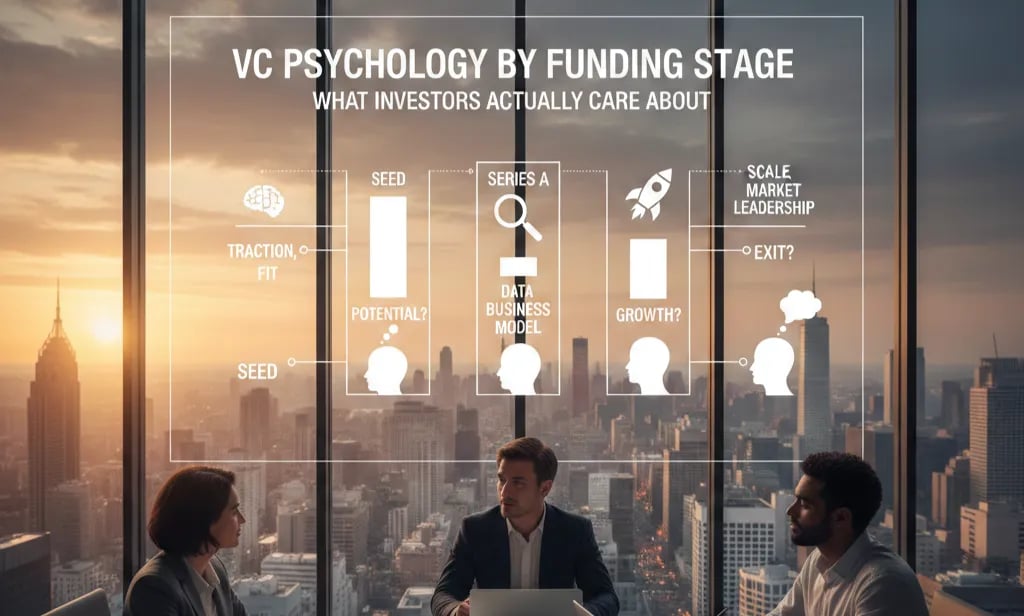
$47,000. That is the average cost-per-hour of a partner's time at a top-quartile US venture fund, once you factor in fund size, management fees, and the opportunity cost of a missed allocation. Every slide you show them that does not match what they are psychologically primed to care about at that specific stage burns that clock — and they will not tell you why they stopped reading. This is not about polish or persuasion; it is about understanding that VC decision-making is stage-gated, and the criteria shift more dramatically between rounds than most founders recognise. That structural reality is the same psychological foundation underpinning the stage-specific Problem and Solution slide framework from Pre-Seed through Series A. Miss the gate, and a genuinely strong business gets filed under "interesting but not for us."
The Cognitive Filter Every VC Runs Before They Finish Your Executive Summary
Investors do not evaluate all decks on the same psychological axis. The error founders make is treating fundraising as a single persuasion exercise, when it is actually three distinct exercises — one per stage — each requiring a different primary proof object.
At Pre-Seed, the investor's dominant psychological question is: Do I believe this founder sees something others have missed, and can they make me believe it in under ten minutes? Evidence is thin by design. The VC is buying a person and a hypothesis. The Problem slide must demonstrate insight density, not data density.
At Seed, the question shifts: Is there a real customer with a real problem, and has this team shown they can extract signal from chaos? The investor now needs early demand proof — not scale, but direction. They are looking for evidence of founder-market fit expressed through customer behaviour, not founder conviction alone.
At Series A, the filter changes entirely: Can this business repeat its early wins at scale, and do the unit economics hold under pressure? The psychological posture of a Series A partner is closer to a stress-tester than a believer. They are not hoping to be convinced; they are actively hunting for the reason to pass.
In a deck reviewed last quarter, a founder with genuine $900K ARR presented their Problem slide using emotional narrative framing appropriate for a Pre-Seed raise — the Series A partner's notes from the call contained one phrase: "not commercially fluent." The business was real. The stage signal was wrong.
The psychological trap most founders fall into is called stage projection: they raise at a higher stage while still communicating at the emotional register of a lower one, or they over-engineer early-stage decks with Series A data language that reads as compensatory rather than earned.
Mapping VC Risk Appetite to the Specific Proof Objects That Neutralise It
As of Q1 2026, the median Series A pre-money valuation in the US sits at $22M–$28M for B2B SaaS, down from the 2021 peak of $35M–$45M. That compression is not just a valuation story — it is a psychology story. Funds that deployed aggressively in 2020–2022 are now managing troubled portfolios and have recalibrated their internal risk tolerance upward. The result: Series A partners in 2025–2026 require a higher evidentiary threshold at every stage below them, because their LPs are asking harder questions about entry discipline.
Here is what that means in stage-specific proof object terms:
Pre-Seed — The Proof Object is Insight Sharpness
What the VC is measuring: Can this founder articulate a non-obvious problem with precision?
What kills the raise: Generic problem statements ("businesses struggle with inefficiency") that signal the founder has not done primary discovery.
Psychological read when it fails: This founder is solving a problem they imagined, not one they found.
Seed — The Proof Object is Demand Signal Validity
What the VC is measuring: Have real buyers expressed preference through behaviour, not just a survey?
Minimum threshold in 2025: 20–40 qualified customer conversations with documented pain points, plus at least one of: LOIs, paid pilots, or pre-revenue contracts.
Psychological read when it fails: The founder knows the problem exists but cannot prove others agree enough to pay.
Series A — The Proof Object is Repeatable Revenue Architecture
What the VC is measuring: Is the go-to-market motion reproducible by a team, or dependent on the founder's personal network?
What kills the raise: CAC that is declining but driven entirely by founder-led sales. No sales hire. No documented playbook.
Burn Multiple benchmark: Top-tier US funds in 2025–2026 are flagging any Series A with a burn multiple above 2.0x as requiring explicit justification. The 2021 tolerance for 3.5x–4.0x is gone.
Psychological read when it fails: This looks like a consulting business, not a scalable software company.
The equation is blunt: Stage Risk = Proof Gap × Check Size. As the check grows, the acceptable proof gap shrinks. A $500K pre-seed bet on a hypothesis is rational. A $7M Series A bet on the same hypothesis is a career risk for the partner.
The Stage-Appropriate Positioning Protocol: Translating VC Psychology Into Slide Architecture
Knowing what investors care about is insufficient if you cannot translate it into the specific language and structure of your deck. Here is the operational fix, stage by stage.
Pre-Seed: Build for Belief, Not Evidence
Weak Version: "Small businesses struggle to manage their finances efficiently. Our software simplifies bookkeeping." This is a category, not an insight. Every VC has seen three versions of this sentence before 9am.
VC-Ready Version: "Solo-operator service businesses — plumbers, electricians, independent contractors — are the last buyer segment still reconciling revenue manually, because every existing bookkeeping tool was designed for office workers who can sit at a screen for 20 minutes. We discovered this across 34 in-person interviews in three US cities. The average operator loses $600/month in uninvoiced work because their reconciliation happens three weeks late." That is a specific buyer, a non-obvious insight, and field evidence. It reads like a founder who found a problem, not one who invented one.
Seed: Build for Signal, Not Scale
At Seed, your Problem slide must reference a buyer segment narrow enough that a VC can mentally picture the specific human experiencing the pain. Your Solution slide must reference what customers have already done in response to the problem — including the workarounds they use now, which validates that the problem is worth solving.
Framework: The Workaround Test. If you cannot name the manual, expensive, or inferior alternative your target customer is currently using, your Problem is not validated at Seed standard. Validated problems always have bad current solutions. State what the bad current solution is, what it costs in time or money, and why it persists.
Series A: Build for Repeatability, Not Vision
Your Solution slide at Series A must answer one question in its first three seconds: who sold this to who, and can someone other than the founder do it again? If your case studies all involve founder-led sales with personal introductions, your Solution slide is hiding a GTM risk that the VC's analyst will find in due diligence regardless.
Structure your Series A Solution slide to show: customer segment acquired → channel used → CAC by channel → time-to-value → NRR at 12 months. That is not a slide. That is a proof of repeatability expressed in the language a Series A partner's psychological filter is trained to recognise.
Four Stage-Psychology Errors That Kill Rounds Even When the Business Is Fundable
1. Emotional register mismatch. Using vision-heavy, inspirational language at Series A reads as a founder who cannot switch from storytelling to commercial fluency. Series A partners are not moved. They are suspicious.
2. Proof object substitution. Substituting media coverage for customer evidence at Seed, or customer count for revenue quality at Series A. These are not equivalent. VCs know the difference immediately.
3. Premature sophistication. Adding LTV/CAC ratios, cohort charts, and NRR data to a Pre-Seed deck does not make you look further ahead. It makes you look like you have been coached to perform a stage you have not earned. The data is thin, and thin data with complex framing is worse than honest early-stage simplicity.
4. Ignoring the risk recalibration of 2024–2026 vintage funds. The psychological posture of VCs right now is not 2021. Founders still pitching with the energy and evidence standards of that era are meeting a room that has been burned and is protecting itself. Match the room.
The Financial Consequence of Getting Stage Psychology Right
Founders who correctly calibrate their deck's psychological register to the specific cognitive filter of their target stage investor do not just get more meetings. They get faster processes, fewer due diligence surprises, and partner rooms where the primary question is valuation — not whether the business is real. That shift alone is worth a measurable improvement in pre-money negotiating position, because the VC is no longer discounting for perceived stage immaturity.
For the complete structural system — including how to build Problem and Solution slides that embed stage-appropriate psychology into every sentence — the full framework is in the Problem and Solution Slides master guide. That is the architecture behind everything covered here.
Founders who have used the Slide-By-Slide VC Instruction Guide inside the $5K Consultant Replacement Kit go into partner meetings with a deck already calibrated to what the VC's analyst will check against at that specific stage — the proof objects, the language register, the evidence thresholds. That is not a marginal edge in a process where most decks fail before slide 6. The full Kit is $497, available at the stage-calibrated investor-ready deck system at FundingBlueprint.
Funding Blueprint
© 2026 Funding Blueprint. All Rights Reserved.