
Problem/Solution Slides by Stage: Pre-Seed → Seed → Series A
Learn how VCs judge problem and solution slides differently at Pre-Seed, Seed, and Series A — and how founders should adjust emphasis, proof, and framing.
PILLAR 2: PROBLEM & SOLUTIONS SLIDES
12/13/202511 min read
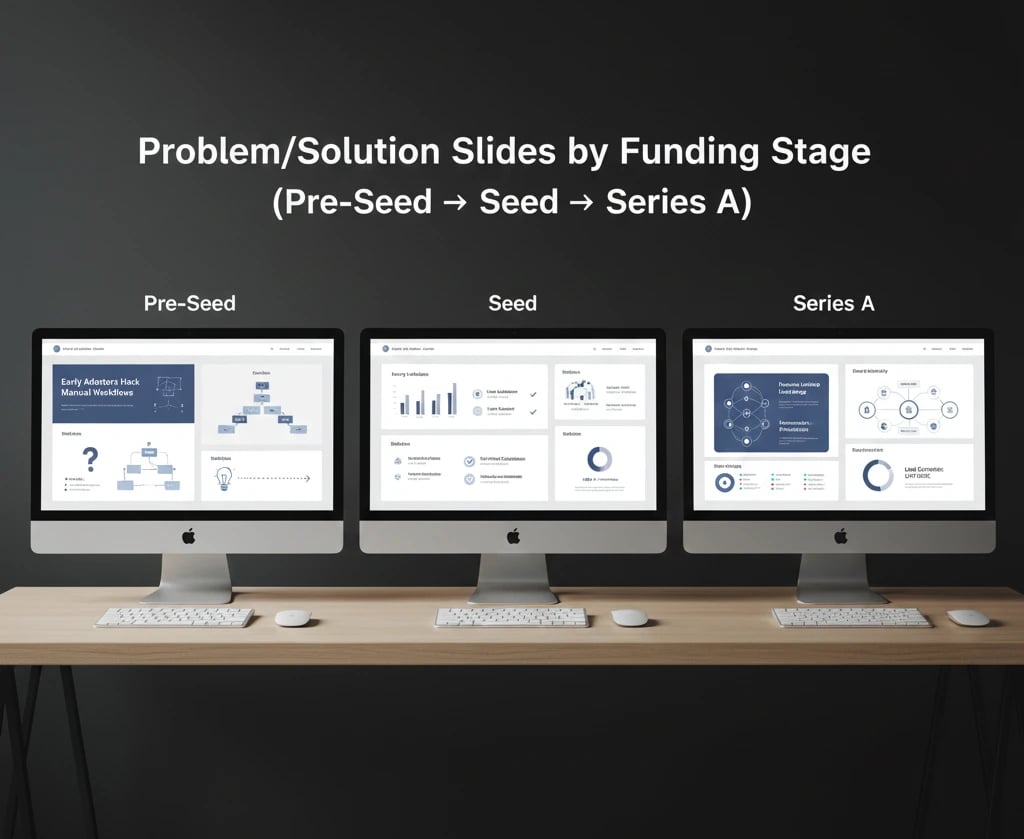
Problem/Solution Slides by Stage: Pre-Seed → Seed → Series A
The Forensic Breakdown No One Sends You Before the Partner Meeting
Your Problem Slide Is Not a Story. It's a Legal Argument.
Most founders treat the Problem slide like an opening monologue. They treat the Solution slide like a product demo. Both instincts are wrong, and they are costing fundable companies their rounds.
The Problem slide is a burden of proof. The Solution slide is your prima facie case. Each stage of fundraising demands a materially different standard of evidence — and the founders who miss this distinction don't fail because their business is weak. They fail because their evidentiary framework is stage-mismatched.
At Pre-Seed, you are arguing that a gap exists. At Seed, you are arguing that your wedge fits the gap. At Series A, you are proving the machine that fills the gap at scale is already running. These are three different legal arguments. They require three different slide architectures.
What follows is not a slide design tutorial. It is a forensic dissection — built from deals won, deals lost, and the specific structural errors that made the difference.
Before we go deeper, it helps to revisit the core Problem & Solution framework
The Trench Report: The $14M Seed Round That Almost Didn't Close
The deal: A London-based B2B SaaS company (vertical: construction compliance) had a genuinely strong product. ARR at the time of raise: £680K. NRR: 118%. The founding team had prior exits. On paper, a clean Seed round.
The structural error: Their Problem slide led with macroeconomic framing — "The UK construction sector loses £12B annually to compliance failures." The Solution slide followed with a product walkthrough. Classic. Also, clinically wrong for the stage.
Three London-based Seed funds passed in the first two weeks. The feedback was almost identical across all three: "We don't understand who specifically is in pain, and we don't understand what you replace."
The problem wasn't the business. It was that the Problem slide argued at the sector level when it needed to argue at the operator level. No named persona. No described workflow. No quantified cost to a specific job title on a specific day.
The pivot: We stripped the macro stat entirely and replaced the Problem slide with a single reconstructed day-in-the-life for a Site Compliance Manager at a Tier 2 UK contractor. Three tasks. Three failure points. Each one costed in time and liability exposure. The Solution slide then mapped directly — not to features, but to intervention points in that exact workflow.
The forensic formula applied:
Cost of Problem (Operator Level) = (Hours Lost Per Incident × Hourly Burdened Rate) + (Regulatory Fine Exposure × Incident Frequency)
For their persona: 4.5 hrs × £85/hr + £8,400 average fine × 0.3 incidents/quarter = £2,906/quarter per site manager — a number they could defend with real customer data.
The round closed at £11.2M (~$14M at the time). Same business. Different evidentiary structure.
Part I: Pre-Seed — Argue That the Problem Is Real
At Pre-Seed, your only job is to establish that a specific human being has a specific, recurring problem they are currently solving badly.
You have no metrics worth showing. You probably have no revenue. What you have — if you've done the work — is direct evidence from a defined cohort of potential customers.
The Problem Slide Architecture (Pre-Seed)
Lead with the persona, not the market. The slide should answer three questions in under eight seconds:
Who is in pain? (Specific role, specific sector)
What does the pain look like on a Tuesday morning?
What are they doing instead — and what does that workaround cost them?
The macro market size does not belong on this slide. It belongs on your Market slide. Conflating them inflates Cognitive Load at the exact moment you need maximum clarity.
The Solution Slide Architecture (Pre-Seed)
At Pre-Seed, your Solution slide should not describe your product in detail. It should describe the mechanism of relief. One sentence on what you do. One visual that shows the before/after state for the persona you just described. That's it.
Founders chronically over-build the Solution slide at Pre-Seed because they are proud of the product. Investors at Pre-Seed are not evaluating the product. They are evaluating your ability to identify and frame a real problem. Show discipline by showing restraint.
Part II: Seed — Prove That Your Wedge Fits
At Seed, the argument shifts. You are no longer proving the problem exists. You are proving that your specific intervention is the correct one, for the correct initial customer segment, at the correct moment in the market.
This is where most decks structurally collapse. Founders carry the same Pre-Seed problem framing into their Seed deck and simply add a metrics slide at the back. This is a Cognitive Load failure. The investor is now holding two incompatible narratives: a pre-revenue problem story and a traction slide with ARR. They don't connect.
The Problem Slide Architecture (Seed)
At Seed, the Problem slide needs to show why now. The classic "Why Now" slide is often separate, but at Seed stage, the mechanism that makes the problem acute right now should be embedded in the problem framing itself. Regulatory shift, infrastructure maturity, workforce change — whatever the catalyst is, it must appear on this slide as evidence, not assertion.
The forensic formula for "Why Now" credibility:
Problem Urgency Score = (Regulatory or Market Event Date) − (Customer's Current Contract Renewal / Budget Cycle) × (Switching Cost in $)
If the urgency is structural and near-term, the score produces a real decision window. If it doesn't, you haven't found your wedge timing yet.
The Solution Slide Architecture (Seed)
At Seed, your Solution slide must contain your ICP definition embedded within it. Not in the appendix. Not on a separate "customer" slide. The ICP is the proof that you understand who the solution is for. Without it, your solution looks generic, and generic solutions don't get funded at Seed.
The slide should also show your replacement thesis. What is the customer doing today? What do you replace, partially or fully? This matters enormously because it tells the investor your competitive surface area and your sales motion simultaneously.
Part III: Series A — Prove the Machine Is Running
At Series A, the Problem and Solution slides are not introductory context. They are the foundation of your repeatability argument.
Most Series A founders make the mistake of treating Problem/Solution as formalities — a warm-up before the metrics. In a well-built Series A deck, the Problem slide is restated at a higher resolution than Pre-Seed or Seed, because you now have customer evidence that confirms and sharpens the original hypothesis.
This is called the Evidence Loop. Your original problem hypothesis → your early customer evidence → your refined problem statement. If your problem statement at Series A looks identical to your problem statement at Pre-Seed, you haven't been learning from your customers. Investors notice this.
The Problem Slide Architecture (Series A)
At Series A, the Problem slide must do three things simultaneously:
State the problem at a resolution that only someone with operational experience in this market could articulate (Operational Grip signal)
Show the quantified cost of the problem at scale (not just per-operator, but system-wide)
Implicitly frame why the problem is structurally unsolvable by incumbents
The forensic formula for System-Level Problem Costing:
Total Addressable Pain ($) = (Cost Per Operator × Operators in ICP Tier 1) + (Downstream Cost of Unresolved Problem × Frequency × TAM Penetration %)
This is different from TAM. This is the economic cost of the problem persisting. It is a more defensible framing than top-down market sizing because it's grounded in unit-level math that you can defend in the partner meeting.
The Solution Slide Architecture (Series A)
At Series A, your Solution slide should be structured around system design, not product features. Show the architecture of how your solution creates a defensible position — network effects, data accumulation, workflow lock-in, switching costs. The investor is now evaluating whether your solution compounds over time.
San Francisco vs. London/Toronto
The same deck, presented to a Benchmark partner in San Francisco and a Balderton partner in London, needs structurally different emphasis at every stage. This is not stylistic. It is strategic.
San Francisco (System 1 Investor Profile: Aspirational/Velocity-Heavy)
SF-based investors, particularly at Seed and Series A, are calibrated toward velocity signals. They are running System 1 pattern recognition: growth rate, team pedigree, market narrative. Your Problem slide in SF should lead with magnitude — the scale of the gap — before specificity. They want to feel the size of the opportunity before they interrogate the mechanics.
Your Solution slide in SF should contain your growth architecture — how does the solution get bigger as the market adopts it? Network effects, viral coefficients, platform extension. These are System 1 signals that trigger conviction before the data room opens.
SF Velocity Signal Formula: MoM Growth Rate = (MRR_t − MRR_{t−1}) / MRR_{t−1} × 100. At Seed, anything above 15% MoM triggers a fast-track; below 10% requires a compelling narrative substitution.
London/Toronto (System 2 Investor Profile: Audit-Focused/Unit Economic-Heavy)
London and Toronto investors — particularly at Seed and Series A — are running System 2 processing by default. They are auditing your logic. Your Problem slide needs to be evidence-dense, not emotionally resonant. Named customer cohorts. Quantified pain. Cited data sources.
Your Solution slide in London/Toronto must contain your unit economics embedded within the solution framing — not deferred to a later slide. Why? Because London/Toronto investors are asking "can this unit work?" before they ask "can this scale?" Metric Integrity is the primary trust signal.
London/Toronto Unit Economic Formula: Contribution Margin per Customer = ARPU − (COGS per Customer + CAC Amortized Over Contract Length). If this number is negative at current scale, the Solution slide must explain the mechanism by which it becomes positive — and at what ARR threshold.
Three Red Flags This Framework Prevents in Technical Due Diligence
Red Flag 1: Stage-Mismatched Evidence Density A Pre-Seed Problem slide that uses market research instead of primary customer evidence fails the DD test because it signals the founder hasn't spoken to customers at depth. DD reviewers flag this as "founder hasn't validated the problem directly." Fix: Every claim on the Problem slide at Pre-Seed must trace to a specific customer conversation or behavioral observation.
Red Flag 2: Solution Without a Replacement Thesis During DD, buyers will ask: "What did customers use before?" If your Solution slide doesn't answer this — either explicitly or implicitly — the DD team will find the answer themselves, and it will almost certainly undermine your competitive positioning claim. The replacement thesis is not optional. It is structural.
Red Flag 3: Mismatched Problem/Metric Resolution At Series A, if your Problem slide describes the pain at the operator level but your metrics are aggregated at the account level, there is a resolution mismatch. DD teams catch this. It signals that your internal data architecture may not support the granular reporting you'll need post-investment. Fix: Ensure your problem framing and your metric reporting live at the same unit of analysis.
Three Earned Secrets (Not in the Standard Playbook)
Earned Secret 1: The UK EIS/SEIS "Problem Slide" Regulatory Trap In the UK, if you are raising under SEIS/EIS (Enterprise Investment Scheme), your Problem and Solution slides may inadvertently describe a business that HMRC considers a "financial instrument" or "excluded trade." This has killed EIS eligibility for at least three companies I've reviewed in the last 18 months — the framing of their "solution" as a financial risk-management tool triggered exclusion. Before finalizing your deck for a UK angel or family office raise, have an EIS counsel review slide language, not just corporate structure.
Earned Secret 2: US Hiring Friction Hidden in the Solution Slide At Series A in the US, if your Solution slide implies a heavy implementation or customer success function, tier-one VCs will run a shadow headcount model before the partner meeting. If your solution requires more than 0.8 FTE CS per $100K ARR to deliver, this is flagged as an operational scalability problem — even if your ARR growth is strong. The fix is to address this on the slide by showing your automation roadmap or your implementation-to-ARR leverage ratio explicitly. Founders who don't know this get surprised in the partner Q&A.
Earned Secret 3: The Canadian SR&ED Credit Arbitrage on Solution Architecture Canadian founders raising from US VCs frequently undervalue their SR&ED (Scientific Research and Experimental Development) tax credit eligibility — and critically, how the framing of their Solution slide affects their SR&ED claim. If the Solution slide describes the product as a "platform" rather than a series of experimental development cycles, SR&ED counsel may have difficulty claiming credits on the core R&D. The architecture of the narrative on Slide 8 has a direct downstream effect on your R&D tax credit recovery, which at Series A can represent $400K–$1.2M in recovered cash. Most US-based investors have no visibility into this, which means the founder must manage it proactively.
Expert FAQ: The Questions the Top 1% Know to Ask
Q: Should the Problem and Solution slides ever be merged into a single slide?
At Pre-Seed, occasionally yes — if the problem is genuinely novel and requires the solution to be visible before the problem makes sense (rare edge case in deep tech). At Seed and above, never. Merging them collapses the investor's System 2 processing. They need to hold the problem in working memory while evaluating the solution. Merging eliminates that cognitive step and weakens conviction formation.
Q: How do I handle a problem that is well-known but poorly solved?
This is the most common position founders are actually in, and it requires a specific rhetorical move on the Problem slide: differentiate the mechanism of failure, not the existence of the problem. Don't say "X is broken." Explain why current solutions structurally cannot fix it — the architectural constraint, the incentive misalignment, the data gap. This is what "Operational Grip" looks like to an experienced investor.
Q: At what ARR should I retire the "early customer" framing on the Problem slide?
At £500K/$600K ARR, you should be retiring anecdotal framing and replacing it with cohort-level evidence. If your Problem slide still says "one of our customers told us..." at Series A, you have a Metric Integrity problem. The language should shift to "across our first 40 accounts, the median time-to-value was X, confirming the problem severity we identified at inception."
Narrative Breadcrumb
There is a structural question this framework deliberately leaves unanswered: how do you handle the Problem/Solution slides when your ICP has shifted between Seed and Series A — which happens in roughly 60% of B2B raises?
The answer requires understanding a specific deck architecture called the "Pivot Acknowledgment Frame" — a counterintuitive slide design that turns ICP drift from a liability into a proof of learning. It is one of the most mishandled situations in fundraising, and it has a precise fix. That's a conversation worth having before your next partner meeting.
Forensic Audit Checklist: Run This Before You Hit Send
1. Stage Alignment Check Does your Problem slide use evidence appropriate to your stage? Pre-Seed = primary customer observation. Seed = cohort data + urgency catalyst. Series A = confirmed hypothesis + system-level cost.
2. Persona Resolution Check Can you name the specific job title, company size, and workflow context for the person experiencing the problem? If the answer is "multiple personas," you have a segmentation problem, not a framing problem. Solve the segmentation first.
3. Replacement Thesis Check Does your Solution slide — explicitly or implicitly — tell the investor what the customer used before you, and why that solution is structurally insufficient? If not, add it in one sentence.
4. Regional Calibration Check Are you sending this deck to investors in both the US and UK/Canada? If yes, do you have a variant that shifts emphasis from velocity framing (US) to unit economic framing (UK/Canada)?
5. Metric Resolution Check Are the metrics you cite elsewhere in the deck reported at the same unit of analysis as the problem you describe on Slide 2? If your problem is described at the user level but your metrics are at the account level, reconcile them before the DD team does it for you.
The five checks above can be run manually — but Metric Integrity failures, stage-mismatched evidence, and regional calibration gaps appear systematically across hundreds of decks for a reason: founders are building slides without a forensic structure to work against.
The $497 Funding Blueprint Kit was built specifically to automate this forensic standard — embedding stage-specific Problem/Solution templates, regional calibration variants, and the exact Forensic Formulas referenced throughout this article directly into a working system that outputs investor-grade framing at each stage. It doesn't replace judgment. It eliminates the structural errors that obscure it. Find it on the home page.
Written from partner meeting rooms in London, New York, and Toronto — where the difference between a pass and a term sheet is almost never the business. It's the architecture of the argument.
Forensic Deep Dives: Problem/Solution Slides by Stage: Pre-Seed → Seed → Series A
The Pre-Seed Problem Slide: Why It Makes or Breaks Early Pitches
Seed Stage Pitch Decks: What VCs Demand on the Solution Slide
Series A Pitch Decks: Shifting from Vision to Operational Proof
Startup Storytelling: Adapting Your Pitch Deck Narrative by Stage
Pitch Deck Stage Fit: The #1 Reason Right Ideas Fail to Raise
Reusing Pitch Decks: Why the Same Slides Fail Across Funding Rounds
VC Psychology by Funding Stage: What Investors Actually Care About
Pitch Deck Evolution: How Problem and Solution Slides Must Mature
The Stage-Adaptive Pitch Deck: A Framework for Pre-Seed to Series A
Funding Blueprint
© 2026 Funding Blueprint. All Rights Reserved.