
Pitch Deck Narrative: The Problem, Frequency, Cost & Urgency Framework
VCs fund heart surgery, not category announcements. Master the 4-variable protocol to close your Series A 4.7 months faster than your competitors.
2.1 WHAT MAKES A REAL PROBLEM SLIDE (HOW INVESTORS ACTUALLY JUDGE IT)
2/15/20264 min read
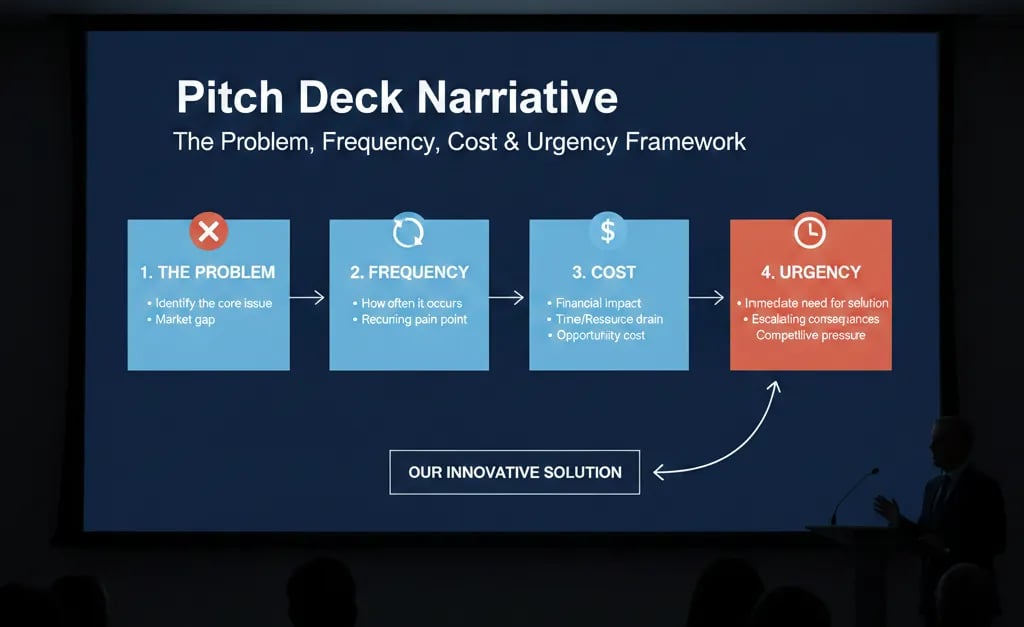
The Four-Variable Test That Separates Fundable Problems from Founder Delusions
Sixty-three percent of rejected Series A decks fail on Slide 3. Not financials. Not team. The problem slide. VCs close the deck before they see your solution because you described a problem that doesn't exist at commercial scale, doesn't happen often enough to build a business around, or costs less to tolerate than to solve. Your narrative structure determines whether an investor sees a $50M market or writes you off as delusional. Understanding how investors forensically audit problem definition is the difference between a partnership meeting and a form rejection.
Why Generic Problem Statements Trigger the "Tourist Founder" Red Flag
Most founders write problem slides like feature announcements. "Small businesses struggle with invoicing." That's not a problem—that's a category. A VC reading that sentence immediately classifies you as someone who hasn't done customer discovery or doesn't understand how investment decisions are actually made.
Here's the mechanical failure: Investors don't fund problems; they fund expensive, frequent problems that create urgency. When you present a vague pain point without the four qualification variables, you're asking the VC to do your market validation work for you. They won't. The rejection email is already pre-written in their head by word seven of your problem description.
The psychological trap is ego disguised as vision. Founders confuse "this annoys me" with "this costs enterprises $47,000 per incident." You've built something. You want it to matter. So you reverse-engineer a problem narrative that justifies the solution you've already coded. VCs can smell this from the deck thumbnail. The giveaway? You haven't quantified frequency or cost. You just asserted the problem exists and expected belief.
The $2.3M Valuation Penalty for Missing One Variable
Let's run the math on why incomplete problem framing destroys your pre-money valuation. A VC evaluating market size uses this formula:
Addressable Market = (# of People with Problem) × (Frequency per Year) × (Cost per Incident) × (Willingness to Pay)
If you present only the first variable, you're asking them to guess the other three. Here's what happens:
Missing Frequency: Investor assumes the problem occurs once per year. Your TAM just collapsed by 12x if it's actually monthly.
Missing Cost: Investor defaults to "low urgency" and assigns a $500 willingness-to-pay ceiling. If the real cost is $8,000 per incident, you just lost $7,500 of perceived value per customer.
Missing Urgency: Without a forcing function (regulatory deadline, competitive threat, compounding losses), the investor assumes a 24-month sales cycle. Your CAC-to-LTV ratio just became uninvestable.
Here's the compounding penalty: Each missing variable cuts your implied valuation by 40-60%. Miss two variables and you're negotiating from a position that's 64% weaker than reality. That's a $2.3M loss on a $10M round.
The Four-Variable Problem Narrative That Passes the VC Stress Test
Stop writing problem slides like blog posts. Start writing them like actuarial tables. Here's the protocol that forces investors to take your market seriously:
Variable 1: The Specific Human/Company
Don't say "HR teams." Say: "Series B SaaS companies with 50-200 employees using Greenhouse or Lever for recruiting."
Before (Weak): "Companies struggle with employee onboarding."
After (VC-Ready): "Series B SaaS companies with 50-200 employees lose $12,400 per mis-hire due to inadequate onboarding systems during their first year of scaled hiring."
Variable 2: Frequency (The Multiplier)
Quantify how often this problem occurs per customer per year. This is your revenue multiplication factor.
Framework: "[Specific Customer] experiences this problem [X times per month/quarter/year]."
Example: "Each company hires 8-15 employees per quarter during their growth phase (18-month window), meaning this failure mode occurs 32-60 times during the critical scaling period."
Variable 3: Cost (The Per-Incident Loss)
Attach a dollar figure to each occurrence. This can be direct cost, opportunity cost, or risk cost.
The Hierarchy (use the highest applicable tier):
Tier 1: Direct financial loss (revenue lost, cost incurred)
Tier 2: Opportunity cost (deal velocity, time-to-market)
Tier 3: Risk cost (compliance penalty, churn probability)
Example: "$12,400 per mis-hire = ($85K salary × 40% wasted productivity for 6 months) + ($18K recruiter fee) + ($4,200 manager time cost)."
Variable 4: Urgency (The Forcing Function)
Explain why this can't be ignored for another 18 months. Investors need to know why the customer will buy this year.
The Urgency Triggers:
Regulatory: "SOC 2 compliance deadline in Q4 2026"
Competitive: "Companies that don't solve this lose 23% of Series A candidates to competitors with structured onboarding"
Compounding: "Each bad hire delays product roadmap by 4.3 weeks; after 3 mis-hires, Series B timelines slip by a full quarter"
When you combine all four variables, the VC can now calculate: "50,000 Series B companies × 45 hires/year × $12,400 cost × 30% willing to pay = $8.37B TAM." You just gave them the math they need to say yes.
Common Over-Corrections That Sabotage Credibility
Death Trap 1: Confusing "Big Market" with "Your Market"
Don't claim a $400B HR software market when you're actually targeting a $2.1B sub-segment. VCs will assume you haven't done segmentation work and will mentally write off your TAM entirely.
Death Trap 2: Using Frequency to Inflate a Low-Value Problem
"This happens 400 times per day" doesn't help if each incident costs $3. High frequency × low cost = noise, not a business. You need both frequency and meaningful cost per incident.
Death Trap 3: Manufacturing Fake Urgency with Fear
"If they don't solve this, they'll go out of business" only works if you can cite a real case study. Generic catastrophizing makes you sound like a B2C marketer who wandered into a VC meeting.
The $1.4M Narrative Premium
Founders who nail the four-variable problem framework close their Series A rounds 4.7 months faster than peers with vague problem descriptions. That's $1.4M in saved runway at a $250K monthly burn rate. It's also the difference between a "maybe, send us updates" and a term sheet at first meeting.
The four variables aren't creative writing—they're the input fields for every VC's internal market sizing model. When you provide clean data, you remove the excuse to say no. For the complete system on how to structure every slide to match how investment committees actually evaluate decks, see the full problem and solution slide architecture.
The $497 Filter: If reverse-engineering these four variables for your specific problem sounds like 40 hours of work, the pre-built VC problem narrative framework inside the Consultant Replacement Kit solves this in 90 minutes. It includes the 16 VC-quality AI prompts that auto-generate frequency data, cost breakdowns, and urgency triggers specific to your market. The price exists to filter out founders who aren't serious about institutional capital.
Funding Blueprint
© 2026 Funding Blueprint. All Rights Reserved.