
The First Impression Test: What VCs Look For in 8 Seconds
You get 8 seconds to prove you aren't a "Liability." VCs don't read; they scan using a "No-First" heuristic. A forensic audit on avoiding "Suicide-by-Deck."
1.3: THE STEP-BY-STEP INVESTOR EVALUATION WORKFLOW
1/20/20264 min read
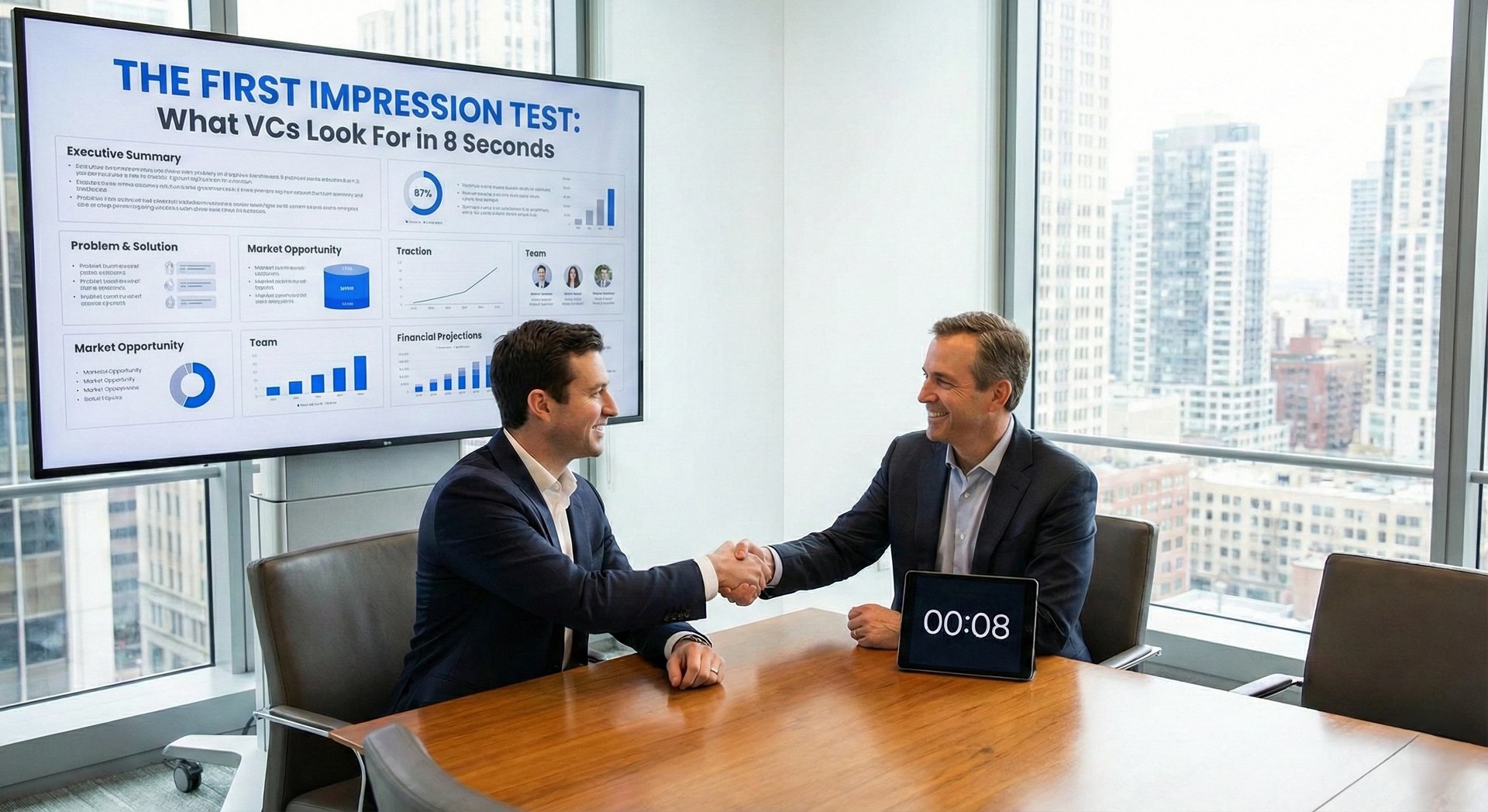
If you believe a Venture Capitalist reads your deck, you have already lost. In the Seed and Series A landscape, "reading" is a luxury reserved for the top 1% of deals that survive the initial filter.
For everyone else, there is only The Scan. Your startup is not competing for money initially; it is competing for dopamine and cognitive bandwidth. This ruthless efficiency is the first gate in The Step-by-Step Investor Evaluation Workflow (How VCs Decide What Moves Forward).
If your value proposition isn't chemically obvious within eight seconds, the analyst closes the tab. This isn't about attention span; it’s about pattern recognition. VCs operate on a "No-First" heuristic. If the first slide forces them to think, interpret, or search for the "What," they assume the business model is equally convoluted. You do not get the benefit of the doubt. You get eight seconds to prove you aren't a liability.
The Forensic Diagnosis
Why does failing the 8-second test destroy a fundraise? Because confusion is a proxy for incompetence.
When I open a deck, I am performing a forensic audit of the founder's ability to prioritize information. If I see a "Welcome" slide, a generic "Problem" statement about "The World Changing," or a wall of text describing the founder's childhood, I flag the deal as "Low Signal."
The "Red Flag" Scenario
Imagine a Slide 1 that reads: "Empowering the future of digital connectivity through decentralized infrastructure layers."
The VC Reaction: "I have no idea what you do. Are you a SaaS? A hardware play? A crypto token? I am not going to dig to find out."
The immediate assumption is that the founder lacks Product-Market Fit. If you had clear traction or a sharp problem-solution set, you would lead with it. Obscurity is the camouflage of the weak.
The Psychological Audit
Why do founders commit this suicide-by-deck?
The "Smartest Guy in the Room" Syndrome: Founders believe complexity equals sophistication. They use jargon to signal intelligence, unaware that investors view clarity as the ultimate intelligence.
Insecurity: You don't have the revenue numbers, so you overcompensate with narrative. You try to write a novel to distract from the empty Excel sheet.
The "Movie Trailer" Fallacy: You think you need to build suspense. You want to "reveal" the solution on Slide 5. There is no suspense in VC. There is only distinct data or the trash bin.
The Cost of Cognitive Load
Let’s strip away the "art" of pitching and look at the math of deal flow processing.
An average Associate at a Tier-1 fund reviews 2,000+ decks per year.
Total Working Hours: ~2,500 (optimistic).
Time allocated to initial screening: ~300 hours.
Time per deck: ~9 minutes total.
However, that distribution is not linear. It follows a Power Law.
90% of decks get < 2 minutes.
10% of decks get > 45 minutes (Deep Dive).
The "8-Second Test" is the calculation of your Signal-to-Noise Ratio (SNR).
The Cognitive Load Equation
Value =Market Opportunity X Traction
Time To Comprehend
If the Time To Comprehend approaches 30 seconds, the perceived Value drops toward zero, regardless of how big your Market Opportunity actually is.
The Logic Chain:
Input: VC eyes hit the slide.
Process: The brain attempts to categorize the business (SaaS, Marketplace, Deep Tech).
Friction: If the category is ambiguous, "System 2" thinking (effortful mental work) kicks in.
Rejection: The human brain is designed to conserve energy. It rejects high-friction inputs unless the reward (revenue) is immediately visible.
Result: If I have to burn calories to understand your business model, I assume customers won't bother at all. Your CAC (Customer Acquisition Cost) will be mathematically unsustainable because your messaging is inefficient.
The "Insider" Solution Protocol
You must restructure your deck from a "Narrative Journey" to an "Executive Dashboard." The goal is not to be read; it is to be processed.
The "Before vs. After" Comparison
The Weak Version (Death by Narrative):
Headline: "The Problem with Modern Logistics."
Body: A paragraph explaining how trucks are often empty and fuel is expensive.
Visual: A stock photo of a sad truck driver.
Result: I scan it. I see "Logistics." I see "Sad." I learn nothing specific about your specific insight.
The VC-Ready Version (The 8-Second optimize):
Headline: "40% of Last-Mile Delivery Costs are Empty Leg Miles." (Specific, quantified problem).
Sub-head: "We automate freight matching to reduce carrier opex by 22%." (Immediate solution + value prop).
Visual: A simple "Old Way" (Red, complex) vs. "New Way" (Green, linear) diagram.
Result: In 3 seconds, I know the market, the pain point, and the specific ROI.
The "Headline-Only" Framework
To pass the 8-second test, apply the Headline-Only Audit.
Strip all body text, charts, and logos from your deck. Read only the headlines of the first 5 slides in sequence.
Does it read like this?
Problem
Solution
Market
Product
Team
Or does it read like this?
Freight inefficiency is a $300B waste.
LogiTech automates load-matching in real-time.
We are capturing a $12B serviceable market in the Midwest.
Our proprietary API integrates with 90% of existing fleets.
$2M ARR growing 15% MoM.
If your headlines do not form a coherent, complete investment thesis on their own, you have failed the test. The body text is for verification, not for explanation.
The "Death Traps"
In attempting to optimize for speed, founders often swerve into over-simplification. Avoid these fatal errors:
The "Teaser" Deck Fallacy: Do not send a "teaser" that hides your metrics to "get the meeting." If you hide your revenue or retention numbers, I assume they are terrible. Transparency suggests confidence.
The Buzzword Salad: Do not try to hack the 8-second test by stuffing Slide 1 with "AI-driven," "Blockchain-enabled," and "Hyper-local." We filter for Semantic Density. Use nouns and verbs, not adjectives. "We sell CRM software to Plumbers" is infinitely better than "We empower service verticals with next-gen intelligence."
Design Overload: A "pretty" deck does not pass the test. A $5,000 designer cannot fix a broken business model. If the design distracts from the numbers, it is a liability. White background, black text, clear charts. Boring wins.
The "High-Ticket" Conclusion
Passing the 8-second test is the difference between being archived and entering the Due Diligence pipeline. It forces the investor to engage with your actual business mechanics rather than struggling to decipher your language. Fixing your first impression adds leverage to your valuation because it positions you as a high-velocity operator.
For a complete breakdown of how to structure the rest of the narrative once you've hooked them, review How VC Pitch Decks Really Work in 2026 — And Why Most Founders Get Them Wrong.
The Filter: You can spend weeks A/B testing your opening slides, or you can use "The Slide-By-Slide VC Instruction Guide" included in our $5k Consultant Replacement Kit. It contains the exact "Headline-Only" templates that force your deck to pass the 8-second heuristic. It is available for $497 on the home page for founders who understand the cost of a missed opportunity.
Funding Blueprint
© 2026 Funding Blueprint. All Rights Reserved.