
Market Pain Intensity vs TAM: What VCs Really Look For in a Pitch
VCs use a hidden formula to score your pitch. Discover how to prove high frequency, severe cost, and failed alternatives to secure your next round.
2.8 INVESTOR PSYCHOLOGY BEHIND PROBLEM & SOLUTION SLIDES
2/28/20266 min read
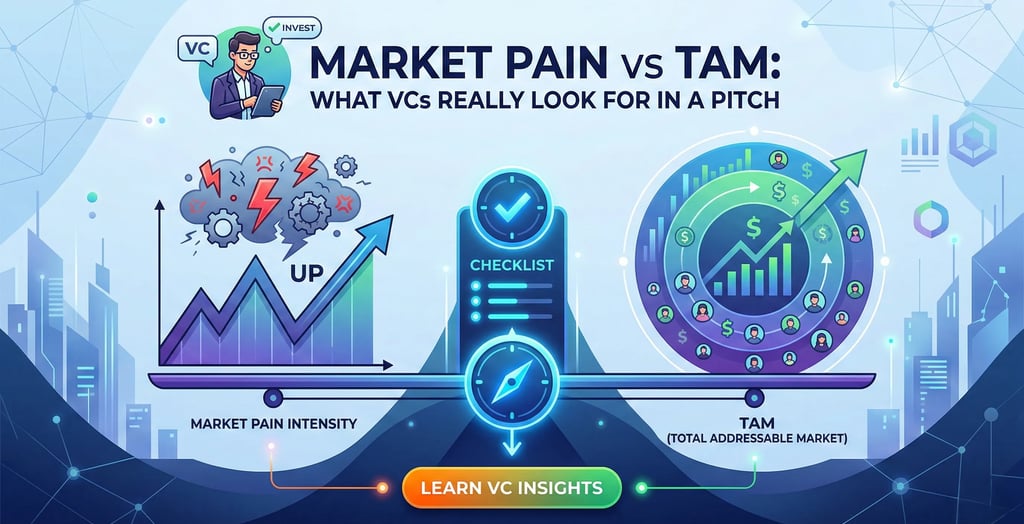

Market Pain Intensity vs TAM: What VCs Really Look For in a Pitch
You will not get a second meeting. Not because your market is too small — but because you proved it was too comfortable. The founders who lose Series A deals on the Problem slide are rarely pitching niche markets. They are pitching large markets where the pain is ambient, distributed, and survivable. That is a structural fundraising failure, and it starts on slide three. Before dissecting the exact mechanism, understand that this is part of a deeper framework on investor psychology behind Problem and Solution slides — because the TAM obsession is a symptom of a more dangerous misunderstanding about what VCs are actually buying.
Why a $14B TAM With Low Pain Intensity Kills Your Series A Faster Than a $2B TAM With High Urgency
Here is the slide that is ending deals in partner meetings right now. The Problem slide opens with a market sizing graphic: "$14.3B addressable market, growing at 11% CAGR." Below it, a bullet point reads: "Businesses waste time on manual reporting processes." The founder moves through it in thirty seconds, confident the number did the work. The VC writes one phrase in their notes: vitamin, not painkiller.
That internal classification — vitamin or painkiller — is the actual filter a VC applies to your Problem slide. It is not about TAM. It is about whether the customer's current situation is tolerable. A large market full of people managing a tolerable inefficiency is not a venture-scale opportunity. It is a services business. The VC is not investing in the size of the problem. They are investing in the urgency of the escape.
The forensic error founders make here is using TAM as a proxy for pain. They assume a large number communicates a large problem. It does not. It communicates a large category — which could contain thousands of incumbents, decades of entrenched behaviour, and buyers who have already decided the status quo is "good enough." In three of the last five Series A decks reviewed in this sub-pillar category, the TAM slide was the strongest slide in the deck and the Problem slide was the weakest. All three deals stalled at the partner meeting.
The psychological driver is investor feedback misread over time. Founders get told "your market is too small" at pre-seed, so they arrive at Series A with an enormous TAM and zero pain architecture. They solved the wrong problem.
The Pain Intensity Formula VCs Use to Score Your Problem Slide
This is the internal calculus a VC partner runs — rarely written down, almost always applied.
Pain Score = Frequency × Severity × Failed Alternatives
Break down each variable:
Frequency: How often does the target customer experience this pain? Daily operational friction scores higher than quarterly compliance friction — even if the quarterly cost is larger in dollar terms.
Severity: What happens if the problem goes unsolved for another 90 days? If the answer is "not much," your pain intensity is low regardless of TAM.
Failed Alternatives: Has the customer already tried to solve this and failed? Evidence of prior spend on inadequate solutions is the single most powerful pain signal a Problem slide can carry. It proves the market has already voted with budget.
As of early 2026, US-based Series A funds are increasingly applying a "Day-One Displacement" test to Problem slides: if the customer could solve this problem tomorrow by hiring one person or adding one tool from an existing vendor, the pain intensity is insufficient to justify venture-scale pricing power. Funds that deployed aggressively in 2021 and wrote down positions in 2023–2024 are now applying this test as a hard filter, not a soft preference.
Here is what the math looks like when you run two companies side by side:
Here is the data from the table organized by company:
Company A
TAM: $18B
Frequency of pain: Monthly
Severity if unsolved: Inefficiency
Failed alternatives: None documented
Pain Score: Low
VC outcome: Passed
Company B
TAM: $3.2B
Frequency of pain: Daily
Severity if unsolved: Revenue loss
Failed alternatives: 2 prior vendor failures on record
Pain Score: High
VC outcome: Term sheet
Company B raises at a higher pre-money valuation despite a TAM six times smaller. The pain architecture is the asset, not the market size.
The Pain Intensity Protocol: Rebuilding Your Problem Slide to Score on All Three Variables
The target is a Problem slide that makes a VC feel the urgency of the customer's situation before you have said a word about your solution.
Weak Version of the Slide:
"$14.3B market. Manual processes cost businesses time and money. Existing tools are fragmented and hard to integrate."
A VC reads this and thinks: "So is every enterprise software category. What makes this one bleed?"
VC-Ready Version of the Slide:
"Mid-market logistics operators lose an average of $340K annually to manual freight reconciliation errors — a figure that compounds when carrier rate changes are applied retroactively. The two dominant legacy tools (named) require 6-week implementations and still generate a 12% error rate. Three of our design partners had already signed and then cancelled contracts with both vendors before engaging us."
The difference is not polish. It is specificity of suffering. The VC-ready version scores on all three pain variables simultaneously: frequency (ongoing operational errors), severity (quantified dollar loss plus vendor failure), and failed alternatives (documented prior spend with named competitors).
The framework to apply is the Pain Architecture Stack:
Name the exact moment of failure — not the general category of pain, but the specific operational breakdown (the invoice, the reconciliation run, the compliance filing)
Quantify the cost in the customer's currency — time, dollars, headcount, or regulatory exposure — not your framing
Document the graveyard — list what the customer already tried. If you have signed termination notices or competitor churn data, this belongs on the Problem slide, not the Competitive Landscape slide
Calibrate the urgency trigger — what external force (regulatory change, market shift, cost pressure) is making the status quo less tolerable in 2025–2026 than it was in 2022? This is your time-pressure argument, and it reframes the VC's risk calculus from "why now" to "why not now is dangerous"
The graveyard element is the most underused proof point at Series A. A customer who fired your competitor and hired you is not just a revenue data point — it is evidence of a market that has already processed the pain, attempted a solution, and found the category unsolved. That is a fundamentally different investment thesis than a greenfield market.
On TAM: do not abandon it. Reframe its role. TAM is the ceiling; pain intensity is the floor. The floor is what gets you funded. Present TAM as the upside of solving an already-proven, acutely felt problem — not as the primary justification for why the problem exists.
Three Ways Founders Undermine Pain Intensity While Trying to Strengthen It
Quoting industry reports instead of customer evidence. "According to Gartner, inefficiency costs the sector $14B annually" is an analyst's framing of a category, not a customer's experience of a problem. Swap every third-party stat for a first-party customer data point wherever possible.
Listing pain without a protagonist. "Businesses struggle with X" has no urgency. "The VP of Operations at a 200-person logistics company loses 11 hours per week to X, and her bonus is tied to the cost metric it affects" has a protagonist with a specific stake. Name the role, the frequency, and the personal consequence.
Solving for TAM expansion instead of pain depth. Founders who get pushback on market size often respond by broadening their ICP to capture a larger TAM. This reliably reduces pain intensity. A tightly defined customer with acute pain scores higher than a broad market with distributed, manageable friction — every time.
What Fixing This Slide Does to Your Pre-Money Negotiation
A Problem slide that scores high on the Pain Intensity Formula changes the VC's internal risk model before a single financial projection is reviewed. Lower perceived execution risk at the problem layer directly increases the pre-money multiple a VC is willing to defend to their LP base. In a market where the median US Series A pre-money sits at $22M–$28M, the difference between a founder who proves acute pain and one who proves large TAM is often a $3M–$6M variance in opening offer — because the first founder has already answered the question the second founder leaves open. The complete system for building a Problem slide that survives partner-level scrutiny is inside the Series A Problem and Solution slide architecture.
Every week your Problem slide leads with TAM instead of pain intensity is a week a VC is classifying your business as a vitamin and moving to the next deck in their inbox. The 16 VC-Quality AI Prompts inside the $5K Consultant Replacement Kit are built specifically to extract pain architecture from your customer data and translate it into the language a VC's investment memo requires — before you walk into the room. The full Kit is $497. Access it at the Series A pitch deck system built around investor-grade problem framing.
Funding Blueprint
© 2026 Funding Blueprint. All Rights Reserved.