
Investor Psychology Behind Problem & Solution Slides
Understand how VCs psychologically evaluate problem and solution slides, what signals trigger conviction, and what silently destroys trust.
PILLAR 2: PROBLEM & SOLUTIONS SLIDES
12/14/202510 min read
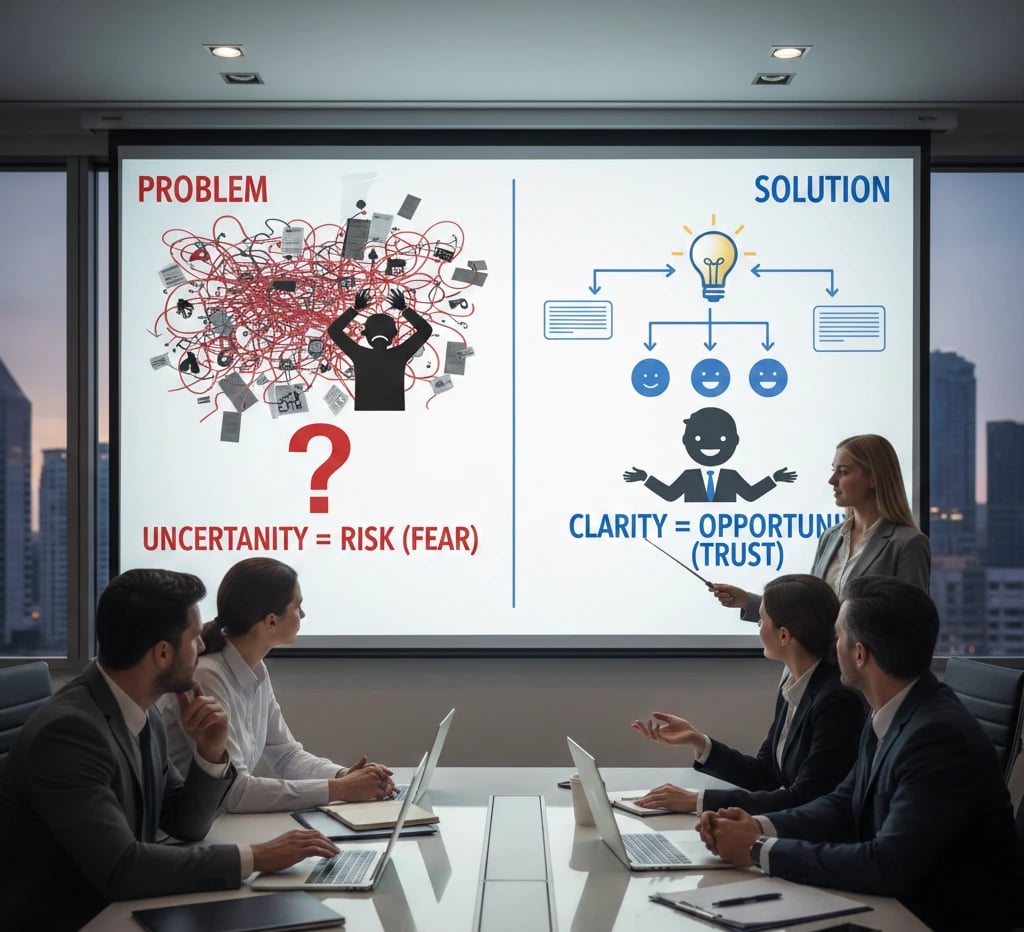
Investor Psychology Behind Problem & Solution Slides: What Your Deck Is Actually Saying Before You Open Your Mouth
The myth: A great problem slide tells investors what's broken. The reality: It tells investors whether you can think.
Most founders treat the Problem and Solution slides as a narrative warm-up — a courtesy preamble before the "real" deck begins. This is a structural error that kills rounds. Experienced investors at the Series A and above are running a parallel cognitive process from slide two onward. They are not listening to your story. They are auditing your judgment. The Problem and Solution slides are, in fact, the highest-density diagnostic tool in the entire deck. Get them wrong and no amount of traction rescues you.
This sub pillar is part of our main Pillar Problem & Solution framework used by investors.
The Trench Report: How a $14M Series A Was Lost - Then Won - on Two Slides
In Q3 2022, a London-based B2B SaaS founder came to us eight weeks out from a term sheet deadline with a lead investor at a mid-tier European fund. The round was £11.2M (~$14M USD). The deck had been through three revisions. The lead partner had gone cold after the second partner meeting. We were called in for forensic triage.
The problem slide read: "The enterprise procurement market is broken. Companies waste billions on inefficient vendor onboarding."
The solution slide read: "Our AI-powered platform streamlines procurement workflows end-to-end."
Both slides were factually defensible. Both slides were functionally useless.
The structural error: The founder had written for a reader operating in System 2 — the slow, deliberate, analytical mode of cognition. But investors in a partner meeting are operating in System 1 — fast, pattern-matching, heuristic-driven. The problem slide demanded that the investor do interpretive work. It offered a category, not a wound. The solution slide offered a mechanism, not a proof of capability.
The pivot: We ran a forensic rewrite in 72 hours. The problem slide was rebuilt around a single, specific operational failure: "A Fortune 500 procurement team takes an average of 47 days to onboard a new vendor. 31 of those days are manual document routing. At £180K average annual vendor value, each onboarding delay costs £7,600 in deferred revenue — multiplied across 200+ vendors per year."
The solution slide was stripped to a single claim, anchored to a live customer outcome: "We cut that 47-day cycle to 11 days. Confirmed across three enterprise clients. Average annual revenue recovery per client: £1.1M."
The lead partner re-engaged within a week of the revised deck. The round closed at £11.2M six weeks later.
The lesson is not that specificity is nice to have. It is that specificity removes the cognitive burden from the investor — and investors reward whoever makes their System 1 pattern-matching feel safe.
The Forensic Anatomy of Problem & Solution Slides
System 1 vs. System 2 - This Is the Core Mechanism
Daniel Kahneman's framework is not a piece of pop psychology. In the context of investor pitch decks, it is an operational specification.
System 1 thinking is automatic, fast, and pattern-driven. It is what fires when an investor glances at your problem slide and within three seconds decides whether the problem is "real." System 2 is deliberate and analytical — it activates only when System 1 raises a flag or when there's enough trust to invest cognitive effort.
Your problem slide must clear System 1 before System 2 ever engages. If your problem requires explanation, you've already lost the slide. This is not a content issue. It is an architecture issue.
Operational Grip is the measure of how precisely a founder demonstrates they understand the internal mechanics of the problem — not just its existence, but who feels it, when they feel it, and what it costs them per unit of time. A problem slide without Operational Grip reads like a market research summary. A problem slide with Operational Grip reads like testimony from a practitioner.
The test: Can the investor point to a specific person, in a specific role, experiencing a specific failure, at a specific cost? If no, the slide lacks Operational Grip.
The Invisible Killswitch
Cognitive Load is the amount of mental processing your slide demands before it yields meaning. Every extra word, every vague abstraction, every market-size statistic without context is a unit of friction. Investors in a partner meeting are reviewing eight to twelve decks per week. Their cognitive budget is finite. Slides that demand high Cognitive Load are not revisited. They are skipped.
The forensic standard: A problem slide should communicate its core wound in under 12 seconds of reading. A solution slide should communicate proof of capability in under 15 seconds. If a stopwatch says otherwise, the slide requires surgery.
Metric Integrity - The Claim That Must Not Break Under Pressure
Metric Integrity is the degree to which every number on your problem and solution slides can survive a 20-minute technical cross-examination. This is where most founders fail during Due Diligence. They cite industry reports, third-party surveys, or analogous benchmarks — none of which are proprietary to their pipeline.
The only metrics that carry full Metric Integrity are those derived directly from your own customer data.
Forensic Formula — Cost of the Problem Per Customer:
Problem Cost (Annual)=Wasted Hours Per Employee×Fully Loaded Hourly Rate×Affected Headcount\text{Problem Cost (Annual)} = \text{Wasted Hours Per Employee} \times \text{Fully Loaded Hourly Rate} \times \text{Affected Headcount}Problem Cost (Annual)=Wasted Hours Per Employee×Fully Loaded Hourly Rate×Affected Headcount
If your problem slide claims "enterprises lose $2M per year to X," you must be able to walk an investor backward through this formula using data from your own discovery calls or customer interviews. Third-party citations are a starting position. First-party derivation is the standard.
San Francisco vs. London/Toronto
The same deck, word for word, will perform differently depending on which side of the Atlantic — or which city — you're in. Founders who ignore this lose meetings they should have won.
San Francisco (Aspirational / Velocity-Heavy)
A SF-based investor, particularly at pre-Series B, is running a velocity heuristic first. They want to know: Is this a category-defining problem? Is this founder moving fast enough to own it before a better-funded competitor enters? The emotional register of the problem slide matters. SF investors are calibrated to reward founders who articulate the magnitude of the problem in terms of market behaviour change. Phrases like "this only works because [underlying structural shift] has just made it possible" activate their pattern-matching for timing bets.
Your solution slide in SF should lead with speed-of-deployment and network effect potential. Case studies are welcome. Revenue metrics are better. But the aspiration of the solution — where the wedge leads in 36 months — carries significant weight.
London / Toronto (Audit-Focused / Unit Economic-Heavy)
A London or Toronto-based investor is running a unit economic audit in parallel with your pitch from slide one. They are asking: Does this founder understand the cost structure of what they've built? Is the solution actually viable at scale without margin deterioration? The emotional register of the problem slide matters less. The operational specificity matters enormously.
In London, your problem slide should quantify the cost of the status quo in a way that allows the investor to triangulate your ICP's willingness to pay. In Toronto, particularly given the SR&ED tax credit environment and the heavy regulatory compliance overhead facing many Canadian enterprise sectors, the problem slide benefits from naming a specific regulatory or compliance friction — this signals that the founder understands the structural incentives their buyer is navigating.
The hard calibration rule: For SF, lead with magnitude and mechanism. For London/Toronto, lead with cost-per-unit and evidence of buyer pain confirmed by data you own.
Three Red Flags This Approach Prevents in Technical DD
Red Flag 1 — The "Assumed Problem" Trap During DD, investors will ask: "How did you confirm this problem exists at scale?" If your problem slide is sourced from industry reports rather than primary research, the DD team will note it. This creates a credibility gap that is surprisingly difficult to close retroactively. Slides built on Operational Grip — founder-owned data, customer discovery transcripts, support ticket analysis — eliminate this flag entirely before it forms.
Red Flag 2 — The Solution-Problem Mismatch A structurally common error: the solution solves a subtly different problem than the one stated. DD teams run a logical mapping exercise between slides 2 and 3. If the causal chain between problem and solution has a gap — even a small one — it signals either that the founder doesn't fully understand the problem, or that the product was built before the problem was validated. Either reading is damaging.
Red Flag 3 — Metric Sourcing Failure When an investor asks "where does this number come from?" and the answer is "a McKinsey report from 2021," the Metric Integrity of the entire deck degrades. Not because the statistic is wrong, but because it proves the founder cannot yet produce proprietary data. DD teams at reputable funds log this. It compounds. Build the problem slide around numbers you can defend from first principles.
Earned Secrets: What General Advice Doesn't Tell You
Earned Secret #1 — The US Hiring Friction Signal In the US market, a problem slide that touches on operational inefficiency in mid-market or enterprise companies carries hidden weight if it implicitly maps to a hiring friction problem. US companies have been operating with significant white-collar hiring overhang since 2022. Any solution that quantifiably reduces headcount dependency — or delays the need to hire a specific role — is being evaluated through a workforce cost lens that many founders never explicitly name. If your solution eliminates the need for a specific hire, calculate the fully-loaded cost of that role ($180K–$260K all-in for a mid-level ops hire in a major US metro) and embed it in the problem cost formula. This activates an investor heuristic that standard market sizing does not.
Earned Secret #2 — UK R&D Tax Credit Framing For UK-based founders pitching to UK institutional investors or angels with SEIS/EIS exposure, the problem slide has a secondary function that almost no one exploits: it establishes the technical novelty of the problem. HMRC's R&D tax credit framework (RDEC and SME schemes) requires that the company be attempting to resolve a "scientific or technological uncertainty." A well-constructed problem slide that articulates the technical uncertainty — not just the market pain — strengthens the R&D claim and signals to a sophisticated UK investor that the company has tax-efficient cost structure baked in. Most founders separate their tax strategy from their narrative strategy. They are the same document.
Earned Secret #3 — The "Solution Confidence Gradient" Experienced investors at the partner level have a calibrated read on founders who are "in love with their solution." The tell is a solution slide that over-specifies the product architecture at the expense of the outcome. This is called false precision — and it signals that the founder has not yet separated product thinking from market thinking. The forensic fix: your solution slide should describe what the customer experiences after using your product, not how the product works. Mechanism belongs in the product demo, not in the deck. The most effective solution slides we have seen contain exactly one technical claim and one economic outcome. Everything else is invitation to the demo.
Expert FAQ: Questions the Top 1% of Founders Know to Ask
"Should my problem slide lead with a data point or a customer story?"
A. It depends on your round stage and investor profile. Pre-seed to Seed: a customer story with an embedded data point (one number, one human) outperforms pure statistics because the fund is betting on your judgment more than the market. Series A onward: quantified problem cost with a reference to customer validation is the standard. The story is supporting evidence, not the headline.
"How long should the problem slide be?"
A. One slide. Always. If your problem requires two slides, you have not yet achieved Operational Grip. You are describing a category, not a problem. The compression exercise itself — forcing the problem into 40 words and one number — is a founder intelligence test. Investors know this.
"Can the solution slide reference a competitor's failure as proof of the problem?"
A. Carefully. Naming a specific competitor's limitation is acceptable if it is factual and if you are prepared to defend the claim technically. What it must never do is become the structure of your solution. "We do what X cannot" is a positioning claim, not a capability proof. Use competitive failure as a footnote, not a headline.
"What if my problem is novel — investors don't recognise it yet?"
A. This is a System 1 problem. Novel problems require more cognitive work from the investor, which means the educational burden shifts to you. The forensic solution: anchor the novel problem to a known, proximate pain that the investor has already pattern-matched. "This is the X equivalent of [familiar problem]" gives System 1 a hook. Without it, investors will label your problem as "category risk" — which is a polite way of saying they don't trust their own ability to validate it.
Forensic Audit Checklist: Run This Before You Send the Deck
Before this deck leaves your outbox, confirm:
1. The Problem Slide Passes the 12-Second Test. Read it aloud, cold. Does the core wound land in under 12 seconds? If you need to explain it, it needs to be rewritten.
2. Every Number Is First-Party or Defensible to First Principles. Audit every metric. If it traces back to a third-party report you cannot validate with your own data, flag it. Replace where possible. Add "per our customer discovery across N customers" wherever applicable.
3. The Problem and Solution Slides Form a Closed Causal Loop. The solution must solve exactly the problem stated — no lateral moves, no implicit connections. A DD analyst will draw a line between them. Make sure that line is straight.
4. The Solution Slide States an Outcome, Not a Mechanism. Strip the architecture. Lead with what the customer now experiences. Add one economic proof point from a live customer.
5. The Deck Is Calibrated to the Investor's Regional Heuristic. Confirm whether this investor operates on a velocity/aspiration frame (SF) or an audit/unit-economic frame (London/Toronto). Adjust the vocabulary and metric emphasis accordingly before sending — not after the meeting.
The Narrative Breadcrumb
Here is the question this piece has not answered — and it is the one that actually determines whether your Problem and Solution slides survive a second partner meeting:
What happens when the investor's System 1 pattern-match confirms the problem — but their System 2 audit of your solution finds a margin structure that doesn't hold at 10x scale?
The answer has nothing to do with your slides. It has to do with a specific table that sits three slides later in your deck — and most founders build it incorrectly in a way that is nearly invisible until DD begins.
A Note on Execution at Scale
The forensic standards described in this piece — Operational Grip, Metric Integrity, Cognitive Load calibration, regional investor heuristics — are individually learnable. The operational challenge is that they must be applied simultaneously, consistently, and before the deck reaches an investor's inbox.
The $497 Funding Blueprint Kit was built to automate exactly this audit layer. It applies these forensic standards structurally across your entire deck — problem through financials — so that the calibration is embedded in the document architecture, not dependent on a founder remembering to apply each check manually. Details are available on the home page.
The best problem slides don't describe a market. They describe a moment — a specific person, experiencing a specific failure, with a calculable cost. Everything else is category analysis. Category analysis does not close rounds.
Forensic Deep Dives: Investor Psychology Behind Problem & Solution Slides
Pitch Deck Psychology: Why VCs Evaluate Founder Judgment Over Slides
Founder-Market Fit: What Your Problem Slide Reveals to Investors
Market Pain Intensity vs TAM: What VCs Really Look For in a Pitch
Cognitive Load in Pitch Decks: Why Simple Startup Solutions Win
The Hidden VC Test: Proving Willingness to Pay in Your Pitch Deck
Building VC Trust: Overcoming Investor Skepticism in Early Pitches
First-Impression Bias: Nailing Your Pitch Deck Problem and Solution
Reducing VC Risk: How Your Pitch Deck Mitigates Investor Uncertainty
Founder Vision vs Delusion: Passing the Ultimate VC Psychology Test
The VC Bias Loop: Balancing Familiarity and Novelty in Pitch Decks
Funding Blueprint
© 2026 Funding Blueprint. All Rights Reserved.