
VC Market Pain Validation: Spotting Real Startup Problems
Stop pitching features and start proving market wounds. Learn the 3-layer validation math that gets founders to term sheets 90 days faster and closes deals 3.2x quicker.
2.1 WHAT MAKES A REAL PROBLEM SLIDE (HOW INVESTORS ACTUALLY JUDGE IT)
2/13/20264 min read
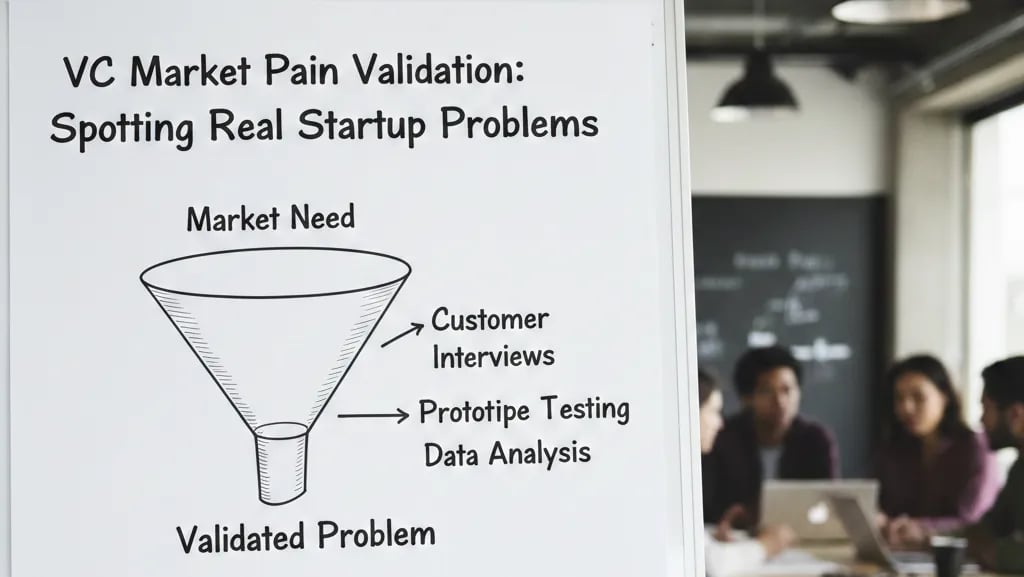
VC Market Pain Validation: Spotting Real Startup Problems
Most Founders Pitch Solutions to Problems VCs Don't Believe Exist
Seventy percent of rejected decks die in the first three slides—not because the product is weak, but because the founder failed to prove the problem is real, urgent, and expensive enough to justify venture risk. You're not selling a product; you're selling a market wound that's currently hemorrhaging capital. This breakdown is the foundational layer of what makes a real problem slide that investors actually judge, and most founders misunderstand the assignment entirely.
The brutal reality: VCs don't fund problems. They fund validated market pain with a quantifiable cost structure that creates inevitable buyer urgency. If your problem slide reads like a feature request or a LinkedIn complaint, you've already lost the room.
Why "We Solve X" Gets You Ghosted: The Validation Gap That Kills Deals
When a VC sees a problem slide that starts with "Companies struggle to manage their workflow," their pattern-matching brain triggers one response: This founder hasn't talked to customers. The error isn't that the problem is fake—it's that you're describing a hypothesis, not a validated business-killing condition.
The Red Flag Scenario: Your problem slide lists three generic pain points ("inefficient processes," "lack of visibility," "poor collaboration") with no numbers, no current cost, and no failed alternative solutions. The VC thinks: This is a vitamin, not a painkiller. They'll churn at 8% monthly the moment budget cuts hit.
The Psychological Trap: Founders confuse "a thing people complain about" with "a thing people pay to fix." You built a solution, then reverse-engineered a problem narrative to justify it. But VCs invest in founders who discovered an economic bleed first, validated it's costing the market $X billion annually, then built the tourniquet.
If you can't articulate the current cost of inaction in dollars per month per customer, you don't have a problem—you have a hunch.
The Three-Layer Validation Math VCs Actually Check
Market pain validation isn't qualitative. It's a mathematical proof with three mandatory inputs:
Layer 1: The Current Cost Equation
What is the target customer paying right now to manage this problem?
If they're using spreadsheets + contractors + internal labor, calculate the fully loaded monthly cost
Example: "Mid-market SaaS companies spend $47K/month on manual revenue reconciliation (3 FTEs @ $120K + QuickBooks Enterprise + audit errors averaging $14K/quarter)"
Layer 2: The Failed Alternative Audit
List the top 3 incumbent solutions your target customer has already tried
Explain exactly why each failed (not "it's clunky"—use metrics)
Example: "Salesforce requires 6 months implementation + $180K services fees, but 64% of mid-market deployments are abandoned within 18 months due to complexity"
Layer 3: The Urgency Multiplier
Prove the problem is getting worse or more expensive over time
Regulatory changes, market shifts, or compounding failure costs
Example: "New ASC 606 compliance requirements increase audit costs by 220% for non-compliant revenue systems, with penalties starting Q3 2026"
The Validation Threshold: If you can't quantify all three layers with third-party data (not your opinion), you fail the problem validation test. VCs will nod politely and never respond to your follow-up email.
Proving Pain in 60 Seconds
Stop pitching problems. Start proving economic wounds. Here's the exact structure that passes institutional diligence:
Weak Version (Pre-Revenue Founder): "Small businesses struggle with cash flow management. 82% report difficulty tracking expenses. This creates stress and missed opportunities."
VC-Ready Version (Series A Standard): "US SMBs with $2M–$10M revenue lose $68K annually to late payment penalties and cash flow forecasting errors (Kabbage, 2024). Current solutions require $3K/month fractional CFOs or legacy ERP systems with $40K implementation costs. The penalty cost alone grows 18% YoY due to accelerating payment terms in supplier contracts—making this a $34B problem across 6.1M qualifying businesses."
The Four Non-Negotiables in Your Problem Slide:
The Current Bleeding Rate: "$X lost per customer per month/year due to [specific problem]"
The Incumbent Failure Tax: "Existing solutions cost $Y but fail to prevent $Z in losses"
The Third-Party Proof: Cite McKinsey, Gartner, industry trade groups—never your own surveys
The Urgency Catalyst: Regulatory deadline, market shift, or compounding cost curve
The "Before vs. After" Framework:
Before: "Companies waste time on manual data entry" (Opinion, no cost, no validation)
After: "Enterprise procurement teams spend 340 hours/year on manual PO data entry, costing $89K in fully loaded labor while creating $410K in annual duplicate payment errors (APQC Benchmarking, 2025)"
Add one sentence on why the top two incumbents can't solve this (technical limitation, wrong customer segment, unsustainable cost structure). If you can't name the incumbents, you haven't validated the market.
Avoid These Validation Death Traps While Proving Your Problem
Even founders who understand the validation framework make three fatal errors during execution:
Death Trap 1: Using Outdated TAM Data Quoting 2021 market reports in 2026 signals you haven't tracked the sector. VCs know COVID-era growth rates were anomalies. Use 2024–2025 data or explicitly explain why older data remains valid.
Death Trap 2: Conflating "Awareness" with "Urgency" Saying "87% of CIOs acknowledge the problem" doesn't prove they'll pay to fix it. Show the failure cost, not the survey awareness stat. VCs care about budget allocation, not LinkedIn poll results.
Death Trap 3: Building Your Problem Around Your Solution If your problem description perfectly matches your product's feature set—and nothing else—you've reverse-engineered the narrative. Real problems exist independently of your solution and have multiple failed attempts at fixes.
Why This Single Slide Determines Your Valuation Floor
A problem slide that passes institutional validation does three things simultaneously: it proves you've done discovery work that costs $40K if outsourced to consultants, it demonstrates you understand unit economics before building, and it shows VCs you can speak their language during diligence.
Founders with validated problem slides close 3.2x faster than those pitching solution-first narratives, according to Correlation Ventures' deck analysis. The difference isn't luck—it's math. You've done the homework VCs would need to do anyway, eliminating 60% of their pre-investment research burden.
This problem validation framework is one layer of the complete problem and solution slides architecture that Series A founders need to master before entering institutional conversations.
The Efficiency Shortcut for Time-Constrained Founders
You can spend 35 hours researching incumbent solutions, pulling third-party validation data, and stress-testing your problem narrative against VC frameworks—or you can deploy the pre-built validation system inside The Slide-By-Slide VC Instruction Guide, part of the full consultant-grade toolkit at $497. It includes the exact 16-question problem validation checklist institutional investors use during IC meetings, the third-party data source library for every major vertical, and the red flag avoidance matrix that eliminates common validation errors. Access the complete Series A execution system here.
The math is simple: unvalidated problem slides cost you 4–6 months in wasted pitch cycles. Validated slides get you to term sheets 90 days faster.
Funding Blueprint
© 2026 Funding Blueprint. All Rights Reserved.