
Using Startup Waitlists as Traction in Early-Stage Pitch Decks
15,000 sign-ups isn't traction; it's a credibility trap. Learn why VCs treat waitlists as vanity metrics and how to prove real Series A demand.
2.2 HOW TO PROVE YOUR PROBLEM IS REAL (EVIDENCE, SIGNALS & PROOF)
2/17/20266 min read
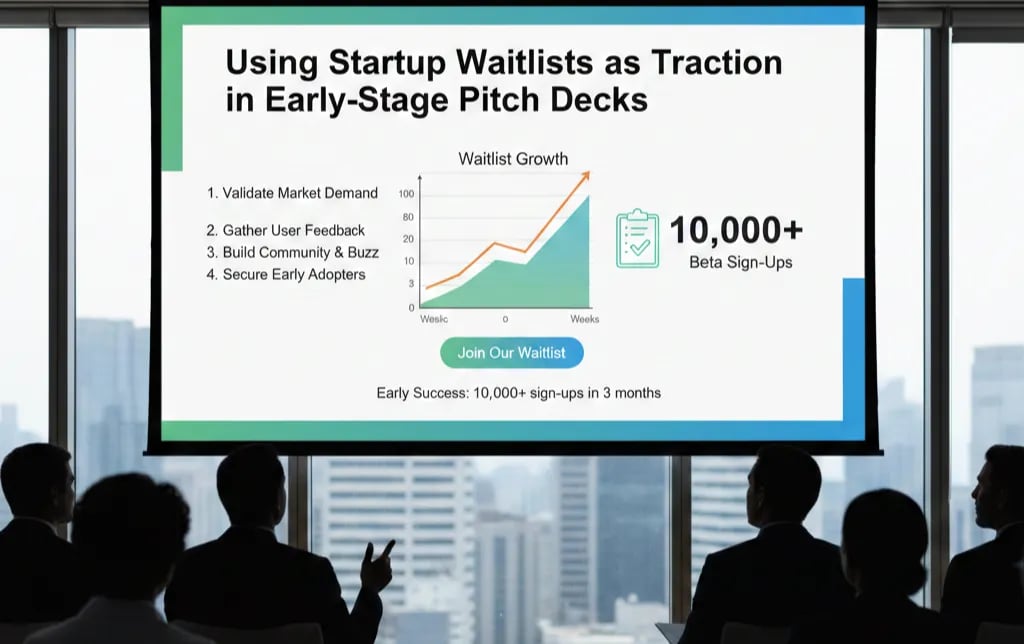
Using Startup Waitlists as Traction in Early-Stage Pitch Decks
$14,000 in sign-ups sounds like a number worth putting in a deck. It is not — not unless you can tell a Series A VC exactly how many of those people paid, tried, or confirmed they would pay before you built a single feature.
Waitlist traction is the most commonly misrepresented metric in early-stage fundraising, and it is destroying raises for founders who genuinely believe they have validated demand. If you are pre-revenue or pre-product and building your first institutional pitch, understand this before you build your Traction slide: a waitlist number without a conversion architecture is not a signal. It is noise with a comma in it. This problem lives directly upstream of what institutional investors actually require to judge a Problem Slide as credible — because waitlist data is almost always presented as problem validation when it is nothing of the sort.
Why Waitlist Numbers Without Conversion Data Are a Series A Credibility Trap
The failure mode is surgical and repeatable. A founder raises a pre-seed round, builds a landing page, runs a LinkedIn campaign or a Product Hunt launch, accumulates 8,000–20,000 email sign-ups, and walks into a Series A conversation presenting those sign-ups as "strong early demand." The VC nods. Then they ask one question: "What percentage converted to your beta, and what did beta users pay or commit to paying?"
If the answer is "we haven't launched yet" or "conversion rates are still early," the meeting is functionally over. The VC has just learned that the founder cannot distinguish between curiosity and demand. Those are not the same thing, and conflating them is one of the most expensive analytical errors a pre-Series A founder can make.
The psychological root here is understandable: waitlist growth feels like momentum because it is measurable, shareable, and emotionally validating. It also requires zero financial commitment from the person signing up. A person who enters their email to "learn more" has told you nothing about willingness to pay, switching cost tolerance, or urgency. They have told you they can operate a keyboard.
In a deck reviewed last quarter, a consumer SaaS founder presented 22,000 waitlist sign-ups as their primary traction metric — the VC firm's analyst flagged in the pre-meeting notes that no conversion data was visible, and the partner opened the meeting by asking for it within the first four minutes. The founder did not have it. There was no second meeting. As of early 2026, top-tier US and UK seed-to-Series-A funds are requiring at minimum a documented activation rate from waitlist to beta — the benchmark expectation sits at 15–25% activation to be considered signal-grade, with anything below 10% treated as list-building, not demand validation.
The Math That Exposes a Hollow Waitlist: What the VC Is Actually Calculating
The numbers expose the problem cleanly. Here is the logic a VC analyst runs when they see a waitlist-as-traction claim:
Scenario A — What the founder presents:
15,000 waitlist sign-ups
"Strong early demand" narrative
No conversion data
Scenario B — What the VC calculates:
For Sign-ups, the Founder's Claim is 15,000, while the VC's Mental Model treats this as an unqualified list.
For Assumed activation rate (no data), the Founder's Claim implies ~100%, whereas the VC's Mental Model puts it realistically at 5–12%.
For Effective validated users, the Founder's Claim states 15,000, but the VC's Mental Model models this at 750–1,800.
For Willingness to pay (no data), the Founder's Claim implies strong, while the VC's Mental Model treats the unknown as $0 modelled.
Finally, for ICP match rate, the Founder's Claim is not stated, and the VC's Mental Model considers it not calculable.
The VC is not being cynical. They are being actuarial. A 15,000-person waitlist with no conversion data models to approximately the same signal value as zero, because it provides no input into CAC, LTV, or retention assumptions. Every financial projection built on top of an unvalidated waitlist is structurally fictional, and any VC who has sat through a full due diligence cycle knows it.
The cognitive load damage is compounding: when a founder presents waitlist data as traction without conversion context, they signal — in one slide — that they either do not know what traction means at the institutional level, or they are hoping the VC will not ask. Neither reading helps the raise.
The Waitlist Validation Protocol: Converting a Vanity Metric Into VC-Grade Traction Evidence
This is fixable. The architecture is not complicated, but it requires you to have done the work before you build the slide.
Step 1: Apply the Demand Validation Hierarchy
Not all waitlist engagement is equal. Here is how VCs assign weight to early-stage traction signals, ranked from weakest to strongest:
Email sign-up on a landing page (no friction, zero commitment)
Beta application form with qualification questions (marginal friction)
Completed onboarding in a beta product (activation signal)
Expressed intent to pay in a discovery call (soft commitment)
Pre-order, LOI, pilot agreement, or paid beta (hard demand signal — this is traction)
If your current traction lives in tiers 1 or 2, do not present it as traction. Present it as list-building and explain your plan to move it up the hierarchy before your raise closes.
Step 2: The Waitlist Conversion Equation
Use this as your internal diagnostic before building the slide:
Validated Demand = (Waitlist Size × Activation Rate) × Willingness-to-Pay Confirmation Rate
Weak version: "We have 11,000 people on our waitlist, reflecting strong market interest in the problem we solve."
VC-Ready version: "We have 11,000 waitlist sign-ups. Of the 2,400 we onboarded into our closed beta (21.8% activation), 340 completed our full workflow at least twice in the first 30 days. Of those, 61 pre-committed to paid plans at $79/month when we opened a pre-order window — a 17.9% conversion from activated users. That is our demand signal."
The second version gives a VC CAC inputs, retention shape, and pricing validation all from the same paragraph. The first version gives them nothing.
Step 3: Segment Your List Before You Present It
A waitlist is only as valuable as its ICP match rate. If your product targets VP-level buyers at mid-market SaaS companies and your 15,000 sign-ups came from a viral Twitter post, your list is likely 90% unqualified. Segment the list by ICP match before your raise, then present the qualified number, not the gross number. A VC-ready slide might read: "Of 15,000 total sign-ups, 1,840 match our ICP criteria (Series B–D SaaS companies, 50–500 employees, US-based). Of those, 420 have completed beta onboarding." That is a dramatically smaller number and a dramatically more credible slide.
Step 4: Use Qualitative Demand Evidence as a Bridge
If your conversion data is thin, supplement it with demand-grade qualitative evidence: documented discovery calls where buyers confirmed budget authority, pilot discussions in progress, or inbound inquiries from named companies. This does not replace conversion data — it contextualises it while you build toward harder metrics.
Four Waitlist Traction Corrections That Backfire at the Partner Meeting
1. Inflating activation by lowering the activation bar. Founders sometimes count "opened the onboarding email" as activation. A VC due diligence checklist will ask for product engagement metrics — sessions, feature usage, return rate. If your "activation" is an email open, your model collapses under the first follow-up question.
2. Presenting gross sign-ups after being asked for ICP-qualified numbers. If a VC asks "how many of these are in your target segment?" and you do not have an answer, the conversation ends. Segment the list before the meeting, not during it.
3. Using waitlist growth rate as a proxy for demand growth. A waitlist growing 20% week-over-week from a PR spike is not demand growth. It is press coverage. Demand growth is conversion rate stability over time, not sign-up volume acceleration.
4. Conflating waitlist size with market size evidence. "We have 50,000 sign-ups which proves the market is massive" is not a logical chain. Market size is a TAM calculation. A waitlist is an engagement metric. Presenting one as evidence of the other signals analytical confusion that a VC will not overlook.
What Credible Waitlist Traction Is Actually Worth at the Negotiating Table
Get this right and the financial impact is direct. A founder who walks into a Series A conversation with a 22% activation rate, a documented 15% paid conversion from activated users, and a segmented ICP-matched list of 2,000 qualified prospects is presenting a repeatable demand engine — not a number. That is the difference between a VC modelling your CAC as speculative versus calculable. In a market where pre-money Series A valuations in the US currently cluster between $22M and $28M (2025 benchmarks), the ability to present demand evidence that feeds a real CAC model can shift your negotiating position by $2M–$5M before you reach the term sheet.
A waitlist is not traction. A waitlist with a conversion architecture, an ICP filter, and documented willingness-to-pay evidence is the beginning of a traction story. Build the architecture first. Then build the slide. For the complete framework governing how your Problem, Traction, and Solution slides connect into a coherent Series A narrative, see the full Problem and Solution Slide system for institutional fundraising.
You can build this conversion architecture manually across 40 hours of iteration and three failed partner meetings, or you can use the Slide-By-Slide VC Instruction Guide inside the $5K Consultant Replacement Kit to structure your Traction slide correctly in one working session — including the exact data hierarchy a VC analyst will check your waitlist metrics against. The full Kit is $497. Access it and the complete pitch deck validation system at FundingBlueprint.
Stop presenting the number. Start presenting the architecture behind it.
Funding Blueprint
© 2026 Funding Blueprint. All Rights Reserved.