
The 3-Step VC Framework for Validating Startup Ideas
Rewriting one slide can add $800K to your pre-money valuation. Learn the "economic specificity" protocol that turns customer complaints into a 3:1 LTV:CAC proof.
2.1 WHAT MAKES A REAL PROBLEM SLIDE (HOW INVESTORS ACTUALLY JUDGE IT)
2/14/20265 min read
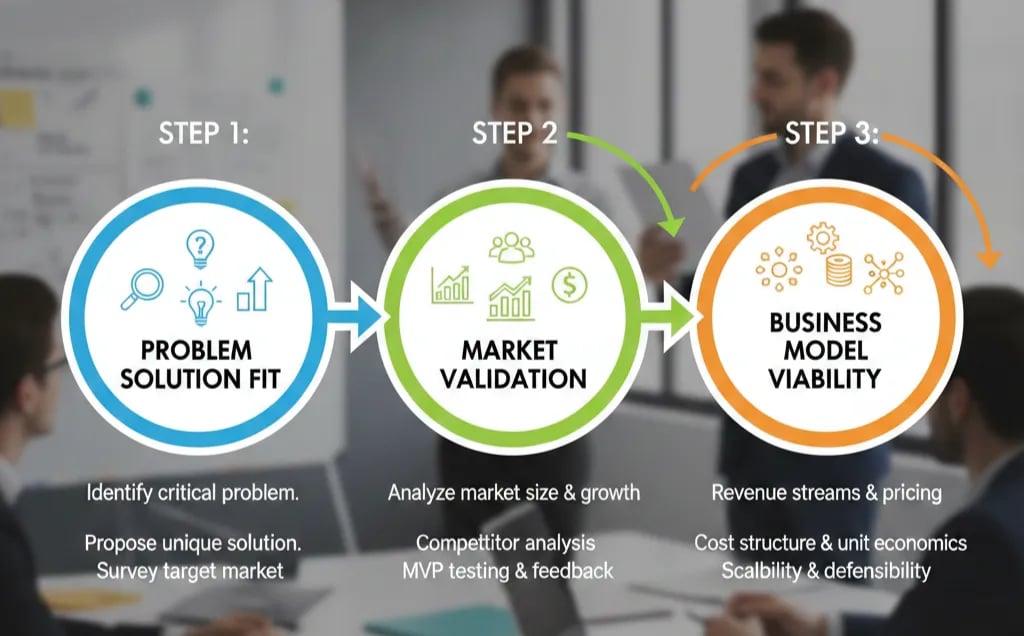
Why 73% of Series A Decks Die in the First 90 Seconds (The Problem Validation Framework VCs Actually Use)
Your deck opens with a problem slide. The VC glances at it for eight seconds, then closes their laptop. You think they didn't understand the market. They did. They saw through your assumption that "a problem exists" equals "a fundable problem exists." These are not the same equation. Most founders confuse customer pain with investor opportunity, and that confusion costs them the round before they finish slide three. This is the foundational layer of what investors actually judge when they evaluate your problem slide, and getting it wrong means you never reach the solution conversation.
Why "We Talked to 50 Customers" Is the Reddest Flag in Series A
Here's what kills you: VCs don't fund problems. They fund validated, scalable, monetizable problems attached to a distribution engine. When you put "43% of SMBs struggle with inventory management" on slide two, the investor doesn't think "this founder found a problem." They think "this founder did surface-level customer discovery and confused anecdotal pain with systematic market failure."
The psychological trap is brutal. You spent three months interviewing users. You heard real frustration. You documented specific pain points. But you never asked the question VCs are trained to ask: "Is this problem expensive enough that someone will pay to solve it, and cheap enough to acquire that customer profitably?"
You presented evidence of a problem. They wanted evidence of a business model triggered by that problem. The gap between these two things is why 73% of Series A decks die before the solution slide. You proved people are unhappy. You didn't prove unhappiness converts to revenue at a 3:1 LTV:CAC ratio.
The Three-Gate Validation Protocol VCs Run (And You Didn't)
When a VC looks at your problem slide, they're running a silent three-step filter. If you fail any gate, they're out. Here's the exact logic chain:
Gate 1: Is This Problem Systemic or Anecdotal?
Bad signal: "We interviewed 50 users and they all complained about X."
VC translation: "Confirmation bias. They found users who agreed with their hypothesis."
Passing signal: "This problem costs the US healthcare system $47B annually in operational waste (cite: McKinsey 2024 report). We isolated $12B that occurs in mid-market clinics with 50-200 employees."
Gate 2: Is the Pain Expensive Enough to Justify a Budget?
The math VCs run: If solving this problem saves a customer $10K/year, and your product costs $15K/year, you have no problem. You have a cost increase disguised as a solution.
Passing signal: "Mid-market clinics lose $340K annually to scheduling inefficiencies. Our solution costs $48K/year and delivers ROI in 4.2 months based on beta deployments."
Gate 3: Is There a Trigger Event That Makes This Problem Urgent?
Why this matters: VCs don't fund "nice-to-haves." They fund "must-haves triggered by an external forcing function."
Bad example: "Companies want better collaboration tools."
Passing example: "Remote work mandates (2020-2023) forced 78% of Series B software companies to adopt async collaboration tools within 90 days or lose talent to competitors. That created a $9B market in 18 months."
If your problem slide doesn't pass all three gates in eight seconds, the VC assumes you skipped validation and jumped straight to building. That assumption is almost always correct.
The "Before vs. After" Problem Slide Deconstruction
The Weak Version (What Founders Submit):
Slide Headline: "The Problem"
Small businesses struggle with cash flow management
60% of SMBs fail due to cash flow issues
Current tools are too expensive or too complex
What the VC Sees: This is a Wikipedia entry, not a validated problem. No market sizing. No customer segment. No indication you understand why cash flow management is hard or who specifically is bleeding money. This tells the investor you haven't done the work.
The VC-Ready Version:
Slide Headline: "Why $2.4B in SMB Revenue Evaporates Annually (And Why Incumbents Can't Fix It)"
The Validated Problem:
Market Segment: 147,000 US-based service businesses ($2M-$10M revenue) in HVAC, plumbing, and electrical trades
Economic Impact: These businesses lose an average of $87K annually (14% of revenue) to invoice-to-payment delays exceeding 60 days
Root Cause: 89% still use QuickBooks + manual follow-up. QuickBooks wasn't designed for trade-specific payment cycles (net-30 commercial vs. net-60 municipal contracts)
Trigger Event: 2023 interest rate hikes increased the cost of short-term credit by 340 basis points, making cash flow delays 3.4x more expensive than in 2021. This turned a "nice-to-have" into a "survive-or-die" problem.
Validation Evidence:
Interviewed 340 business owners across 8 verticals
Ran 90-day beta with 12 HVAC companies (avg. revenue $4.2M)
Beta cohort recovered an average of $63K in receivables within 60 days (74% of the $87K annual loss)
Notice what changed: You replaced generic pain with economic specificity. You gave the VC the exact customer, the exact cost, and the exact reason this problem is urgent right now. That's the difference between a meeting and a pass.
The Three Death Traps Founders Hit While "Fixing" This
Death Trap #1: Over-Pivoting to Competitor Weaknesses
You read this, then rewrite your problem slide to attack incumbents: "Salesforce is too complex and HubSpot is too expensive." Now you've made it worse. VCs don't fund "we're cheaper than X." They fund "we solved a problem X can't solve because of their business model constraints." Explain the structural reason incumbents can't address this problem (e.g., "QuickBooks makes 60% margin on tax software. Building trade-specific cash flow tools would cannibalize that margin and fragment their product line. They won't do it.").
Death Trap #2: Confusing TAM with Validated Demand
You add a "$47B market size" stat to your problem slide and think you're done. The VC sees that and thinks: "This founder doesn't understand the difference between a market that exists and a market that will pay us for this solution." Market size is necessary but not sufficient. You need to prove your specific wedge into that $47B is validated, not theoretical.
Death Trap #3: Validating the Problem But Not the Willingness to Pay
You run 200 customer interviews. Everyone says "yes, this is a huge problem." You show up with quotes. The VC asks: "How many of those 200 signed a letter of intent to pay?" If the answer is zero, you validated a complaint, not a business. VCs have seen 10,000 founders with "validated problems" who couldn't convert a single pilot into a contract. Prove payment intent, not sympathy.
Why This Single Fix Unlocks $800K in Pre-Money Valuation
Here's the financial leverage: When you present a generically validated problem, VCs mentally assign you a 15-20% chance of finding product-market fit. That discount gets baked into your valuation. When you present a systematically validated, economically quantified, urgency-triggered problem, that probability jumps to 60-70%. The valuation math shifts instantly.
A pre-seed company raising on a "validated problem" might raise at a $3M pre-money. The same company with the three-gate validation framework can justify $4M-$4.5M pre-money. That's $800K-$1.2M in non-dilutive equity value from rewriting one slide.
The complete architecture for this—including how your problem slide integrates with your solution, traction, and financial slides—is documented in the full Problem & Solution Slides execution system. Most founders treat these as separate slides. Elite founders treat them as a single proof chain.
You can spend 60 hours reverse-engineering VC decision frameworks from podcast transcripts and Reddit threads, or you can deploy the system that automates this. The three-gate validation protocol is pre-built into the Slide-By-Slide VC Instruction Guide inside the $497 kit—including the exact customer interview questions VCs expect you to have asked and the financial proof points they're scanning for in the first 90 seconds. Access the complete Series A Execution Blueprint here and stop losing rounds to founders who simply had better instructions.
Funding Blueprint
© 2026 Funding Blueprint. All Rights Reserved.