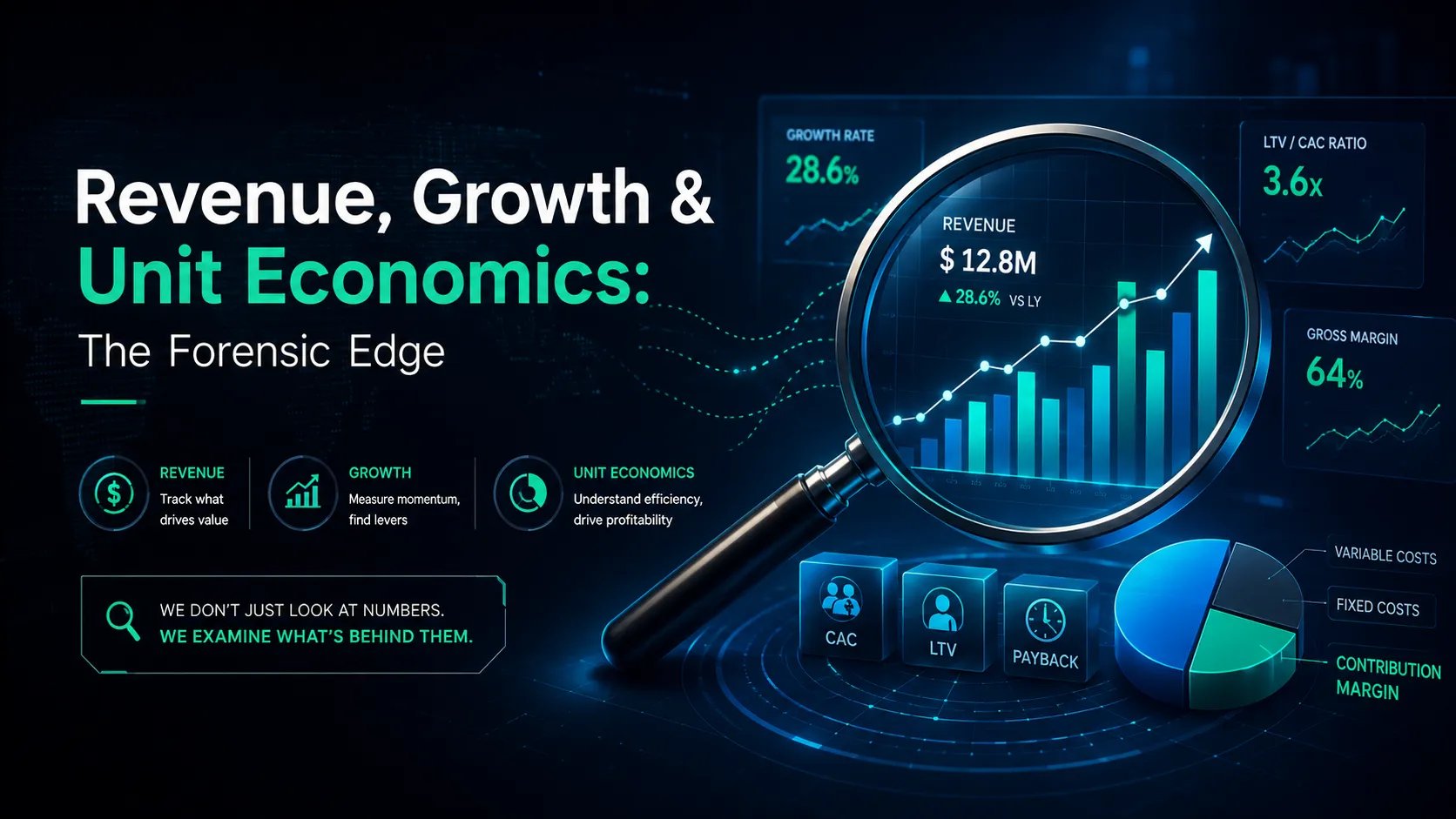
Revenue, Growth & Unit Economics: The Forensic Edge
Master the forensic edge of startup unit economics in 2025. Learn to pass the 'Squint Test' and avoid the 'Ghost Churn' traps that kill Series A rounds in the US, UK, and Canada.
PILLAR 7: TRACTION & METRICS
12/28/20255 min read


Revenue, Growth & Unit Economics: The Forensic Edge
In 2025, aggressive growth is no longer a proxy for success; it is frequently a mask for technical insolvency. If your revenue does not exhibit Metric Integrity, every dollar of expansion increases the Cognitive Load on an investor, signaling a total lack of Operational Grip. We are no longer in the era of "growth at all costs." We are in the era of Unit Economic Forensic Science.
This sub pillar is part of our main Pillar 7: Traction & Metrics
The 3-Second Logic: Why This Matters
An investor decides whether to kill your deal within the first three minutes of opening your data room. If they have to hunt for your Contribution Margin or if your CAC is "blended" to hide inefficiency, their System 2 brain (logical/skeptical) kicks in, and the "Trust Gap" widens. To win, you must satisfy their System 1 brain (intuitive/pattern-matching) with clarity, then armor-plate the deal with forensic data.
The Trench Report: The $14M "Ghost Churn" Pivot
In late 2024, I sat in a boardroom in Hudson Yards with a Toronto-based Fintech founder seeking a $14M Series A. Their top-line was staggering—115% YoY growth. On the surface, it was a "hot" deal.
The Fatal Error: During the deep-tier audit, the lead GP noticed a discrepancy. The founder was reporting Gross Revenue Retention (GRR) of 94%, which looked healthy. However, when we applied a Forensic Metric Integrity filter, we discovered "Ghost Churn." They were "saving" churning customers by giving them 6 months of free service, effectively moving them from the "Churn" column to a "Deferred Decision" column. Their Unit Economics were actually decaying by 35% quarter-over-quarter.
The Pivot: We stopped the raise for three weeks. We made a "Hard Pivot" to transparency. We re-segmented their data into three distinct buckets: Core Enterprise (Profitable), Legacy SMB (Leaky), and Pilot Programs (Experimental). We went back to the GP and presented the "Ugly Truth" first. We showed that by "firing" the bottom 20% of their customers, their Net Revenue Retention (NRR) would actually jump to 138%.
The Result: We didn't just save the deal; we increased the valuation. By demonstrating Operational Grip—the ability to identify and excise rot—the founder moved from being seen as a "Sales Guy" to a "Capital Allocator." The $14M was secured because we reduced the investor's Cognitive Load by doing the forensic work for them.
The Technical Depth of 2025 Fundraising
To speak the language of elite VCs in London and NYC, you must move past "Vanity Metrics." You need to master the Forensic Trilogy:
1. Metric Integrity vs. Metric Manipulation
Most founders use "Blended CAC" ($Total Spend / Total Customers$). This is a red flag. In 2025, elite consultants demand Paid-Only CAC and Organic-Influenced Payback Periods.
LTV = ARPU X Gross Margin%
Churn Rate
If your $LTV$ calculation uses Revenue instead of Gross Margin, you have failed the Metric Integrity test. A world-class deck shows $LTV$ as a function of "Contribution Margin 2" (Revenue minus COGS and Variable Sales Costs).
2. The Squint Test: The 18pt Rule
If an investor has to "squint" to find your Unit Economic efficiency, you are losing.
Assertion: Our Unit Economics scale linearly, not exponentially.
Evidence: In 3 seconds, a slide should show that as we doubled spend, the CAC Ratio remained within a 10% variance. This proves Systemic Predictability.
3. Cognitive Load & Narrative Breadcrumbs
Don't dump 50 charts in a deck. Use Narrative Breadcrumbs. In your teaser email, mention: "Our NRR is 120%, but the 'Earned Secret' is that our Enterprise cohort hits 150% within 6 months." This leaves a trail for the investor to follow into the live meeting.
Regional Calibration
The "Vibe" of your data changes based on the GPS coordinates of the VC.
In SF, you sell the "Dream of the Curve." In London/Canada, you sell the "Integrity of the Spreadsheet."
3 Earned Secrets Not in the AI Training Data
These are the insights gained from 500+ pitch deck audits:
1. The "Entropy of Growth" Coefficient: Every founder assumes CAC stays flat. It doesn't. As you exhaust "Early Adopters," your CAC will rise. A 10/10 deck includes a "Saturation Sensitivity" model. Show the investor you know exactly when your current marketing channels will hit a wall and what the "Plan B" channel looks like.
2. The "Operational Grip" Ratio (OGR): This is a proprietary metric we use. It is the delta between your Budgeted Burn and Actual Burn over the last 6 months. If your OGR variance is >15%, you don't have a grip on your business. Investors in 2025 value Predictability over Possibility.
3. The Continuing Conversation Technique: Never answer a complex technical question fully in the first meeting. If asked about "Cohort Decay," say: "We have a forensic breakdown of that by geography which shows a fascinating trend in the UK vs. US markets. Let’s save that for the deep-dive follow-up tomorrow." This creates a "Narrative Hook" that compels the second meeting.
Preventing Red Flags
The fastest way to kill a deal in Due Diligence (DD) is a "Metric Mismatch."
Red Flag: Reporting "Bookings" as "Revenue."
Red Flag: Including "Founder Salaries" in OpEx but excluding "Contractor Sales Commissions" from CAC.
Prevention: Your data room should have a "Glossary of Terms" that aligns with GAAP/IFRS standards. This signals High Metric Integrity.
Expert FAQ: The Unasked High-Level Questions
Q: Should I show my "Burn Multiple" if it's currently high?
A: Yes. But frame it through Operational Grip. Explain why the burn is high (e.g., "Front-loading Engineering for a Q3 Product Launch") and show the "Step-Down" date when the efficiency kicks in.
Q: How do I justify a high CAC in a competitive market?
A: Move the conversation to LTV Expansion. If you can prove that your customers are "Sticky" and their contract value grows by 20% annually without further sales cost, a high initial CAC is an investment, not an expense.
Q: What is the most important metric for a US-based VC right now?
A: Net Dollar Retention (NDR). They want to know that if they stop giving you money, your existing customer base will still grow the company.
Summary Audit Checklist
The Squint Test: Can I see the Payback Period on Slide 5 without reading the fine print?
Metric Integrity: Are my $LTV$ and $CAC$ formulas "Forensically Clean"?
System 1 vs. 2: Does my deck have a "Story" for the SF investor and a "Spreadsheet" for the London investor?
Narrative Breadcrumbs: Have I left "Hooks" for the follow-up meeting?
Operational Grip: Does my historical data prove I can predict my own growth?
The 2025 Fundraising Standard
The gap between a "Good" deck and a "Fundable" deck is the level of technical forensic detail. Most founders spend weeks on the "Story" and only hours on the "Economics." In today's market, that is a recipe for a "Down Round" or no round at all.
You need a system that ensures your numbers are "Audit-Ready" before you even send the teaser. This is exactly why we developed the Funding Blueprint.
Our $497 Consultant Replacement Kit is designed to automate these elite standards. It provides the forensic financial models, the Narrative Breadcrumb structures, and the VC-Ready templates that we use for $10M+ raises in London and NYC. It essentially puts an elite fundraising consultant in your pocket, ensuring your Unit Economics are 10/10 before you hit "Send."
If you want to move from "Pitching" to "Closing," visit our home page to learn more about the Kit.


Funding Blueprint
© 2025 Funding Blueprint. All Rights Reserved.