
Storytelling Frameworks Used by Top Startups: The Architecture of Conviction
Build the 'Architecture of Conviction.' Master the storytelling frameworks used by top startups in SF, London, and NYC to bridge the gap between data and a term sheet.
PILLAR 5: STORYTELLING AND NARRATIVE ENGINEERING
12/21/20254 min read

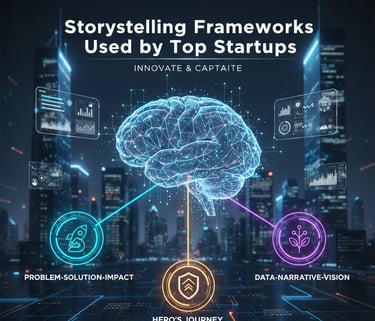
Storytelling Frameworks Used by Top Startups: The Architecture of Conviction
If you study the early pitch decks of Airbnb, Uber, or Slack, you’ll notice they don't just present data; they follow a rigorous narrative architecture. In the venture capital hubs of London, New York, and San Francisco, a "story" isn't a vague sequence of events—it is a logical machine designed to move an investor from curiosity to commitment.
The brutal truth? A "great idea" without a framework is just noise. Top startups use specific storytelling structures to ensure their "Signal" remains pure as it travels through the VC’s internal evaluation process. Behind every "overnight success" in the US, UK, and Canada is a founder who mastered the frameworks that turn complexity into inevitability.
This sub pillar is part of our main Pillar 5: Storytelling and Narrative Engineering
1. The "Strategic Narrative" (The Andy Raskin Framework)
This is the framework that powered the legendary Zuora and Salesforce decks. It is the gold standard for category-defining startups. It completely skips the traditional "Problem" slide in favor of a "Big Change."
The Big Change: You name a shift in the world that creates winners and losers. (e.g., "The move from ownership to subscription.")
The Winners and Losers: You show that those who don't adapt to this shift will die.
The Promised Land: You describe the future state where your customer has successfully adapted.
The Magic Gifts: You introduce your product features as "gifts" that help the customer reach that Promised Land.
The VC Signal: This framework triggers the Availability Heuristic. If the investor has noticed this "Big Change" in the news or other portfolio companies, they immediately associate your startup with a global trend, reducing their perceived risk.
2. The "Bridge" Framework (Current Hell vs. Future Heaven)
This framework is highly effective for B2B SaaS and Fintech startups in London and Toronto, where investors are obsessed with efficiency and ROI. It is a stark, binary comparison that makes the "Status Quo" look intolerable.
The Current Hell: Quantify the pain. Use the "Economic Bleed" logic. (e.g., "The industry is wasting £10B a year on manual reconciliation.")
The Future Heaven: Show the world where that waste is eliminated.
The Startup as the Bridge: Your product is the only way to get from Hell to Heaven.
The VC Signal: This triggers Loss Aversion. By quantifying the "Hell," you make the investor feel the pain of the status quo. They don't just want to fund your solution; they want to stop the bleeding.
3. The "Inevitability" Engine (The Data-Backed Story)
Commonly used by "deep tech" and high-growth startups in San Francisco and New York, this framework uses traction to prove that the story has already begun.
The Spark: A technical breakthrough or a regulatory change.
The Proof of Life: Early traction metrics (The "Signal") that show the market is reacting.
The Scale-up Logic: "If we pour $X into this engine, it will reach $Y scale because the unit economics are proven."
The VC Signal: This triggers Confirmation Bias. By showing the "Proof of Life" first, you get the investor to agree that the product works. They then spend the rest of the pitch looking for reasons to justify why they should give you the money.
The "Trench" Report: The $20M "Causality" Win
I once audited a deck for a Canadian AI firm that was struggling to raise. Their deck was 15 slides of "cool features." They had no framework. They were telling the investor, "Look at our shiny toy."
The Fix: We applied the "Therefore/But" framework.
"We have the best algorithm, BUT the market is locked behind legacy silos. THEREFORE, we built an API that bypasses those silos. BUT our competitors charge $100k, THEREFORE we are launching a freemium model to capture the 80% of the market they ignore."
The Result: The narrative became a relentless chain of logic. It felt like a legal argument. They raised their $20M Series A from a New York fund because the "Therefore" chain made the investment feel like a mathematical certainty.
Key Takeaways: Narrative Frameworks
The Hero’s Journey Pivot: Stop making yourself the hero. The Customer is the hero; your product is the Magic Gift that allows them to overcome the "Monster" (The Problem).
The "Three-Act" Structure: Establish the Status Quo, introduce the Disruption, and conclude with the Inevitable Future.
The "Bridge" Framework: Clearly define the "Current Hell" and the "Future Heaven," and position your startup as the only bridge between the two.
Logical Consistency: Use the "Therefore/But" rule (popularized by South Park creators) to ensure every slide has a causal relationship with the next.
Expert FAQ: Narrative Frameworks
Which framework is best for a Seed round?
The Bridge Framework is often best for Seed rounds because it focuses on a specific pain point and proves you have the "Magic Gift" to solve it. It’s simple, punchy, and easy for an Associate to explain to a Partner.
How do I use "The Hero's Journey" in a pitch?
Make the Customer the hero. The story shouldn't be "We worked hard to build this." It should be "Our customer was struggling with [Monster], then they found [Your Product], and now they have reached [Promised Land]."
Why do top startups avoid the "Standard" template?
Because the standard template (Problem/Solution/Market) is often too static. Top startups want to show Velocity. Frameworks like the "Strategic Narrative" show that the world is moving, and the startup is moving even faster.
Should I use different frameworks for different regions?
Yes. In SF, use the "Strategic Narrative" (Vision). In London/Toronto, use the "Bridge" (Efficiency). In New York, use the "Inevitability Engine" (Data/ROI).
Funding Blueprint
© 2025 Funding Blueprint. All Rights Reserved.