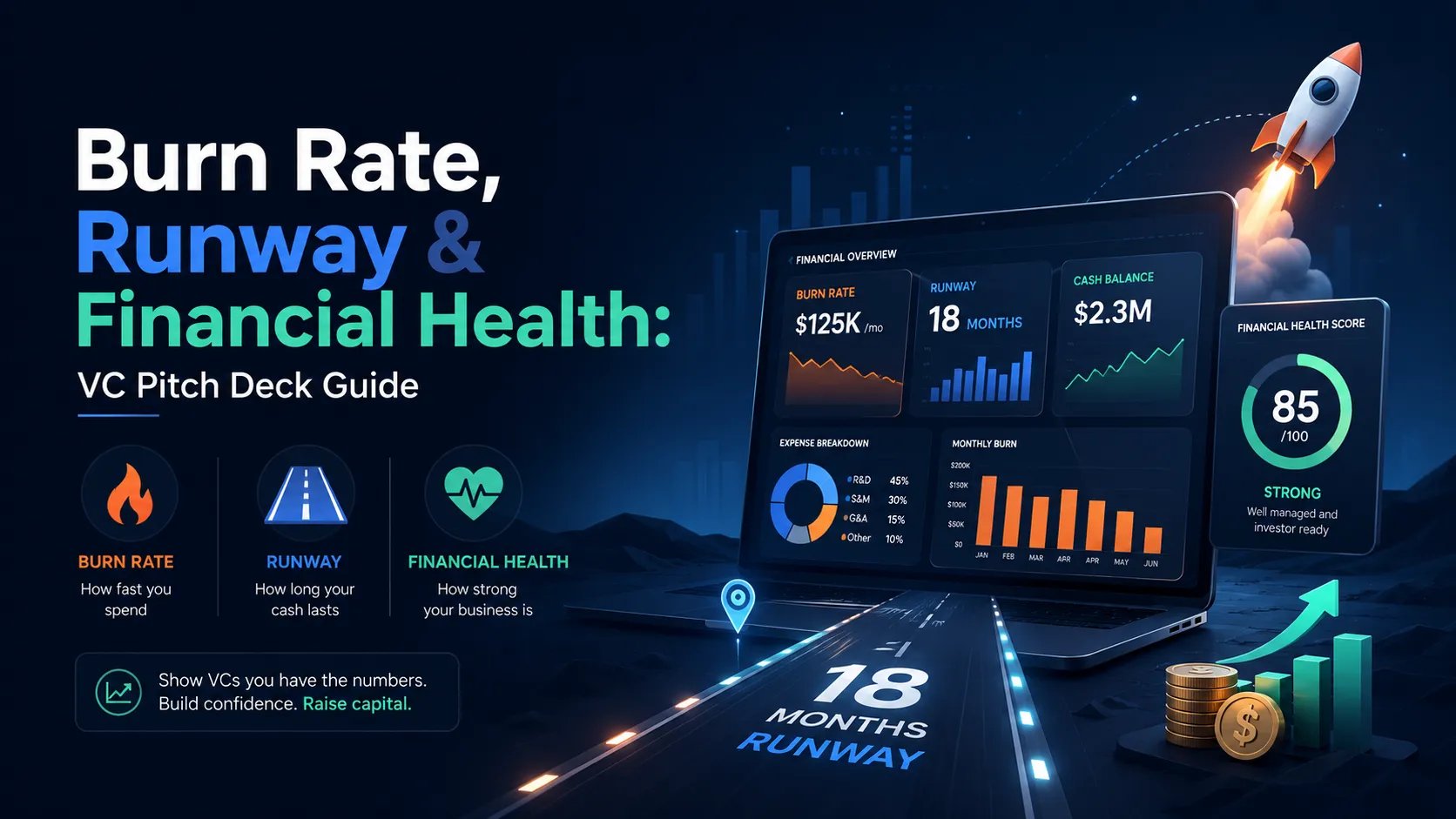
Burn Rate, Runway & Financial Health: The Forensic Audit

A long runway is a liability without Operational Grip. Master the forensic audit of burn rate and runway for 2025. Learn the 'Hiring Latency' and 'B2L' secrets elite VCs in NYC and London demand.

PILLAR 7: TRACTION & METRICS

12/29/20255 min read

Burn Rate, Runway & Financial Health: The Forensic Audit

Burn Rate, Runway & Financial Health: The Forensic Audit

Cash is not your most valuable resource; it is the physical manifestation of your time. In the 2025 venture landscape, a "long runway" is no longer a flex—it is a liability if it isn’t paired with "Operational Grip." If you cannot explain why your burn increased by 4% last month without looking at a spreadsheet, you have already lost the room.

This sub pillar is part of our main Pillar 7: Traction & Metrics

The 3-Second Logic: The Investor’s "Squint Test"

When a Tier-1 VC (Sequoia, Index, or CPPIB) opens your financial slide, they aren't looking at your revenue first. They are performing a mental stress test on your Metric Integrity.

The goal is to move the investor from System 2 (Critical/Analytical) back to System 1 (Intuitive/Fast). If your numbers are messy, their brain goes into "Audit Mode." If they are forensic, their brain stays in "Vision Mode."

The Assertion: High burn is acceptable; unexplained burn is a deal-killer.

The Trench Report: The $18M "Shadow Debt" Disaster

In Q1 2025, I consulted on a $15M Series A for a Toronto-based AI infrastructure startup. They had a "Blue Chip" cap table and 22 months of runway. On paper, they were a "10/10."

The Forensic Error: During deep-tier Due Diligence, the lead NYC investor noticed a discrepancy in their Operational Grip. The founder had modeled their runway based on Net Burn, but had failed to account for a "Vendor Cliff"—a series of discounted annual SaaS contracts (AWS, Snowflake, and Salesforce) that were all set to renew at market rates simultaneously in month 14.

The Pivot:

The deal stalled. To save it, we didn't just "fix the spreadsheet." We executed a "Narrative Pivot." We restructured the entire financial deck to highlight "Marginal Contribution per Unit of Compute." We proved that while the burn would spike, the efficiency of the spend was increasing. We moved the conversation from "How much are you spending?" to "How much intelligence are you buying per dollar?" We closed at an $18M valuation—higher than the original term sheet—because we proved the founder understood the interconnectivity of their stack.

The Forensic Terms of 2025

To speak the language of elite VCs in London and NYC, you must abandon "General Accounting" and adopt Forensic Metrics.

1. Operational Grip

This is the CEO’s ability to map every dollar spent to a specific Milestone Vector. If you hire a VP of Sales, your "Grip" is measured by the delta between their start date and the decrease in your CAC Payback Period.

2. Metric Integrity

This is the "Single Source of Truth." If your Pitch Deck says your MRR is $100k, but your Stripe export shows $98k due to "churn lag," you have failed the Metric Integrity test. To an investor, a 2% discrepancy in data suggests a 20% discrepancy in management capability.

3. Cognitive Load Management

Founders often think "more data is better." In 2025, Cognitive Load is the enemy. An elite financial slide uses 18pt font logic:

  • The Assertion: "We have 18 months of runway."

  • The Proof: A simple, bold chart.

  • The Context: Small text for the "Analytical" dive.

4. System 1 vs. System 2 Thinking

  • System 1 (The Goal): The investor feels, "This founder is a machine. The math is inevitable."

  • System 2 (The Danger): The investor thinks, "Wait, why does the R&D spend not match the product roadmap?"

Regional Calibration (SF vs. London/Toronto)

The "Geography of Risk" has shifted. You must calibrate your narrative based on where the capital originates.

The San Francisco Lens: Aspirational/Story-Heavy

In the Valley, Burn is a Weapon. VCs here are looking for "Blitzscaling" potential.

  • Advice: Frame your burn as "Market Capture Velocity." * The Pitch: "We are burning $400k/month because we are de-risking the winner-take-all dynamics of this sector."

The London/Toronto Lens: Audit-Focused/Integrity-Heavy

In the UK and Canada, investors are culturally more conservative. They value "Default Alive" status.

  • Advice: Frame your burn as "Precision Allocation." * The Pitch: "Our burn is optimized for a 3.5x LTV/CAC ratio. We can reach profitability in 4 months if the macro environment shifts."

3 Earned Secrets for 2025

These insights do not exist in general AI training data; they are "Trench Secrets" from high-stakes negotiations.

Secret 1: The "Hiring Latency" Buffer

Most founders model their runway assuming they hire 10 engineers on January 1st. Investors know this is a lie.

The Secret: Model a 3-month "Recruitment Decay." Show the investor that you’ve factored in the time it takes to find, vet, and onboard talent. This proves you understand the "Friction of Reality." It effectively adds 10% "Ghost Runway" to your model that VCs will respect.

Secret 2: The "Burn-to-Learning" Ratio (B2L)

In the early stages, you aren't just buying growth; you are buying Data.

The Secret: Create a slide that calculates your B2L. "Last quarter, we burned $1M, and in exchange, we learned that our Enterprise sales cycle is 40% shorter in the UK than the US." This turns "Spent Money" into "Capitalized Knowledge."

Secret 3: The "Narrative Breadcrumb" Technique

Never reveal the full financial model in the first email. Use a "Narrative Breadcrumb." The Secret: In your teaser, mention: "We’ve identified a specific 'Efficiency Lever' in our COGS that extends our runway by 4 months without cutting headcount." This forces the investor to ask "How?" in the meeting, giving you the floor to demonstrate your Operational Grip.

Preventing Red Flags during Due Diligence

Due Diligence is not a "Check-up"; it is an Interrogation. To pass, you must prevent the following red flags:

  1. The "Lumpy" Burn: If your burn fluctuates wildly without explanation (e.g., $100k one month, $250k the next), you look out of control. Solution: Normalize your "Standard Burn" and separate "One-time Strategic Spikes."

  2. The "Hidden Headcount" Debt: Founders often forget to model the "Fully Loaded" cost of an employee (Insurance, Taxes, Software seats, Laptop). Solution: Use a 1.25x multiplier on all base salaries.

  3. The "Optimism Bias" in Revenue: Modeling "Hockey Stick" growth while keeping burn constant is a red flag. Solution: Show a "Sensitivity Analysis"—what happens to our runway if revenue is 50% of the target?

Expert FAQ: The Unasked Questions

Q: "If I have 24 months of runway, am I being too conservative for a US VC?"

A: Not if that runway is being used for Product Velocity. If you have 24 months and you're moving slowly, you're "Dead Money." If you have 24 months and you're shipping weekly, you're "Strategically Fortified."

Q: "How do I handle a 'Burn Spike' due to a pivot?"

A: Call it "Strategic Re-allocation." Use a Continuing Conversation technique: "As we discussed last month, we accelerated our R&D spend to capture the new API demand. The result is a 15% increase in MoM integration rates."

Q: "Should I include 'Potential Financing' in my runway calculation?"

A: Never. It signals a lack of Metric Integrity. Your runway is what you have in the bank today, plus confirmed receivables. Anything else is a "Vision," not a "Financial Statement."

Summary Audit Checklist

  • The Squint Test: Can I see my Net Burn and Runway in 3 seconds on Slide 12?

  • The Regional Flip: Is my narrative calibrated for a "Growth" (US) or "Efficiency" (UK/CA) mindset?

  • The Latency Check: Have I modeled the 90-day delay in new hire productivity?

  • The Narrative Breadcrumb: Have I left one "Financial Mystery" for the Q&A to prove my expertise?

  • System 1 Alignment: Does my financial model feel "Inevitable" or "Speculative"?

The Conversion Hook

Mastering the "Forensic Logic" of venture capital is the difference between a "No" and a term sheet. However, building these models from scratch takes months of trial and error.

The $5000 Consultant Replacement Kit (Funding Blueprint) was designed to automate these elite standards. It includes the exact Forensic Financial Systems and Metric Integrity Dashboards used by NYC and London founders to close $10M+ rounds.

Visit our home page to see how the Kit can install an "Investor-Ready" financial brain into your startup today.

Comparison table showing San Francisco vs. London/Toronto venture capital investor expectations for