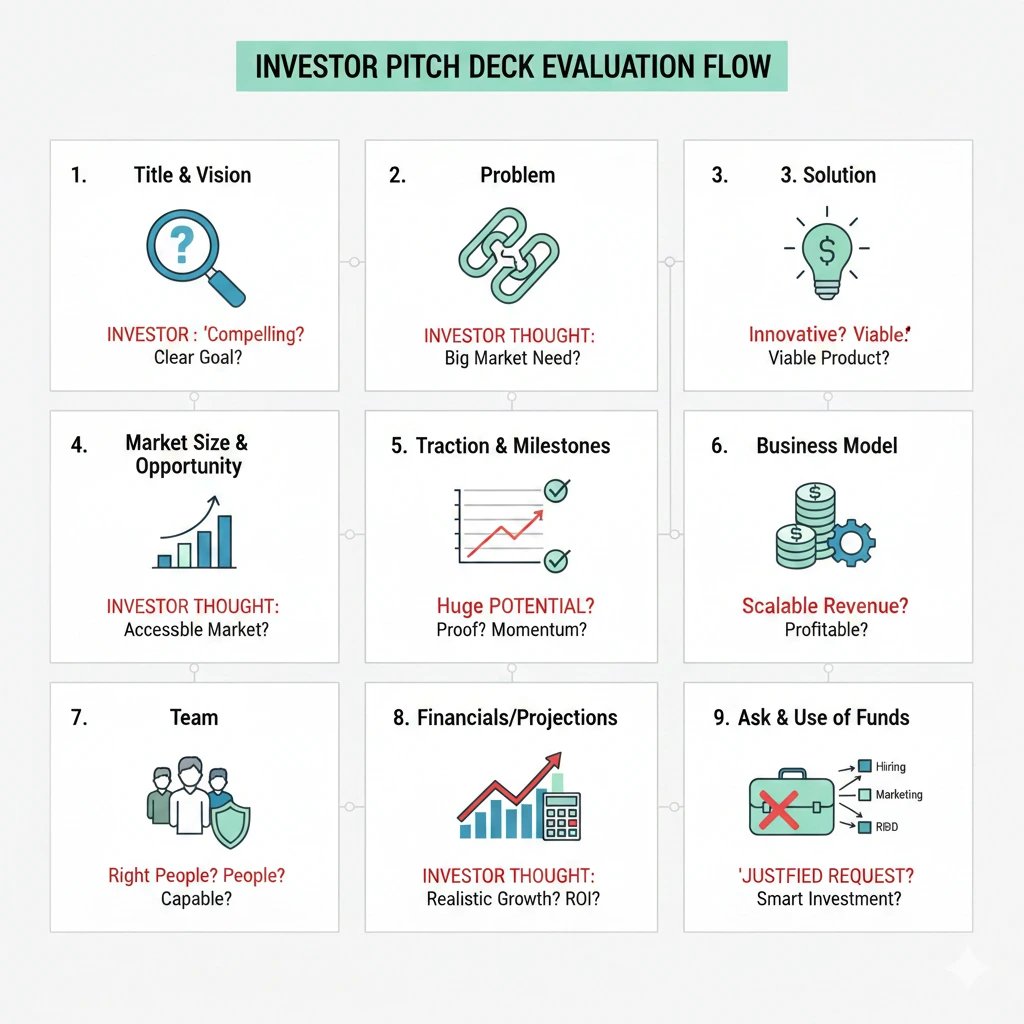
Slide-by-Slide Mastery: How VCs Evaluate Every Pitch Deck Slide
Learn how VCs evaluate each pitch deck slide, what signals they extract, and how founders should structure every slide to pass investor judgment.
PILLAR 3: SLIDE STRUCTURE & FRAMEWORKS
12/15/20254 min read


Slide-by-Slide Mastery: How VCs Evaluate Every Pitch Deck Slide
Storytelling is for the stage; logic is for the bank account. When I’m reviewing a deck from a founder in London, New York, or Toronto, I am not looking for a narrative masterpiece. I am looking for a sequence of logical "green flags" that prove you aren't going to set my Limited Partners' capital on fire.
The brutal truth? Most founders spend 80% of their time on the slides that matter the least. You obsess over the "Vision" slide while I’m squinting at your "Unit Economics" to see if your business model is actually a disguised charity.
This sub pillar is part of our main PILLAR 3 — SLIDE STRUCTURE & FRAMEWORKS.
The VC Lens: The "De-Risking" Checklist
In an Investment Committee (IC) meeting, we don't ask, "Is this cool?" We ask, "What are the ways this dies?" Every slide in your deck is either a shield that deflects a risk or a red flag that invites one.
We evaluate decks through a lens of Information Density. If a slide is 90% stock photos and 10% data, you are hiding something. In the US, we look for "Blitzscale" potential—can this capture a market in 24 months? In the UK and Canada, we look for "Capital Efficiency"—how far can you stretch a seed round before you need me again? If your slides don't answer these regional anxieties, you’re dead on arrival.
The "Trench" Report: The $10M Font Size Fiasco
I once sat in on a pitch for a London-based fintech firm. On paper, they were perfect. But their "Competition" slide was a standard 2x2 matrix where they were in the top-right corner (shocker). When I pressed the CEO on why a legacy bank couldn't just replicate their "proprietary" API, he pointed to a tiny footnote on slide 8.
The consequence? The IC viewed his inability to front-center the competitive threat as a sign of intellectual dishonesty. We passed. Two months later, a Tier-1 US firm funded their direct competitor who had a slide titled: "Why we will probably fail (and how we’ll prevent it)." That founder acknowledged the risk head-on. That is the signal we crave.
The Tactical Framework: The "3-Second Signal" Audit
To master the slide-by-line evaluation, every slide must pass the RIE Framework:
Relevance (The "So What?"): If this slide disappeared, would the investment thesis crumble? If not, move it to the appendix.
Insight (The "Earned Secret"): Does this slide tell me something I don't already know about the industry? Don't tell me "Retail is moving online." Tell me "High-street returns are costing UK retailers £7B annually, and we've cut that by 40%."
Evidence (The "Proof"): Every claim must be tethered to a metric. "Fast growth" is a claim. "15% WoW growth over 12 weeks" is evidence.
Semantic Depth: The Slide-by-Slide Micro-Audit
Let’s get technical. Here is exactly what is being audited during that 45-second flip-through.
1. The Problem (The Market Gap)
Stop talking about "pain points." Start talking about Economic Inefficiency. I want to see a quantified loss. If you’re pitching to a New York VC, the problem needs to be a "hair on fire" emergency. If it's a "nice to have," your Customer Acquisition Cost (CAC) will be too high.
2. The Solution (Product-Market Fit)
I don’t want a feature list. I want to see the Value Prop expressed as a function of time or money. Show me the UI/UX, but only if it demonstrates a 10x improvement over the status quo. In Canada, investors are particularly sensitive to "Feature vs. Platform" risks. Prove you aren't just a Chrome extension.
3. Traction (The Proof of Life)
This is where the adults stay in the room. I’m looking for:
CMGR: Compound Monthly Growth Rate.
LTV/CAC: Show me the LTV is calculated on a contribution margin basis, not gross revenue.
Cohort Retention: A "Smile Curve" in your retention cohorts is the single most beautiful thing a VC can see. It proves that users who leave eventually come back.
4. Market (TAM/SAM/SOM)
If I see a top-down chart from Gartner, I assume you’re lazy. Give me a Bottom-Up Market Sizing.
Calculation: (Total Number of Reachable Accounts) x (Annual Contract Value). If that number isn't $1B+ for a US fund or £500M+ for a UK fund, you aren't "venture scale."
5. The Business Model (The Engine)
Show me your Gross Margin. If you are a "tech" company with 30% margins, you are actually a services company. I want to see 70-80% margins. Mention your Payback Period—if it’s under 6 months, you have a money-printing machine.
6. Competition (The Defensive Moat)
The 2x2 matrix is tired. Use a Feature Comparison Table but include "Incumbent Inertia" as a competitor. Acknowledge that your biggest competition isn't another startup; it's the customer doing nothing.
The Pillar Connection: Strengthening "The Pitch Deck Masterclass"
This sub-pillar is the "execution layer" of the Pitch Deck Masterclass. You can understand the "Core Structures," but if you fail the slide-by-slide audit, the structure is just an empty house. This is where you convert abstract strategy into high-fidelity signal. Mastering these individual components ensures that when an investor performs their due diligence, the "Golden Thread" of your narrative remains unbroken.
Expert FAQ: The Insider Truths
Q: Should I include my valuation on the 'Ask' slide?
A: Never. In London and New York, the market sets the price. Putting a number on the slide anchors the negotiation and can scare off leads. Just state how much you are raising and what milestones that capital will buy you (e.g., "Raising £2M to reach £100k MRR").
Q: How many slides is too many?
A: 12 slides for the core deck. 50 slides for the appendix. If I ask a technical question about your Net Revenue Retention (NRR) and you can instantly pull up an appendix slide with a cohort heat map, you’ve won the meeting.
Q: What if my traction is currently weak?
A: Then pivot the "Traction" slide to a "Momentum" slide. Show me the velocity of your product development, the quality of your early design partners, or the growth of your waitlist. VCs invest in lines, not dots. Show me the slope of your progress.
Q: Do VCs actually read the "Team" slide first?
A: In Toronto and SF, often yes. We want to see Founder-Market Fit. Why are you the one person in the world who can solve this? If your team slide is just a list of universities, you’re missing the point. I want to see "Founding Engineer at [Successful Scale-up]" or "Ex-[Industry Giant] with 10 years of domain expertise."
Funding Blueprint
© 2025 Funding Blueprint. All Rights Reserved.