
Seed Stage Pitch Decks: What VCs Demand on the Solution Slide
Are you pitching features instead of mechanisms? Stop losing Seed rounds to product brochures. Learn the Solution Slide standard VCs demand in 2026.
2.5 PROBLEM/SOLUTION SLIDES BY STAGE: PRE-SEED → SEED → SERIES A
2/21/20266 min read
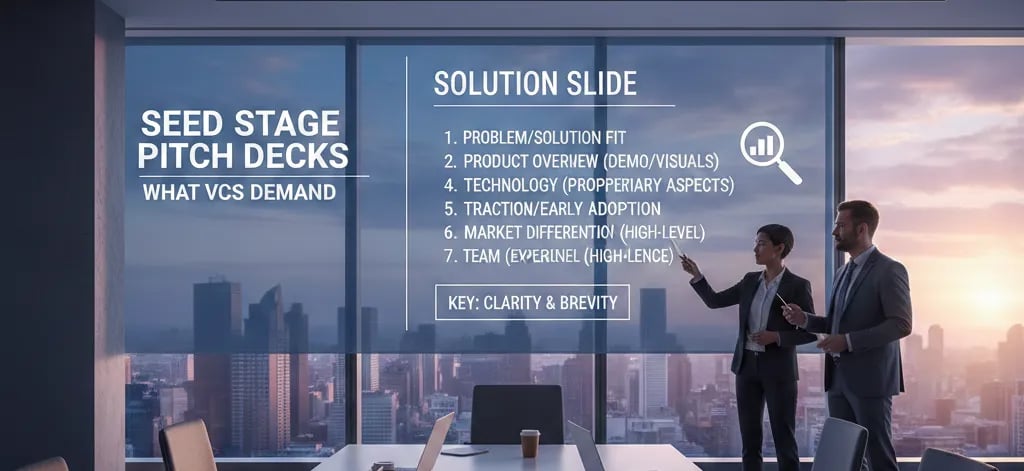
Seed Stage Pitch Decks: The Solution Slide Standard VCs Are Holding You To in 2026
(And Why Most Founders Miss It by One Layer)
You will not get a second meeting. Here is the slide that closed that door before you left the room.
The Seed Solution Slide is where founders most consistently destroy rounds they had already half-won. The Problem Slide got the VC leaning forward. The traction slide had a number worth discussing. But the Solution Slide — the one that should have connected those two — read like a product brochure. Features listed. Benefits claimed. Mechanism absent. The VC mentally filed it under "not differentiated enough" and spent the rest of the meeting looking for a reason to pass instead of a reason to wire.
This failure pattern is specific to Seed, and it is specific to how Solution Slides are built at this stage. The full progression of how Solution Slides must evolve from Pre-Seed through Seed to Series A makes clear why the Seed version carries a unique burden — it must prove mechanism, not just concept. If the Pre-Seed Solution Slide sells a hypothesis, the Seed Solution Slide must sell a working thesis.
Why Seed-Stage Solution Slides Fail the Mechanism Test (And What That Costs You in the Room)
A Pre-Seed VC is betting on the problem and the team. A Series A VC is betting on the model and the moat. A Seed VC is betting on something more precise: that the specific way you have chosen to solve this problem is the right way, and that early evidence confirms it is working.
That is a mechanistic question, not a features question. And almost every weak Seed Solution Slide answers the wrong question.
Here is what a VC is actually asking when they look at your Solution Slide at Seed:
What specifically does your product do that changes the outcome the Problem Slide described?
Why does this mechanism work when others have failed or ignored it?
Where is the early signal that confirms the mechanism — not just that customers signed up, but that the product is producing the promised result?
Founders answer with features because features feel concrete. "Our platform uses AI to automate X" sounds specific. It is not. It describes a category, not a mechanism. In 2025, with AI appearing in over 70% of Seed-stage decks reviewed by top-tier US funds, "AI-powered" is now table stakes language — it adds no differentiation and often triggers skepticism about whether the founder understands their own technical architecture. The last four Seed-stage Solution Slides I reviewed that led with AI automation as the headline were all asked to resubmit after the first partner call — in each case, the follow-up question the VC could not get answered was: "But why does your approach work?"
The psychological error is conflating what the product does with how the product works. Founders are close to the product, so they default to describing it. VCs are evaluating the business, so they need to understand why it wins.
The Mechanism Gap: A Mathematical Case for Why Feature-First Slides Lose Deals
Consider what a Seed VC is underwriting. As of 2025, median Seed check sizes from institutional funds in the US sit between $1.5M and $3M, with pre-money valuations typically ranging from $8M to $15M. At that entry price, the fund's return model requires the company to reach Series A at a $25M–$40M pre-money minimum. That means the VC needs to believe your solution can scale from early traction to a repeatable, defensible growth engine.
A feature list does not answer that. A mechanism does.
Here is the gap mapped precisely:
Invoice Automation
What Founders Write: "Our platform automates invoice processing."
What VCs Need to Read: "We intercept the AP exception queue at the point of escalation — the 11% of invoices that cause 80% of processing delays — and resolve them without human review."
Churn Reduction
What Founders Write: "We use ML to reduce churn."
What VCs Need to Read: "Our model identifies the behavioral signature of at-risk accounts 34 days before cancellation — early enough for CS intervention, late enough to target only genuinely at-risk users."
Operational Efficiency
What Founders Write: "Our tool saves ops teams 6 hours per week."
What VCs Need to Read: "We eliminate the reconciliation step between the WMS and ERP entirely — the step that currently requires a human bridge because the two systems were never designed to communicate."
The right column is mechanism. It describes where in the workflow the product intervenes, why that intervention point is the correct one, and what specifically changes as a result. The left column describes an outcome without explaining how it is produced.
The credibility equation at Seed: Precise Intervention Point + Reason the Mechanism Works + Early Validation Signal = A Solution Slide a VC can stress-test.
If a VC cannot stress-test your solution, they cannot underwrite it. If they cannot underwrite it, they pass.
The "Working Thesis" Protocol: Building a Seed Solution Slide That Closes the Mechanism Gap
The standard you are building toward: your Solution Slide should be specific enough that a VC can immediately form a diligence question. A diligence question means they are testing your answer, not dismissing it. That is a buying signal disguised as scrutiny.
Step 1 — Name the Intervention Point, Not the Category Do not describe the space you are in. Describe the exact moment in your customer's workflow where your product changes the outcome. "We integrate with Salesforce" is a category claim. "We intercept the deal review step between the AE and manager — the step where 40% of deal risk goes unidentified — and surface the signal before the QBR, not after" is an intervention.
Step 2 — Explain the Mechanism in One Sentence Finish this sentence: "The reason our solution works where others have failed is _____." If you cannot finish it cleanly, the slide is not ready. This sentence belongs on the slide, stated directly. VCs respect founders who can articulate their own edge without prompting.
Step 3 — Attach Early Validation to the Mechanism, Not to General Adoption Seed-stage validation must prove the mechanism is working, not just that people are using the product.
Weak: "We have 14 paying customers."
Strong: "Across 14 paying customers, we have reduced average AP exception resolution time from 4.2 days to 11 hours. Six customers have expanded within 90 days of reaching that outcome."
The expansion data is critical. It tells the VC the mechanism produces repeatable value — which is the only thing that can justify a Series A later.
Before vs. After — Full Slide Framing:
Weak Version: "Our AI platform helps finance teams automate manual workflows, saving time and reducing errors. Customers report high satisfaction and improved efficiency."
VC-Ready Version: "We eliminate the reconciliation gap between ERP and WMS systems for mid-market manufacturers — a manual process that currently costs $340 per shift in labor and error correction. Our system resolves exception queues automatically at the point of flag, before human escalation. Across 14 customers, average resolution time dropped from 4.2 days to 11 hours. Six expanded within the first quarter."
The difference is not length. It is the presence of mechanism, intervention point, and outcome validation — all three, in sequence.
Three Errors Seed Founders Make When Rebuilding the Solution Slide
1. Adding a demo screenshot instead of a mechanism. A product screenshot shows what the UI looks like. It does not explain why the product works. Screenshots belong in the product section. The Solution Slide needs logic, not visuals.
2. Claiming differentiation without specifying what you are different from. "Unlike legacy tools, our platform is built for modern teams" is not differentiation. It is positioning language with no anchor. Name the specific failure mode of the alternative — then explain why your mechanism avoids it.
3. Burying the early validation signal at the bottom as an afterthought. At Seed, validation is the most important thing on the slide. It should not appear as a footnote after four bullet points about features. Lead with the outcome. Explain the mechanism. Support it with the number.
The Seed Solution Slide Is Not a Product Description - It Is a Business Underwriting Document
Every element of this slide is feeding a VC's internal model: Can this mechanism scale? Is the early evidence real? Does this founder know why their product works? A slide that answers all three — precisely and without requiring the VC to ask — is a slide that earns the term sheet conversation.
The full system for building slides that perform this function at every stage, from problem framing through solution architecture and beyond, is inside the complete Problem and Solution slide framework built for venture-backed founders.
You can build this manually across 40 hours of iteration, stress-testing every word choice against what a Seed-stage VC analyst will actually check during diligence — or you can use the Slide-By-Slide VC Instruction Guide inside the $5K Consultant Replacement Kit to deploy the correct structure in one focused session. The Guide specifies exactly what belongs on a Seed Solution Slide, in what sequence, and why each element earns its place. The full Kit is $497. Build the slide that survives the mechanism question at the pitch deck system Seed-stage founders are using before their first institutional meeting.
The VC is not asking what your product does. They are asking why it works. Answer that question on the slide before they have to ask it out loud.
Funding Blueprint
© 2026 Funding Blueprint. All Rights Reserved.