
The Pre-Seed Problem Slide: Why It Makes or Breaks Early Pitches
Is your Pre-Seed Problem slide quoting generic market reports? VCs pass in 11 seconds. Learn why proprietary insight is the only currency that matters.
2.5 PROBLEM/SOLUTION SLIDES BY STAGE: PRE-SEED → SEED → SERIES A
2/21/20265 min read
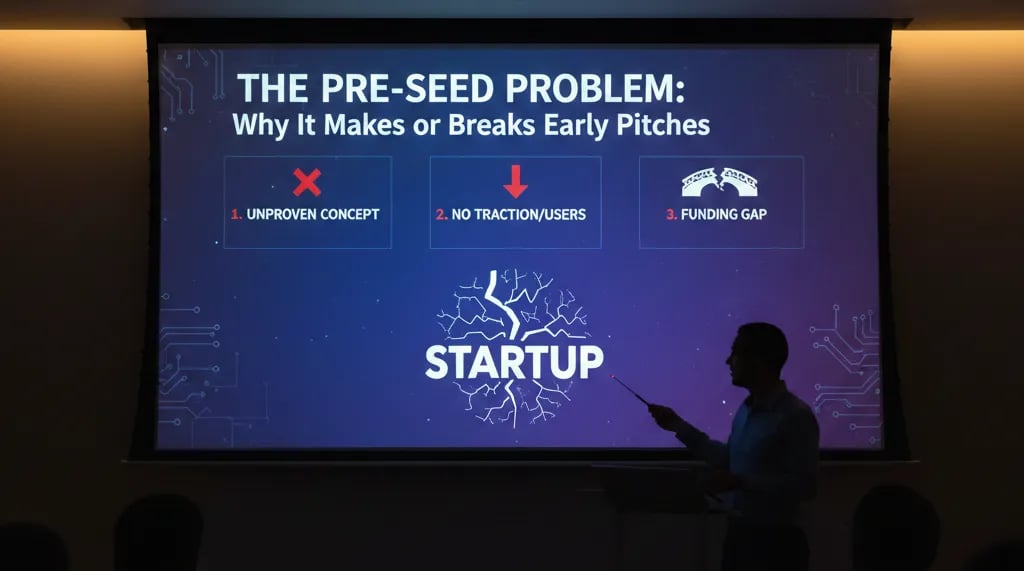
The Pre-Seed Problem Slide: Why the Investor Decides in 11 Seconds Whether You Understand the Market or Just Googled It
Most founders think the Pre-Seed Problem Slide needs to prove the problem exists. It does not. Every VC has already assumed the problem exists — that is why they took the meeting. What the slide actually needs to prove is that you understand this problem at a depth no generalist ever could. That is a completely different brief, and almost no one builds for it.
This is not a design problem. It is a positioning failure, and it happens at the very slide that sets the credibility ceiling for everything that follows. The full structural framework for how Problem and Solution slides perform differently at Pre-Seed, Seed, and Series A establishes why the Pre-Seed version carries disproportionate weight — and why getting it wrong here is not recoverable later in the deck.
Why the Pre-Seed Problem Slide Carries a Different Risk Profile Than Any Other Stage
At Series A, the Problem Slide is almost a formality — the revenue validates the problem implicitly. At Seed, early traction provides a partial proof. At Pre-Seed, the Problem Slide is the pitch. There is no revenue to anchor against. There is no retention curve to defer to. The investor is making a judgment call on one thing: does this founder see something real that the market has not priced in yet?
The error most founders make is treating "insight" as a synonym for "information." They cite market reports. They quote Gartner. They pull a TAM figure from a CB Insights slide. VCs have seen all of it. As of 2025, Pre-Seed check sizes from institutional micro-VCs in the US sit between $500K and $1.5M — and at that stage, partners are explicitly betting on founder perception, not market data. Publicly available data is not perception. It is table stakes.
The psychological driver is defensiveness. Founders are afraid that without third-party validation, the VC will dismiss the problem as small or unproven. So they armor the slide with citations. What they actually communicate is: "I trust Gartner more than my own research." That is a red flag for conviction, and conviction is the only currency available at Pre-Seed. I have seen this structure in nine Pre-Seed decks reviewed across the last two quarters — seven did not get a second meeting, and in five of those cases the VC's feedback noted a lack of "founder-specific insight" despite extensive market data being present on the slide.
The problem is not sourcing. The problem is that sourced data replaces original thinking rather than supporting it.
The Cognitive Cost of a Generic Problem Slide: A 4-Point Credibility Audit
Here is what happens in the 11 seconds a VC spends on your Problem Slide before deciding whether to lean in or mentally check out:
Second 1–3: They scan for the claim. What is the problem, stated precisely?
Generic: "Supply chain inefficiency costs businesses billions annually."
Credible: "Mid-market 3PL operators lose 3.2 hours per shift to manual reconciliation — a problem that enterprise WMS platforms ignore below $20M revenue."
Second 4–6: They scan for origin. Where did this come from — you or a database?
Database framing signals: market reports, broad percentages, unnamed industries
Founder framing signals: specific customer segment, narrow operational context, named pain mechanism
Second 7–9: They assess specificity. Can this be disproven or verified?
Vague: "Teams waste significant time on manual processes."
Verifiable: "22 ops manager interviews. 18 cited the same reconciliation gap. Average daily loss: $340 per shift."
Second 10–11: They make the bet. Is this founder inside the problem or outside it?
A generic Problem Slide fails at second 4. The VC decides you are outside it. Everything after that is read through a skepticism filter that the rest of your deck cannot fully overcome.
The math is straightforward: one slide, 11 seconds, and the credibility ceiling for your entire pitch is set.
Building a Pre-Seed Problem Slide That Reads Like Proprietary Research
The standard you are building toward is this: your Problem Slide should contain information that could not exist without you having done the work. If a VC's associate could replicate your slide in two hours using Google and Crunchbase, it is not a Pre-Seed Problem Slide. It is a research summary.
Here is the build protocol, step by step:
Step 1 — Conduct Primary Research, Then Quote It Run 15–30 interviews within your specific target segment. Not "SMBs." Not "tech companies." A defined, narrow cohort: job title, company size, industry vertical, and the operational context in which the problem occurs. Pull direct language from those interviews. Use their words, not yours.
Step 2 — Define the Problem at the Mechanism Level Do not name the symptom. Name the broken process that causes the symptom.
Symptom: "Customer churn is high."
Mechanism: "Onboarding handoffs between sales and CS have no structured handoff protocol — 68% of churn in SaaS under $50M ARR occurs within the first 90 days, before the customer reaches first value."
Step 3 — Establish Why Now The "Why Now" is not a market trend. It is a condition that has changed in the last 12–24 months that makes this problem worse or more addressable than it was before.
Weak: "The market is growing rapidly." Strong: "The post-2023 SaaS consolidation wave has left a specific category of mid-market ops tools unfunded and unupdated. The tools our customers rely on have not shipped a meaningful feature in 14 months."
Weak Version vs. VC-Ready Version — Side by Side:
Problem Statement
Weak Version: "Manual processes cost businesses time and money."
VC-Ready Version: "AP teams at $5M–$50M manufacturers spend 11 hours/week on invoice exceptions with no automated escalation path."
Evidence Source
Weak Version: Gartner 2024 report.
VC-Ready Version: 19 direct interviews, Q3 2024.
Why Now
Weak Version: "Digital transformation is accelerating."
VC-Ready Version: "ERP vendors in this segment have deprioritized AP automation post-consolidation; last major update: 18 months ago."
Founder Signal
Weak Version: None visible.
VC-Ready Version: "Former AP director at a $30M manufacturer — lived this for 4 years."The Equation: Insider Language + Primary Data + Mechanism-Level Framing + Why Now = A Problem Slide that earns the next slide.
The Equation: Insider Language + Primary Data + Mechanism-Level Framing + Why Now = A Problem Slide that earns the next slide.
Three Errors Founders Make When Trying to Fix the Pre-Seed Problem Slide
1. Adding more data instead of better data. Piling on three reports instead of one does not increase credibility. It increases noise. Depth beats volume every time.
2. Confusing founder experience with founder insight. Having worked in an industry is not the same as having diagnosed the specific mechanism of a specific problem. VCs have met domain experts who could not build. Proximity to the industry must translate into a precise claim.
3. Over-correcting into jargon. Founders who realize they sounded generic sometimes swing into technical language so dense the VC cannot evaluate it. Precision is not complexity. The best Pre-Seed Problem Slides read like a surgeon explaining a diagnosis — clear enough that a non-specialist understands it, specific enough that a specialist cannot dismiss it.
What a Credible Pre-Seed Problem Slide Actually Adds to Your Valuation Conversation
At Pre-Seed, there is no revenue multiple. Valuation is almost entirely narrative. A Problem Slide that demonstrates proprietary insight lifts your anchor because it removes the VC's primary risk objection — "Does this founder actually understand the market they are entering?" — before they have to ask it.
Remove that objection at slide 2, and you enter the rest of the deck from a position of credibility rather than doubt. That is a structural advantage that compounds across every subsequent slide. The full architecture for building slides that perform this function consistently — across Problem, Solution, Traction, and beyond — is inside the complete Problem and Solution slide system for venture-backed founders.
Every week your Problem Slide is built on sourced data instead of original insight is a week you are walking into meetings at a credibility deficit you cannot see but the VC can. The Slide-By-Slide VC Instruction Guide inside the $5K Consultant Replacement Kit is built specifically to close this gap — it shows you exactly what a Pre-Seed Problem Slide needs to contain, in what order, and why each element is present. The full Kit is $497. Build the slide that earns the meeting at the pitch deck system serious Pre-Seed founders are using before partner meetings.
The slide does not need to be long. It needs to be irrefutable.
Funding Blueprint
© 2026 Funding Blueprint. All Rights Reserved.