
What to Include in a Pre-Revenue Deck
No revenue? You need 'Proxy Metrics.' A forensic audit of the Pre-Revenue deck: How to sell 'Inevitable Success' using Waitlist Velocity and Talent Density instead of financial fiction.
1.4 HOW PITCH DECKS FIT INTO DIFFERENT FUNDRAISING STAGES?
1/25/20264 min read
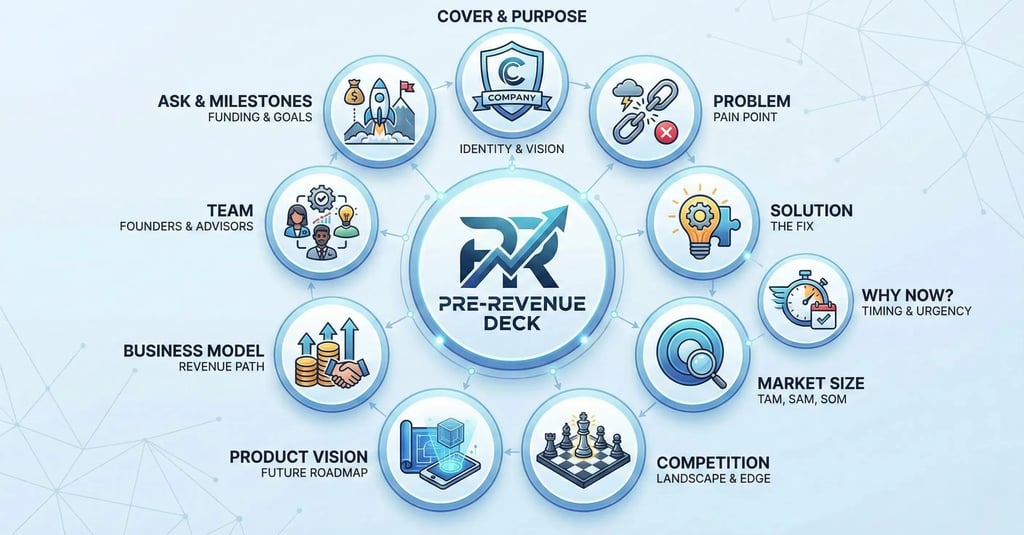
What to Include in a Pre-Revenue Deck
If you are building a pre-revenue deck, you are currently trading on a promise, not performance. However, 90% of founders in the US and UK interpret "promise" as "imaginary financial modeling." They present a hockey-stick chart showing $50M ARR by Year 3 based on absolutely zero data. This is not ambition; it is negligence.
Your pre-revenue deck has one job: De-risk the inevitable failure rate.
Founders at the Pre-Seed stage often believe the deck is about the solution. It isn't. It is about the mechanism of value capture. This distinction is critical because understanding How Pitch Decks Fit Into Different Fundraising Stages is the difference between a term sheet and a "pass." If you treat a pre-revenue deck like a Series A deck minus the revenue, you have already failed.
Why "Projections" Kill Pre-Seed Deals
When a partner at a Tier-1 fund sees a 5-year financial model in a pre-revenue deck, they don't see "potential." They see a founder who doesn't understand unit economics.
The "Red Flag" Scenario: Slide 12: A detailed Excel paste showing $15M EBITDA in 2029. The VC Internal Monologue: "This founder is hallucinating. They don't know their CAC, they have no churn data, and they are guessing pricing elasticity. If they are this delusional about math, they will be this delusional about product market fit."
Psychological Audit: Founders include these slides out of Insecurity and Mimicry. You see public Series B decks and copy the structure, ignoring the context. You fear that without big numbers, the opportunity looks small. In reality, precision on the inputs (hypothesis) is infinitely more valuable than precision on the outputs (revenue) at this stage.
The Cost of "Cognitive Load"
Pre-revenue investing is an exercise in probability, not accounting. Every claim you make that cannot be mathematically verified increases the investor's "Cognitive Load."
Verified Metric: "We have a waitlist of 5,000 users acquired at $0.00 CAC via viral loops." (Load: 0. Instant validation.)
Unverified Metric: "We project capturing 1% of the $50B market." (Load: High. Requires diligence on the market, your assumptions, and your execution capability.)
The Logic of Dilution: If you focus on unproven revenue, you force the investor to discount your valuation based on risk.
Risk of execution: 50%
Risk of market adoption: 50%
Risk of technical failure: 50%
If your deck focuses on "What we might earn," the investor applies all three discounts. Your pre-money valuation collapses. If your deck focuses on "What we have already de-risked" (Team, Tech, Insight), you remove discount factors.
The Equation: Valuation = (Market Size × Execution Probability) / Risk Premium
Your deck must mechanically lower the Risk Premium, not artificially inflate the Market Size.
The Proxy-Traction Framework
Since you cannot show Revenue, you must show Revenue Proxies. You need to prove that money wants to enter your bank account, but the gate isn't open yet.
The Fix: Replace the "Financial Projections" slide with a "Validation Evidence" slide.
The Before vs. After:
Weak Version: A generic graph showing user growth from 0 to 1M over 18 months.
VC-Ready Version: A snapshot of your "Waitlist Velocity."
Metric: "Waitlist growing at 15% WoW with $0 ad spend."
Metric: "3 Letter of Intent (LOIs) signed from Fortune 500 pilots (Total Contract Value: $150k)."
Metric: "Beta retention rate of 60% after 4 weeks (Industry avg: 20%)."
The "Risk-Killer" Framework: Structure your pre-revenue narrative around these three pillars of evidence:
The "Hair on Fire" Problem: Prove the customer pain is acute, not just annoying. Quote 5 customer discovery interviews where they explicitly stated willingness to pay.
The "Unfair" Distribution Advantage: Do not say "We will use FB Ads." Say "We have access to a proprietary community of 10k target users."
The "Builder" Velocity: Show how much you have built with how little capital. "Built MVP in 3 weeks for $500." This signals capital efficiency—a primary metric for Series A eligibility later.
The "Death Traps"
Avoid these lethal errors when pivoting to this model:
The "Advisory Board" Crutch: Do not list "Advisors" from Google or Meta unless they have invested cash. Putting a logo on a slide implies endorsement; if they haven't written a check, the endorsement is weak. It signals you are relying on borrowed credibility.
The "Conservative" Projection: Do not try to look reasonable by projecting "only" $2M in Year 1. It’s still a guess. It’s better to say "We don't know revenue, but here is our burn rate and here is the exact milestone we will hit with this check."
Over-Engineering the MVP: Do not show a 50-slide technical architecture. Show the User Journey. How many clicks to solve the problem? Keep it to 3 steps max.
The "High-Ticket" Conclusion
A pre-revenue deck is a document of intent backed by early signals. By removing the financial fiction and replacing it with validation evidence, you shift the conversation from "Do I believe these numbers?" to "Do I believe this team?"
This shift in framing can legitimately impact your seed round dilution by 5-10%. On a $2M raise, that is $100k-$200k of equity you keep. Stop pitching a fantasy business. Pitch a verified hypothesis.
For a comprehensive breakdown of the entire narrative structure, review How VC Pitch Decks Really Work in 2026 — And Why Most Founders Get Them Wrong.
The Filter Plug
You can guess which metrics to highlight, or you can simply execute the Slide-By-Slide VC Instruction Guide included in our $5k Consultant Replacement Kit ($497) available on the home page. It forces you to answer the exact questions investors are asking before they even open your email.
Funding Blueprint
© 2026 Funding Blueprint. All Rights Reserved.