
How Pitch Decks Fit Into Different Fundraising Stages
Learn how investors evaluate pitch decks differently at Pre-Seed, Seed, and Series A—and why stage mismatch quietly kills otherwise strong startups.
PILLAR 1: HOW VC PITCH DECKS REALLY WORK
12/10/20257 min read
How Pitch Decks Fit Into Different Fundraising Stages: From Vision to Velocity
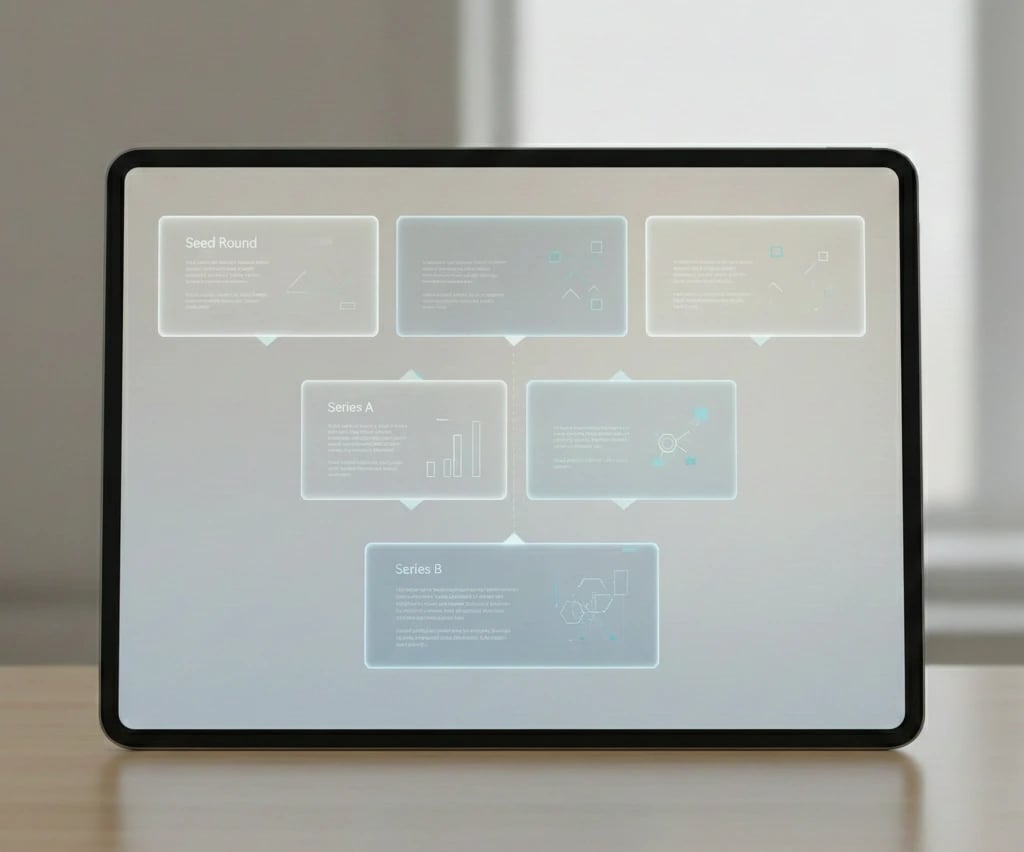
In the global venture capital hubs of London, New York, and San Francisco, a pitch deck is a living document. It is not a "set-and-forget" asset. The deck that secured your $500k Angel round in Toronto will be laughed out of a Mayfair boardroom during a Series B roadshow. As your company matures, the "Signal" investors look for shifts fundamentally: you move from selling Vision (Pre-Seed) to proving Velocity (Seed/Series A) to demonstrating Validation and Defensibility (Series B & Beyond).
The brutal truth? Most founders fail to evolve their narrative as they scale. They keep pitching the "Dream" when the VC wants to see the "Machine." In 2025, with capital being more discerning than ever across the UK, US, and Canada, understanding the technical requirements of each stage is the difference between a term sheet and a "polite pass." You must learn to "re-skin" your narrative for the specific risk-appetite of the stage you are entering.
This sub pillar is part of our main Pillar 1 — How VC Pitch Decks Really Work.
The VC Stage-Gate: What We Screen For
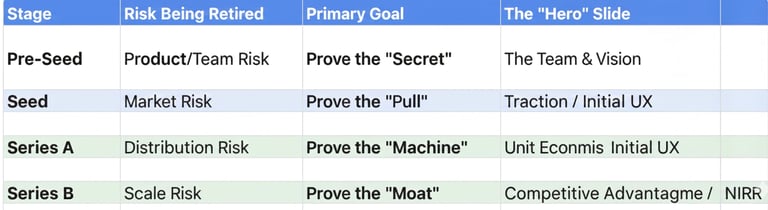
Investors categorize deals into "Risk Buckets." Each stage represents a different type of risk being retired.
1. The Pre-Seed Deck: Selling the "Earned Secret"
At the Pre-Seed stage, you often have no product and no revenue. In San Francisco and New York, this is the "Napkin Phase." Your deck is a psychological argument for your own brilliance and the inevitability of the problem you’ve identified.
The "Jockey" Evaluation
Since there is no "Horse" (the business) yet, the investor is underwriting the "Jockey" (you). Your deck must scream High Agency. You need to prove you have an "Earned Secret"—an insight about the market that you discovered through trial and error, which no one else understands yet.
The Technical Requirement
Founder-Market Fit: Why are you the only person in London or New York who can solve this?
The "Why Now": What technological or regulatory shift (e.g., a new AI breakthrough or a change in UK tax laws) makes this possible today when it wasn't possible six months ago?
Minimalism: Keep it to 10 slides. Don't build a 5-year financial model; it’s a work of fiction that signals you don't understand the volatility of early-stage startups.
2. The Seed Deck: Proving "Product-Market Pull"
By the Seed stage, you should have a Minimum Viable Product (MVP) and early evidence that people want it. In Toronto and Vancouver, Seed investors are significantly more conservative than their peers in Palo Alto. They want to see "Signal" in the noise.
The "Pull" Narrative
At Seed, the story shifts from "I think people want this" to "People are screaming for this." Your deck must highlight Usage Depth. Are people logging in every day? Is your "Waiting List" growing organically?
The Semantic Depth of Seed Metrics
Instead of raw revenue, focus on Retention Cohorts. Even if you only have 10 customers, show that they haven't left.
The VC Thought: "If I give them $2M, can they turn this 'Spark' into a 'Flame'?"
The Red Flag: Using "Cumulative" charts to hide a flat-lining growth rate.
3. The Series A Deck: The "Unit Economic" Audit
This is the most difficult transition for founders. The Series A is the "Grown-up" round. In London and New York, Series A investors are Efficiency Hawks. They are no longer buying a story; they are buying an Engine.
Proving the "Machine"
The narrative of a Series A deck is: "We have found a repeatable way to acquire customers for $1 and turn them into $3 of value." If your deck still looks like a Seed deck—all vision and no math—you will fail.
The Technical Requirements
The GTM (Go-To-Market) Slide: This is now your most important slide. How do you find customers? Is it a "Product-Led Growth" (PLG) motion or a "Top-Down" sales force?
The LTV/CAC Ratio: You must show a path to a 3x ratio.
Payback Period: In the current 2025 economy, UK and Canadian VCs want to see a <12 month payback period. Anything longer is considered capital inefficient.
4. The Series B Deck: The "Scalability" Narrative
By Series B, you aren't just a "startup"; you are an "incumbent-in-waiting." The question is no longer "Will it work?" but "How big can it get?" and "Can anyone stop you?"
The "Moat" and Defensibility
Investors like Hamilton Helmer’s 7 Powers (Moats) are the focus here. Does your business have Network Effects? High Switching Costs? Cornered Resources? Your deck must prove that even if Google or Amazon enters your space, you have a structural advantage they cannot touch.
The Predictability Metric
The "Hero" metric of Series B is Net Revenue Retention (NRR).
The Signal: If your NRR is >120%, it means your existing customers are growing so fast they cover the cost of any churn. This is the ultimate signal of a "Category King."
Fundraising in London vs. San Francisco: Stage Divergence
The "Stage" definition varies wildly by geography.
San Francisco (The "Infinite Upside"): SF investors often treat a Series A like a Seed. They are willing to fund "Aggressive Burn" if the market capture is fast enough. They are looking for the "100x" outcome.
London & Toronto (The "Pragmatic Resilience"): These investors are looking for "Default Alive" companies. They want to see that you can reach the next milestone without needing a "bridge round." A "Seed" in London often requires the traction that an SF company would have at Series A.
The "Trench" Report: The $10M Series A "Ghost"
I once reviewed a Series A deck for a high-growth Fintech firm in the UK. They had a brilliant Seed round based on a "Visionary Narrative." When they went out for their $10M Series A, they used the same deck but updated the logos.
The consequence? They were rejected by 22 funds in a row. The feedback was always: "We love the story, but we don't understand the Sales Velocity." They were still selling the "Secret" when they should have been selling the Distribution Machine.
The Fix: We gutted the vision slides and added a 5-page deep-dive on their Sales Funnel, CAC by Channel, and Cohort LTV. We showed that their "Unit Economics" were getting better as they scaled. They closed the round with a Tier-1 fund in six weeks. You cannot win a Series A with a Seed narrative.
Semantic Depth: The Mechanics of "Growth vs. Scale"
In your deck, you must distinguish between Growth (adding revenue by adding resources) and Scale (adding revenue at a much faster rate than you add costs).
1. The Operating Leverage Slide
In later-stage decks (Series A/B), you need to show Operating Leverage.
The Formula: Operating Leverage= %Change in EBIT
%Change in Sales
The Signal: As your revenue grows, your fixed costs should stay relatively flat. This proves the "Machine" is profitable at scale.
2. The "Traction Slope"
Investors don't just look at the last point on your graph; they look at the Slope. A "Linear" slope is a lifestyle business. An "Exponential" slope is a venture business. In your Series A deck, your traction slide should emphasize the Compounded Monthly Growth Rate (CMGR).
Key Takeaways for Founders
Pre-Seed: Sell the Team and the Secret. Keep it short, bold, and visionary.
Seed: Sell the Pull. Show that customers are obsessed with the MVP. Focus on retention.
Series A: Sell the Engine. Focus on GTM, LTV/CAC, and repeatability.
Series B: Sell the Moat. Focus on NRR, market share, and structural defensibility.
Audit Your Deck: Every 6 months, ask: "Am I still selling the 'Dream' or am I selling the 'Machine'?" If the latter, it’s time to update your metrics.
Key Takeaways: The Evolution of the Deck
Pre-Seed/Seed: Focus on Founder-Market Fit and the "Earned Secret." The deck is a bet on the Jockey.
Series A: Focus on Product-Market Fit and Repeatable Unit Economics. The deck is a bet on the Engine.
Series B & Beyond: Focus on Scalability, Market Dominance, and Moats. The deck is a bet on the Industry Leader.
Regional Nuance: SF values "Vision" earlier; London and Canada demand "Unit Economic Proof" much sooner in the lifecycle.
The Metric Shift: Your narrative must evolve from "Engagement" (Seed) to "Efficiency" (Series A) to "Predictability" (Series B).
Expert FAQ: Featured Snippet Optimization
How does a Seed pitch deck differ from a Series A deck?
A Seed deck focuses on Product-Market Fit and the "Early Signal" of customer demand. It is vision-heavy and team-focused. A Series A deck focuses on Distribution and Repeatability. It requires deep-dives into unit economics (LTV/CAC), sales funnels, and predictable revenue growth.
What metrics do VCs look for at Series B?
At Series B, VCs prioritize Net Revenue Retention (NRR), Market Share, and Capital Efficiency. They are looking for proof that the company can scale its operations without a proportional increase in costs (Operating Leverage).
Should I include a financial model in a Seed deck?
No. At the Seed stage, a complex 5-year model is seen as "noise." Instead, include a "Use of Funds" slide that outlines the specific Value-Inflection Points (e.g., "Hire 3 engineers to launch Version 2.0") you will reach with the capital.
Why is "Founder-Market Fit" important at Pre-Seed?
At Pre-Seed, there is no data to evaluate. Therefore, the investor is betting on the founder's unique insight ("Earned Secret") and their ability to execute in a specific industry. Without this "Fit," the risk of founder burnout or strategic misalignment is too high.
Forensic Deep Dives: Stage-Specific Architecture & Strategy
The Blueprint Shift: How Pre-Seed Decks Differ From Seed Decks
The 2026 Standard: What VCs Expect at the Seed Stage
The Growth Pivot: How Series A Decks Must Evolve From Early Rounds
The Scale Equation: Why Later-Stage Decks Prioritize Metrics Over Vision
The Narrative Bridge: What to Include in a Pre-Revenue Deck
The Hard Proof: What to Include in a Post-Revenue Deck
The Iteration Loop: How to Update Decks Between Funding Rounds
The Cohort Filter: Deck Requirements for YC, Techstars, and Top Accelerators
The Audience Lens: Tailoring Decks for Angel Investors vs. VCs
The Engagement Hook: When to Send a "Lite Deck" vs. a Full Deck
Recent Micro blog:-
Funding Pitch Deck: Scaling Your Deck for Seed-Plus
Funding Blueprint
© 2026 Funding Blueprint. All Rights Reserved.