Pitching Different Types of Investors: The Taxonomy of Capital

Pitching Different Investors: Treating Angels like VCs is fatal. Master the Taxonomy of Capital and Investor Motivation Score (IMS) elite London and NYC founders use in 2026.

PILLAR 9 - FUNDRAISING STRATEGY

1/3/20269 min read

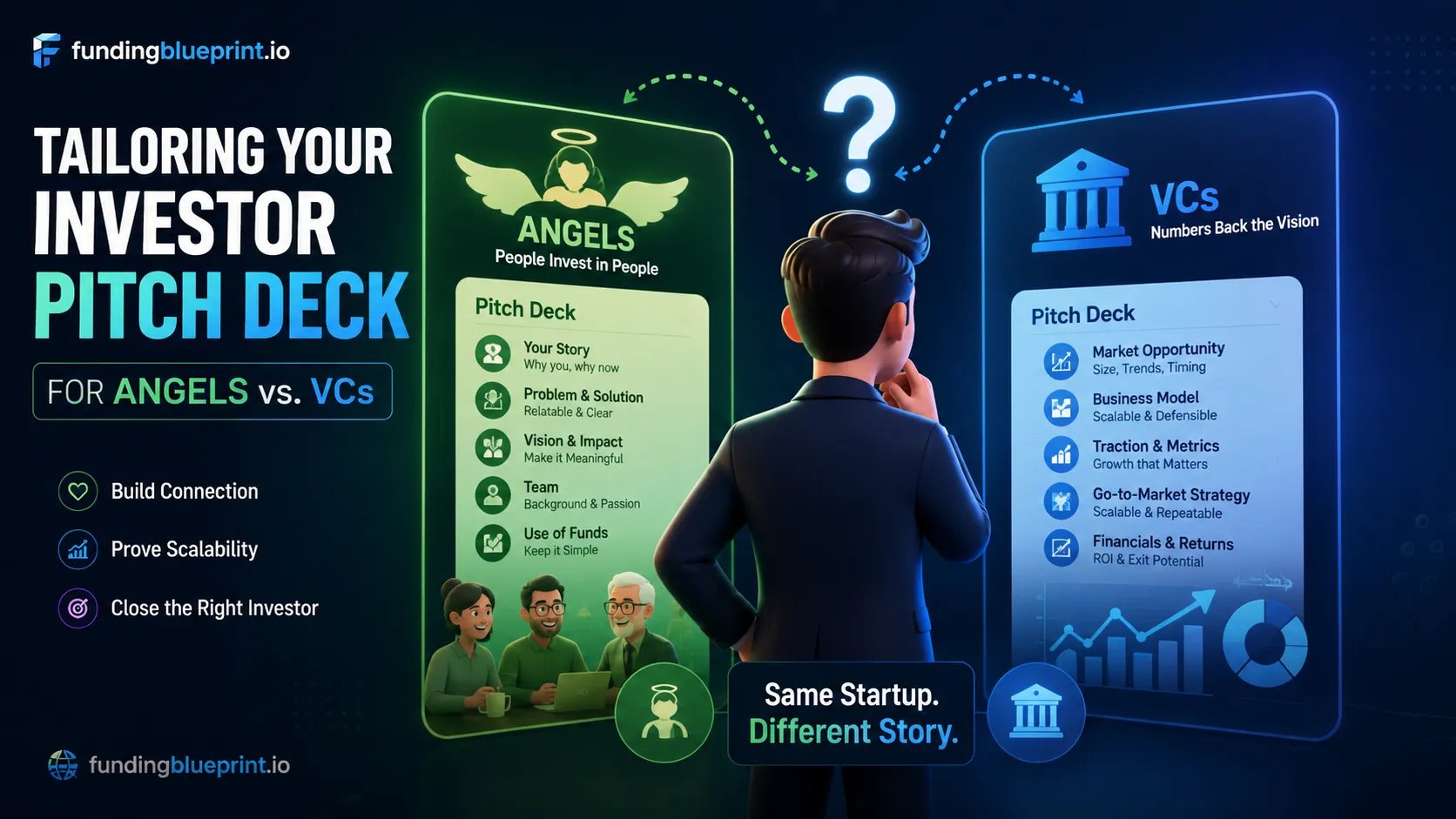
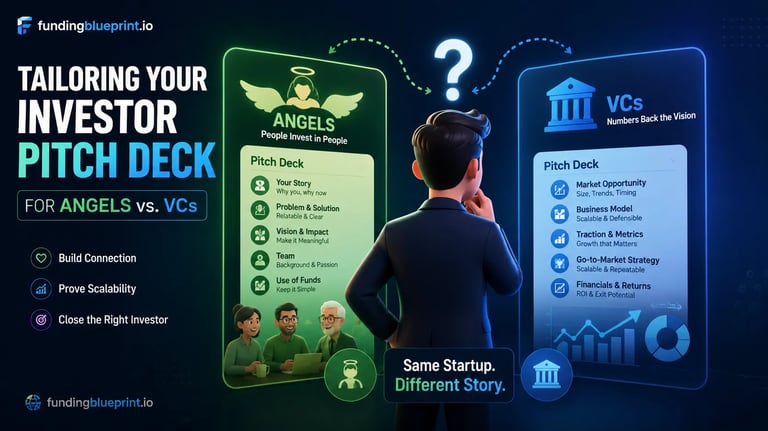
Pitching different types of investors infographic slide.

Pitching Different Types of Investors: The Taxonomy of Capital

Money is fungible, but investors are not. A dollar from a Tier-1 VC comes with a jetpack; a dollar from a bad angel comes with a handcuff.

The most pervasive and fatal error in early-stage fundraising is the "One Deck Fits All" strategy. Founders assume that because every investor wants a Return on Investment (ROI), they all speak the same language, value the same metrics, and respond to the same psychological triggers. This is a gross oversimplification that leads to a "market mismatch."

In a forensic audit of failed fundraising campaigns, we often find that the founder didn't fail because the business was bad; they failed because they pitched a "Moonshot Narrative" (high burn, high growth) to a "Wealth Preservationist" (Family Office), or a "Dividend Narrative" (profitability, slow growth) to a "Power Law Investor" (VC).

You are pitching to four distinct biological species of capital: Angels, Venture Capitalists (VCs), Family Offices, and Corporate VCs (CVCs). Each species has a different metabolic rate, a different predator-prey relationship with risk, and a different "Exit Horizon."

This analysis is a surgical guide to Investor Calibration. We will dissect the neural pathways of each investor type so you can engineer your narrative to trigger their specific buy-signals, ensuring you never again pitch a "Gambling" story to a "Savings" investor.

This sub pillar is part of our main PILLAR 9 — FUNDRAISING STRATEGY

The Trench Report: The "Family Office" Mismatch (A $5M Failure)

In Q3 2025, I was retained to advise a PropTech founder in London raising a $5M Series A. He had a solid, revenue-generating business with $2M ARR (Annual Recurring Revenue) and was operating at break-even. He secured a meeting with a prominent Multi-Family Office in Mayfair—a firm managing the generational wealth of old-money real estate tycoons.

The Structural Error:

The founder used his standard "Silicon Valley" pitch deck.

  • The Narrative: "We are raising $5M to aggressively hire 50 sales reps, burn our cash reserves to capture market share, and aim for a $1B IPO in 5 years."

  • The Forensic Reaction: The Family Office passed within 20 minutes.

  • The Diagnosis: To a VC, "Aggressive Burn" sounds like ambition. To a Family Office manager (whose primary job is not losing the family's money), "Aggressive Burn" sounds like negligence. They don't need a 100x return; they need to ensure the capital survives for the next generation. The founder terrified them.

The Technical Pivot:

We rewrote the narrative specifically for the second Family Office meeting. We did not change the business; we changed the "Asset Framing."

  • The New Narrative: "We are a 'Default Alive' business. We are profitable today. We are raising to accelerate growth, but our downside is mathematically protected by hard assets and long-term contracts. We are building a generational platform that will compound at 30% for the next decade."

  • The Shift: We replaced "Moonshot/Disruption" language with "Compounder/Durability" language.

The Result:

The second Family Office led the round. They didn't want a lottery ticket; they wanted a durable asset that acted as a hedge against inflation. By understanding their Risk Profile, we unlocked capital that VCs would have ignored (because the growth wasn't 300% YoY).

The Forensic Formula: The Alignment Score A(s)

Before entering the room, calculate the mathematical fit between your exit timeline and their fund structure.

A(s) = Investor Time Horizon (Years) X Risk Tolerance Factor (0.1 - 1.0)

Your Planned Exit Horizon (Years)

  • Forensic Application:

    • VCs: Time Horizon = 7-10 years. Risk Factor = 1.0 (High).

    • Family Offices: Time Horizon = 20-50 years. Risk Factor = 0.3 (Low).

    • Angels: Time Horizon = 3-7 years. Risk Factor = 0.8 (Variable).

  • The Rule: If A(s) varies by more than 50% from the investor's baseline, no amount of charisma will close the deal. You are selling the wrong asset class.

The Taxonomy of Capital Sources

You must adapt your "Voiceover" for each species. While your core product slides remain the same, the emphasis of the financial and vision slides must shift dramatically.

1. The Angel Investor (The Believer)

  • Who: High Net Worth Individuals (HNWIs), exited founders, or senior executives investing their own personal money.

  • The Biological Imperative: Vicarious Living & Status. They are investing for ROI, yes, but primarily they invest because they miss the thrill of the build. They want to be "smart." They want to tell their friends at the country club that they backed the next Uber.

  • The Pitch Strategy: Sell the "Founder Story" and the "Big Vision."

    • The Voiceover: "I want you on the Cap Table not just for the check, but because you solved this exact problem at [Previous Company]. I need your brain." (Flattery is a high-conversion tactic here).

  • Forensic Risk: They are emotional. If the market turns, they can panic. Ensure they are "accredited" and understand they might lose it all.

2. The Venture Capitalist (The Portfolio Manager)

  • Who: Professional money managers investing Other People's Money (Limited Partners - LPs).

  • The Biological Imperative: The Power Law. They are mathematically incentivized to find outliers. A fund of 30 companies usually has 1 winner that returns the entire fund, and 29 failures/mediocre outcomes. A 3x return is a failure to a Tier-1 VC because it doesn't move the needle on a $500M fund.

  • The Pitch Strategy: Sell the "Market Size" and "Unfair Advantage."

    • The Voiceover: "If this works, we don't just win a niche; we become the category king of a $10B market. Here is the math on how we get to $100M ARR."

  • Forensic Risk: They will force you to grow fast. If you miss metrics, they have the fiduciary duty to replace you or cut funding. They are not your friends; they are your shareholders.

3. The Family Office (The Steward)

  • Who: Private firms managing the wealth of one or more ultra-rich families.

  • The Biological Imperative: Wealth Preservation & Intergenerational Transfer. They hate losing money more than they love making it. They prefer "real" businesses (Real Estate, Manufacturing, B2B SaaS with high retention) over speculative deep tech.

  • The Pitch Strategy: Sell "Durability" and "Cash Efficiency."

    • The Voiceover: "We have strong unit economics and a clear path to profitability. We are not dependent on future financing risk."

  • Forensic Risk: They move slowly. Decision-making is opaque and often relies on a "Patriarch" or "Matriarch" who may not be in the room.

4. The Corporate VC (CVC) (The Strategist)

  • Who: The investment arm of a corporation (e.g., Google Ventures, Salesforce Ventures, Intel Capital).

  • The Biological Imperative: Strategic Synergy & Market Intelligence. They invest to see what is coming next in their industry or to fuel their own ecosystem. Financial return is often secondary to strategic insight.

  • The Pitch Strategy: Sell "Integration" and "Future Roadmap."

    • The Voiceover: "Our tech complements your cloud infrastructure perfectly. By investing, you ensure this capability exists within your ecosystem rather than going to a competitor."

  • Forensic Risk: "The Right of First Refusal" (ROFR). Never give a CVC a ROFR on acquisition. It kills your exit options because no other buyer will bid if they know Google has the right to match it.

Regional Calibration (SF vs. London)

The behavior of these species changes based on the geography of the capital.

San Francisco Angels vs. London Angels

  • SF Angels: Operate on a "Pay It Forward" culture. They write $25k-$50k checks over coffee with very little diligence. They often don't even ask for a deck; they bet on the founder's pedigree.

  • London/European Angels: Operate on a "Tax-Driven" culture. They care deeply about EIS/SEIS (Tax relief schemes).

    • Forensic Note: If you are pitching in the UK and do not have "SEIS Advance Assurance" (a letter from HMRC), 90% of angels will not invest. It is a binary filter. You must have this paperwork ready before the first meeting.

US VCs vs. European VCs

  • US VCs: Focus on "Dreaming." "What if this goes right?" They are willing to fund unproven business models (like Uber or WeWork) if the potential scale is massive. They value Velocity.

  • European VCs: Focus on "Downside Protection." "What if this goes wrong?" They focus on revenue early. They want to see proof of traction before writing a Series A check. They value Efficiency.

Metric Logic & Red Flags

Each investor type audits different metrics. Showing the wrong metric to the wrong investor is a red flag that signals "Founder-Market Mismatch."

Red Flag 1: Pitching "Dividends" to a VC

  • The Error: "We plan to reach profitability and distribute profits to shareholders by Year 3."

  • The Forensic Reality: VCs hate dividends.

  • The Math: VCs are taxed heavily on income but lightly on capital gains. More importantly, if you pay a dividend, it means you have run out of ideas on how to grow. VCs want you to reinvest every dollar of profit back into Sales & Marketing to increase the Share Price for an eventual exit (IPO/M&A).

  • The Fix: Pitch "Reinvestment Rate" and "Top-Line Growth."

Red Flag 2: Pitching "Burn Rate" to a Family Office

  • The Error: "We are burning $200k a month to acquire users."

  • The Forensic Reality: Family Offices view burn as bleeding. They worry about dilution. If you burn cash, you will need to raise more money, which dilutes their ownership.

  • The Fix: Pitch "Unit Profitability." Show that the core unit (one customer) is profitable, even if the company is not yet profitable due to fixed costs.

Red Flag 3: Pitching "Exit Strategy" to an Angel (Too Early)

  • The Error: "We plan to sell to Facebook in 18 months."

  • The Forensic Reality: Angels invest for the journey. If you talk about selling before you've even started, you look like a mercenary (just here for money), not a missionary (here to solve a problem). Angels back missionaries.

  • The Fix: Focus on the Mission. "We are going to solve this problem for the entire industry."

Earned Secrets

These are the hidden dynamics of the investor landscape that generic blogs miss.

Secret 1: The "CVC" Information Trap

Corporate VCs often take meetings just to gather intel for their internal product teams.

  • The Secret: If a CVC asks for your "Product Roadmap" and "Technical Architecture" deep dive in the first meeting, they are likely spying (sometimes unintentionally).

  • The Hack: Share the Vision, protect the IP. Only share code/architecture after a term sheet is signed or with a strict NDA (though VCs rarely sign NDAs, CVCs sometimes will in later stages).

Secret 2: The "Angel Syndicate" Lead

Angels often herd together. You don't need to convince 20 angels individually.

  • The Secret: You need to convince one "Syndicate Lead".

  • The Hack: Find the "Super Angel" in your sector. If they commit $25k, they will often send a link to their syndicate (on AngelList or Odin) and fill the rest of your $200k allocation in 48 hours from their followers. The "Lead" does the diligence; the "Followers" just wire the money.

Secret 3: Family Office "Gatekeepers"

You rarely pitch the Billionaire directly. You pitch their "Chief Investment Officer" (CIO).

  • The Secret: The CIO is incentivized not to lose money. If they make a 10x bet, they get a small bonus. If they lose the family money, they get fired. They are conservative.

  • The Hack: Frame your startup as a "Hedge" against disruption. "Your family made money in traditional retail. Our e-commerce software hedges your exposure to retail decline." Position yourself as insurance for their legacy portfolio.

Expert FAQ: The Unasked Questions

Q: Can I have VCs, Angels, and Family Offices in the same round?

A: Forensic Answer: Yes, this is the ideal "Hybrid Cap Table."

  • Structure: The VC acts as the "Lead" (sets the price, does the legal work, sits on the board). The Angels act as "Value-Add Followers" (fill the rest of the round, provide intros). The Family Office provides "Patient Capital" (doesn't pressure you for a quick exit).

  • Benefit: VCs give you deep pockets; Angels give you operational advice; Family Offices give you stability.

Q: Who is the hardest to close?

A: Forensic Answer: Corporate VCs (CVCs).

  • Why: They have double the bureaucracy. The Investment Committee must say yes, and the Business Unit must say yes. The sales cycle for a CVC check is 6-9 months, compared to 2-3 months for a financial VC. Do not rely on them for immediate runway.

Q: Should I create different Pitch Decks for each type?

A: Forensic Answer: No, create different "Appendix" sections.

  • Core Deck: Keep the standard 15-slide narrative (Problem, Solution, Market, Team).

  • VC Version: Add 3 slides on "Market Size & Power Law Potential" in the appendix to answer their scale questions.

  • Family Office Version: Add 3 slides on "Cash Flow Analysis & Downside Protection" in the appendix to answer their risk questions.

  • Tactics: Tailor the verbal pitch, not the PDF file, to avoid version control nightmares.

Forensic Audit Checklist

Before you walk into the meeting, identify the Species and prepare the trap:

  1. The Species Check: Is this a VC, Angel, or Family Office? (Check their website/LinkedIn. If they talk about "Generations," it's a Family Office. If they talk about "Disruption," it's a VC).

  2. The "Check Size" Math: Does their typical check size match your allocation? (Angels: $10k-$50k; Seed Funds: $500k-$2M; Family Offices: $1M-$10M).

  3. The "Tax" Check (UK Only): If pitching Angels, do you have SEIS/EIS Advance Assurance?

  4. The "Fund Life" Check (VCs): Are they in a Zombie fund? (Vintage year check).

  5. The "Conflict" Check (CVCs): Does taking money from Google Ventures stop you from selling to Microsoft later? (Strategic signaling risk).

Narrative Breadcrumb

You have calibrated your pitch to the specific psychology of the investor. You have navigated the Family Office's fear and the VC's greed. You have secured the verbal "Yes."

But a verbal "Yes" is not cash. Now comes the paperwork. The investor says, "We are interested. Send us your deck." This is the moment of truth. If the document you send does not match the forensic precision of your conversation, the deal dies in the inbox. You need a visual asset that converts interest into a signature.

(Note: The Funding Blueprint Kit includes the VC-Ready Pitch Deck (Elite Canva Template) and the Slide-By-Slide VC Instruction Guide. These tools ensure that when you finally get the "Yes," you send a deck engineered with the exact Sequoia/a16z logic required to convert that click into a partner meeting. Access the full forensic suite at the home page.)