
The "Single Insight" Pitch Deck Slide: Why Less Text Wins Funding
Is your Problem slide too text-heavy? VCs stop reading when faced with paragraphs. Learn why a 43-word slide instantly kills Series A pitches.
2.7 TACTICAL DESIGN RULES FOR PROBLEM & SOLUTION SLIDES VCS ACTUALLY RESPECT
2/27/20265 min read
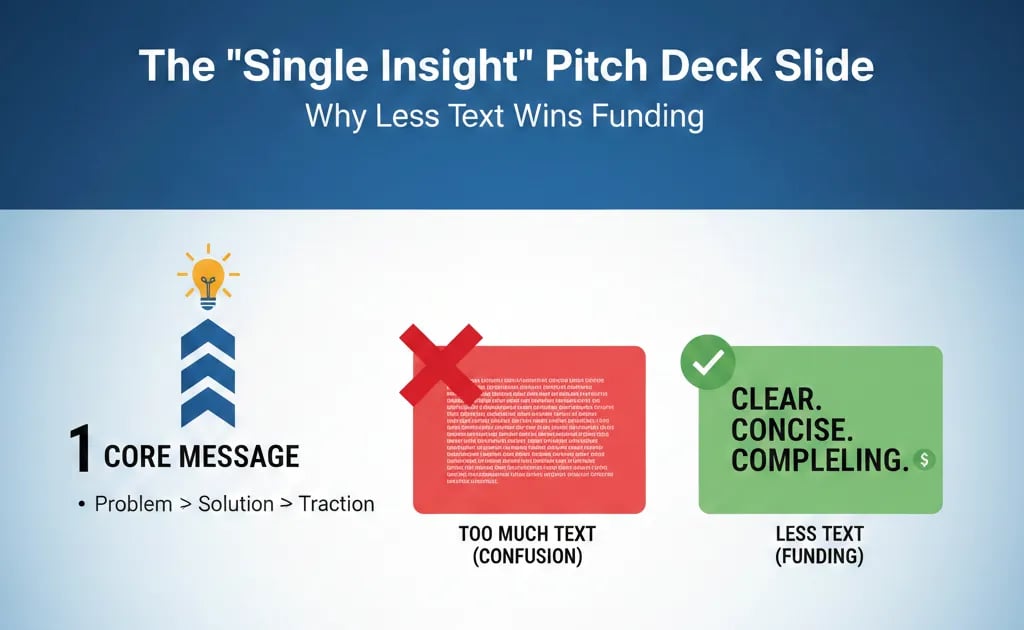
The "Single Insight" Pitch Deck Slide: Why Less Text Wins Funding
Forty-three words. That is the average body-text count on a Problem slide from a founder who did not get a second meeting last quarter. The founders who did get the callback averaged eleven.
This is not a writing exercise. It is a signal processing problem, and right now your deck is generating noise when it needs to generate conviction. The moment a VC's eye hits a paragraph on a pitch slide, the pitch has already failed — their brain has shifted from "evaluating the bet" to "doing comprehension work." Those are not the same cognitive state, and only one of them leads to a Term Sheet. This post is one component of a broader execution layer — the full system lives inside the tactical design ruleset for Problem and Solution slides that clear partner-level screens.
How Text-Heavy Problem Slides Signal Founder Risk, Not Founder Rigour
The pattern is consistent: a founder who cannot distil their Problem slide to a single insight does not have a communication problem. They have a clarity-of-thesis problem, and experienced VCs know it.
Here is what a text-heavy Problem slide looks like to a fund analyst: three bullet points explaining market context, a supporting sentence referencing industry fragmentation, a quoted statistic mid-paragraph, and a closing line about the "gap in the market." The founder believes they are building the case. What the analyst sees is a founder who has not decided what they actually believe. A slide with five ideas has zero ideas. Each additional sentence dilutes the primary claim and forces the VC to do the prioritisation work that the founder should have already done.
The psychological root is almost always one of two things: fear of appearing shallow, or conflating "comprehensive" with "credible." Both are founder-stage cognitive traps. Depth in a pitch is demonstrated through the precision of a single claim — not through the volume of supporting claims surrounding it. In a deck reviewed in Q2 of this year, a B2B logistics founder used nine lines of body text across their Problem and Market slides to establish context that one financial headline would have communicated in under three seconds; the fund passed at the associate screen without scheduling a call.
The Psychological Audit is straightforward: if you have more than two sentences on a Problem slide, you are not clarifying — you are hedging. And investors do not fund hedges.
The Attention Economics of a Partner Meeting: Why Word Count Is a Valuation Variable
The math here is not complicated, but founders consistently underestimate it.
As of early 2026, the median US Series A pre-money sits at $22M–$28M, with top-tier funds stress-testing a minimum 18-month runway before committing — a direct behavioural shift from the 12-month standard in 2021. In this environment, partners are not more patient; they are more selective with where their conviction capital goes. A text-heavy slide does not get more scrutiny — it gets less, because the VC routes around it.
Run the attention economics:
1 headline + 1 supporting data point
Reading Time Required: 2–3 seconds
VC Cognitive Mode: Evaluating the bet
Outcome: Conviction building
1 headline + 3 bullet points
Reading Time Required: 8–12 seconds
VC Cognitive Mode: Comprehension mode
Outcome: Disengagement risk
2 paragraphs + embedded stats
Reading Time Required: 18–25 seconds
VC Cognitive Mode: Reading, not investing
Outcome: Mental pass
A 20-slide deck at average bullet-point density requires 4–6 minutes of active reading from a partner who has eleven other decks in their queue today. The founders who clear that queue are not the ones who explained more — they are the ones who required less effort to believe.
The Single Insight Formula:
(1 Specific Problem Claim) + (1 Quantified Consequence) + (0 supporting sentences) = a slide that works
"SMB accountants spend 11 hours per week on manual reconciliation that generates zero revenue" is a complete Problem slide. Everything else is noise.
The "Single Insight" Rebuild Protocol: From Text-Dense to VC-Ready
The fix requires architectural thinking, not editing. Cutting words from a bad structure produces a shorter bad slide. You need to rebuild around a single cognitive objective.
Weak Version — Problem Slide:
Title: "Inefficiencies in the Mid-Market Procurement Workflow"
Body: "Procurement teams in mid-market manufacturing firms face a range of operational challenges including manual PO processing, lack of real-time spend visibility, and fragmented supplier communication. These inefficiencies create delays, cost overruns, and compliance risks. Current solutions are either enterprise-grade and too expensive, or consumer-grade and insufficient for operational complexity."
Result: The VC has read a market overview. They now know there is a category. They do not know what you believe, what the cost of inaction is, or why this is a fundable problem today.
VC-Ready Version — Problem Slide:
Headline (the entire slide): "Mid-market procurement teams manually process $2.3M in POs per year with an average 6-day approval cycle. Every day of delay costs $18K in working capital."
Supporting visual: A single bar chart showing approval cycle length vs. working capital cost.
Nothing else.
Result: The VC sees a specific, financial, urgent problem. They know the scale. They know the cost. They are already calculating the addressable value of solving it. That is the mental state you need them in before slide 3.
The "Single Insight" Build Framework — apply before writing any slide:
Write the one thing you need the VC to believe — not understand, believe — after this slide.
Quantify the consequence of the problem — cost, time, frequency, or revenue impact. One of the four. Not all four.
Delete every sentence that does not directly prove the belief from Step 1.
If you have more than one sentence left, you have not made a decision yet. Go back to Step 1.
Test it at speed — hand the slide to someone unfamiliar with your business. Give them three seconds. Ask what the problem is. If they cannot answer precisely, the slide has failed.
The framework is sequential. Do not skip Step 3.
Three Mistakes Founders Make When Trying to Cut Text (That Still Kill the Deck)
1. Converting paragraphs to bullet points without reducing ideas. Three bullets with a full sentence each is still three ideas. The format changed; the cognitive load did not. A bullet point is not a simplification — it is a visual shortcut that still requires the same mental processing if the underlying claim is not singular.
2. Moving text to speaker notes and assuming the slide is now clean. The slide is the pitch. A partner reviewing your deck asynchronously — which happens in the majority of first-pass reviews — sees only the slide. If the argument lives in your notes, it does not exist for most of your audience.
3. Treating the headline as decoration and the body as the substance. In a VC-ready deck, the headline is the substance. The visual supports the headline. If your headline is a topic label ("The Problem") rather than a claim ("Unaudited SaaS spend costs mid-market CFOs $740K per year in shadow IT"), you have already lost the function of the slide.
What a Single-Insight Problem Slide Is Actually Worth in Pre-Money Terms
A deck that communicates with precision does not just feel cleaner — it repositions the founder. A partner who processes your Problem slide in two seconds and immediately understands the bet is now evaluating you as a founder who has done the hard cognitive work of distillation. That is the founding characteristic of a capital-efficient operator. In a $22M–$28M pre-money environment where conviction is the scarce resource, being easy to believe is a competitive advantage, not a simplification. The full architecture governing how your Problem and Solution slides function as a single, interconnected fundraising instrument is inside the complete structural system for Series A Problem and Solution slide construction.
Every week this slide structure stays text-heavy is a week a partner-level VC routes around your deck at the screening stage — and you do not get a call explaining why. The Slide-By-Slide VC Instruction Guide inside the $5K Consultant Replacement Kit includes a word-count and single-insight audit for every slide in your Problem and Solution sequence, built to the standard a fund analyst will apply before your deck reaches a partner. The full Kit is $497. Access the guide and run your current deck against the benchmark at the Series A pitch resource built for founders who need fund-analyst-grade output without the consulting invoice.
Funding Blueprint
© 2026 Funding Blueprint. All Rights Reserved.