
The Hidden VC Test: Proving Willingness to Pay in Your Pitch Deck
Stop confusing "willingness to talk" with willingness to pay. VCs don't fund surveys. Learn the WTP Proof Protocol to secure your Series A term sheet.
2.8 INVESTOR PSYCHOLOGY BEHIND PROBLEM & SOLUTION SLIDES
2/28/20264 min read
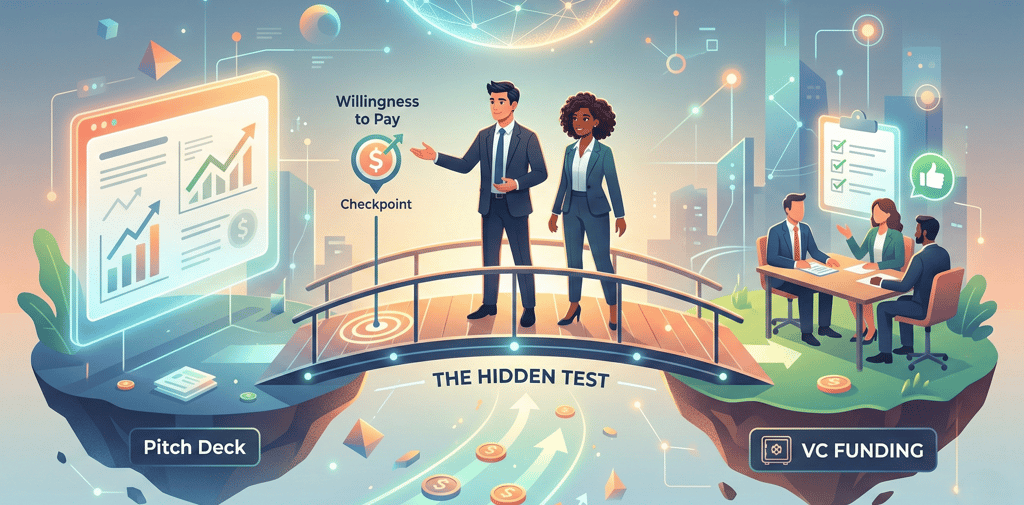

The Hidden VC Test: Proving Willingness to Pay in Your Pitch Deck
$0 in revenue does not mean your startup lacks value. But $0 in evidence of willingness to pay means your pitch deck lacks a business. There is a difference, and most pre-revenue founders at the Series A stage never learn it until the term sheet fails to arrive. This post dissects the specific slide failure that triggers that outcome — and it is part of a deeper breakdown of investor psychology behind Problem and Solution slides every founder raising in 2025–2026 must understand.
Why "We Talked to 200 Customers" Is Not Willingness-to-Pay Evidence
Here is what a broken slide looks like. Under a header called "Validated Problem," a founder lists three bullet points: number of discovery calls completed, a quote from a customer saying the problem "keeps them up at night," and an NPS score from a beta cohort. The VC reads it, nods, and writes one word in their notes: soft.
None of that is willingness to pay. It is willingness to talk. Those are not the same asset.
The forensic error here is conflating engagement signals with financial commitment signals. VCs at the Series A stage — particularly 2025-vintage funds stress-testing every deal against tightened LP mandates — are not asking "do people have this problem?" They are asking a harder question: "Has anyone handed over money, a contract, a pilot fee, or a signed LOI to make this problem go away?" The moment a VC cannot find the answer on your slide, they begin discounting your entire market size claim. In a deck reviewed last quarter, a B2B SaaS founder included fourteen customer quotes and zero pricing data — the fund passed before reaching the traction slide.
The psychological root of this mistake is intellectual generosity. Founders love their discovery process. They ran the calls, they synthesised the pain, they believe the demand is real — and it probably is. But belief is not a data point a VC can put in a memo to their partners. Evidence of financial commitment is.
The Mathematical Cost of a Soft Validation Stack
Walk through the VC's internal math when your willingness-to-pay evidence is weak.
Your stated TAM: $4.2B
Your conversion assumption: 0.5% market capture in 3 years
Your implied ARR at Year 3: $21M
VC's discount on that number without hard WTP proof: 60–70%
That discount is not arbitrary. As of early 2026, top-tier US funds require a burn multiple below 1.5x at Series A — meaning for every dollar burned, you must show at least $0.67 in net new ARR. If your WTP evidence is anecdotal, the VC has no rational basis for trusting your CAC or LTV assumptions, which means your unit economics model collapses under scrutiny before the partner meeting.
The cascade looks like this:
Weak WTP evidence → VC discounts your conversion rate assumption
Discounted conversion rate → your projected ARR at exit drops
Dropped ARR → your implied valuation at Series B shrinks
Shrunken Series B valuation → the Series A math no longer works for a $20M–$25M check (the current median US Series A pre-money range sits at $22M–$28M in 2025)
Math doesn't work → no term sheet
This is not a soft rejection about "market timing." It is arithmetic.
The WTP Proof Protocol: Reframing One Slide to Close the Evidence Gap
The fix is not adding more quotes. It is replacing the validation framework entirely.
Weak Version of the Slide:
"200 discovery interviews conducted. Customers described this as a top-3 operational pain point. NPS from beta: 67."
A VC reading this thinks: "They built a survey, not a business."
VC-Ready Version of the Slide:
"14 design partners under signed $5K pilot agreements (total committed: $70K). 3 converted to annual contracts at $24K ARR. Average sales cycle: 22 days. Pipeline: 31 qualified prospects with verbal commitment to pilot pending product milestone in Q2."
The formula to build this is what I call the WTP Evidence Stack:
WTP Score = ($ Committed) + (Contract Stage) + (Decision-Maker Seniority) + (Unsolicited Inbound)
Each layer adds weight. Even one signed LOI from a VP of Operations at a mid-market company outweighs 500 survey responses from anonymous users. The hierarchy matters:
Tier 1: Paid pilots, signed contracts, invoices issued
Tier 2: Signed LOIs, verbal commitments from budget owners with a follow-up email trail
Tier 3: Waitlist with credit card capture, pre-orders, paid beta access
Tier 4: Discovery calls, surveys, NPS (treat as table stakes, not proof)
Only Tier 1 and Tier 2 belong on a Series A deck. Tier 3 is acceptable for pre-seed. Tier 4 should not appear on any fundraising slide after your first friends-and-family round.
Present your WTP stack as a mini-table: commitment type, number of instances, total dollar value, and seniority of decision-maker. Four columns. One table. This single change restructures how a VC reads everything that follows — your TAM, your sales motion, your GTM hire plan.
Three Ways Founders Break This Fix While Trying to Apply It
Inflating Tier 3 into Tier 2. A waitlist is not an LOI. Do not present a free sign-up as evidence of financial intent. A VC's analyst will ask one question on due diligence: "Can you share the LOI?" If you cannot produce a document, the tier collapses.
Disclosing the pilot discount. If your $5K pilot is normally a $24K annual contract, do not volunteer that the pilot was deeply discounted to land it. That converts your Tier 1 evidence into a pricing risk signal.
Presenting WTP on the Traction slide instead of the Problem slide. By the time a VC reaches traction, their thesis is already formed. WTP evidence belongs adjacent to your Problem framing — it closes the loop immediately and prevents the discount cascade from starting.
The Pre-Money Value of One Strong WTP Slide
Fixing this single slide can move your pre-money by $3M–$5M. Not because the slide is magic, but because it removes the VC's largest discount variable — execution risk on demand. A founder who enters a partner meeting with a table showing $70K in committed pilot revenue and two signed annual contracts is negotiating from a fundamentally different position than one presenting discovery call volume. The entire Problem and Solution slide system is built to close this evidence gap across every critical section of your deck.
Founders who have used the Slide-By-Slide VC Instruction Guide inside the $5K Consultant Replacement Kit go into partner meetings with a WTP slide that already matches what the VC's analyst will check against during diligence prep. That is not a marginal advantage — it removes the most common reason a deal stalls between first meeting and term sheet. The full Kit is $497. You can access it at the VC-ready pitch deck system built for Series A founders.
Funding Blueprint
© 2026 Funding Blueprint. All Rights Reserved.