
Why VC Pitch Decks Are Different from Startup Pitch Presentations
Stop sending your presentation deck. Learn the mathematical proof why "Hybrid Decks" kill Series A funnels and how to bifurcate your Pitch Deck for investors.
1.1: WHAT A VC PITCH DECK ACTUALLY IS?
1/15/20265 min read
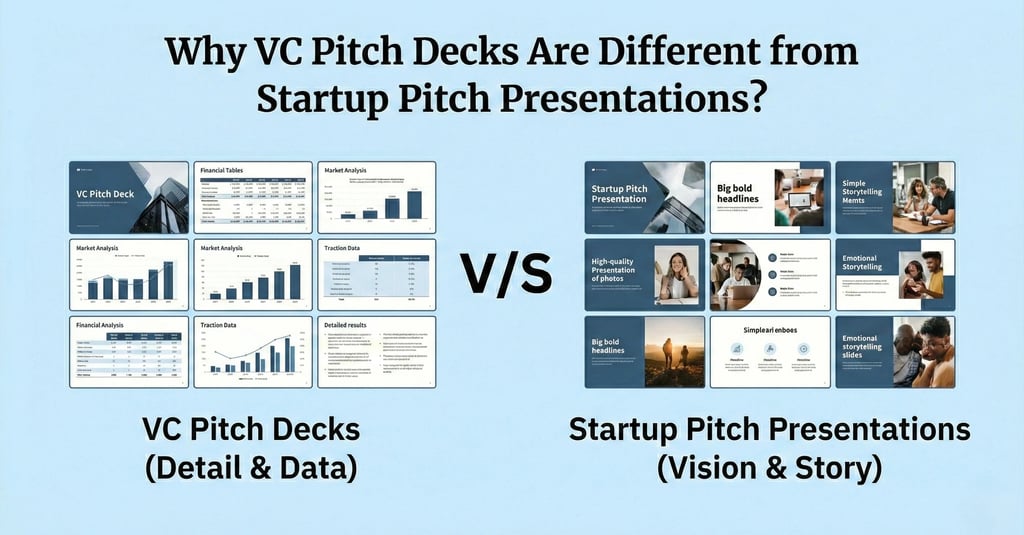
The Pitch Deck Is Not The Presentation
If you are a Seed or Series A founder currently circulating a single PDF for both email intros and live Zoom calls, you are actively sabotaging your own capital efficiency. You are falling victim to the "Universal Deck Fallacy"—the amateur belief that one asset can serve two diametrically opposed consumption environments. It cannot.
This is not a stylistic preference; it is a structural failure in your fundraising architecture. To understand the fundamental mechanics of this asset class, you must first study What a VC Pitch Deck Actually Is (and What Investors Mean When They Ask for One). When you force a VC to read a presentation slide, or listen to a reading slide, you trigger immediate cognitive friction. In a market where attention spans are measured in milliseconds, friction is indistinguishable from rejection.
The Forensic Diagnosis: Why Hybrid Decks Bleed Capital
The error here is functional, not aesthetic. When we audit failed fundraising campaigns, we consistently find a "Hybrid Deck" at the scene of the crime. This is a Frankenstein document—too dense to be a visual backdrop for a speech, yet too vague to be read standalone in an email.
The "Red Flag" Scenario
Imagine a General Partner (GP) opens your email on a Tuesday morning. They have 4 minutes before their next board meeting. They open your attachment. It is a "Live Presentation" deck—highly visual, minimal text, relying on a voiceover that isn't there.
Slide 1: A picture of a rocket ship.
Slide 2: The word "Growth" in 72pt font.
Slide 3: A complex, unlabeled graph.
The VC’s Verdict: "Incomprehensible." They close the file. You have been rejected not because the business is bad, but because the asset failed to transfer information asynchronously.
Conversely, consider the "Reading Deck" projected on a screen during a live pitch.
The Scenario: You are on Zoom. You put up a slide with 150 words of text, three bulleted lists, and a financial table.
The Reaction: The VC immediately stops listening to you to read the slide. They cannot process your voice and the text simultaneously. You have lost control of the narrative.
The Psychological Audit
Why do founders persist with this inefficiency?
The "Steve Jobs" Delusion: Founders believe their charisma can carry a deck that lacks data. This works for consumer product launches; it fails for due diligence.
Laziness: Creating two distinct assets requires double the work. Founders rationalize the shortcut by calling it "efficiency." It is actually laziness disguised as optimization.
Fear of Omission: Founders try to cram every detail into the live deck because they are terrified of leaving something out, unaware that density kills retention.
The Mathematical Proof: The Physics of Information Transfer
We can prove the necessity of two distinct decks using basic information theory and cognitive load limits. The human brain processes inputs through limited channels. When you violate these limits, your conversion rate from "First Meeting" to "Due Diligence" drops toward zero.
The Bandwidth Discrepancy
Reading Speed: The average VC reads at 250–300 words per minute (wpm).
Speaking Speed: You pitch at roughly 130–150 wpm.
If you project a text-heavy slide (The "Reading Deck") while speaking:
The VC reads ahead of you (at 2x your speed).
They finish the slide while you are still explaining the first bullet point.
Result: Boredom. They check their email while waiting for you to catch up to their eyes.
The Cognitive Load Cost
The "Split-Attention Effect" is a well-documented psychological phenomenon. When learners (investors) are required to split their attention between disparate sources of information (your voice vs. dense text), cognitive load increases, and learning (retention of your thesis) decreases.
The Calculus of Attention:
Visual Channel: Processes images/graphs.
Verbal Channel: Processes speech/text.
When you put text on a screen, it competes for the Verbal Channel.
Text on Screen +Founder's Voice = Cognitive Overload
However, images do not compete with voice. They occupy the Visual Channel while your voice occupies the Verbal Channel.
Visuals on Screen + Founder's Voice = Dual Coding (High Retention)
Therefore, mathematically, a deck designed for reading (email) must be 100% self-explanatory text/prose. A deck designed for presenting (Zoom) must be near-zero text. Attempting to merge them creates a mathematically impossible scenario for the investor's brain.
The "Insider" Solution Protocol: Bifurcated Asset Generation
To survive the Series A filter, you must decouple your narrative into two specific assets. This is the standard operating procedure for top-tier raises.
Asset 1: The "Leave-Behind" / "Send-Ahead" (The Pitch Deck)
This is the document you email. It is a visual white paper. It must pass the "stand-alone test": If you were hit by a bus, could an investor understand your entire business model, unit economics, and competitive moat just by reading this PDF?
Format: 15-20 Slides.
Density: High. Full sentences. Annotated charts.
The Framework: The "3-Second Headline Rule." The headline of every slide must state the conclusion, not the category.
Weak: "Market Size."
VC-Ready: "The SOM is $4B, growing at 15% CAGR due to regulatory tailwinds."
Asset 2: The "Live Presentation" (The Visual Aid)
This is the backdrop for your performance. It exists solely to reinforce your spoken words emotionally and visually.
Format: 10-12 Slides (Highly visual).
Density: Near Zero. No bullet points. No paragraphs.
The Framework: The "Billboard Test." Can the slide be understood in 3 seconds while driving past it at 60mph?
Weak: A list of 5 competitors with feature comparison checkmarks.
VC-Ready: A single 2x2 matrix positioning you in the top right, with logos only.
The Before vs. After Execution
The Problem Slide: "Unit Economics"
The Amateur (Hybrid) Version:
A slide titled "Financials." It contains a screenshot of an Excel spreadsheet with 30 rows of data, plus three bullet points explaining LTV/CAC on the right.
Email Context: The font is too small to read the Excel rows.
Live Context: The audience squints at the screen, ignoring your voice.
The VC-Ready (Bifurcated) Version:
For Email (The Deck): A slide titled "LTV/CAC Ratio expands to 5:1 at Scale." It features a simplified bar chart showing the ratio evolution, accompanied by a 50-word paragraph explicitly detailing the CAC payback period, churn assumptions, and expansion revenue levers.
For Live (The Presentation): A slide containing only the number "5:1" in massive typography, and a green arrow pointing up. You verbally explain the nuance while the investor stares at the impressive metric.
The "Death Traps"
While implementing this bifurcation, founders often swing too far in the opposite direction. Avoid these terminal errors:
The "Follow-Up" Blunder: After a great live pitch, you email the investor the same visual-only deck you just presented.
Why it kills the deal: They want to share the deck with their partners who weren't on the call. The partners see only pictures and big numbers with no context. You fail the partnership vote. Always send the "Reading Deck" as the follow-up.
The "Data Room" Premature Dump: Including raw data dumps in the "Send-Ahead" deck.
Correction: The Send-Ahead is a marketing document, not a due diligence folder. Keep the math rigorous but summarized. Save the cohorts and raw SQL dumps for the Data Room phase.
The "High-Ticket" Conclusion
The delta between a generic "pitch deck" and a bifurcated "presentation suite" is often the difference between a passed email and a term sheet. By respecting the cognitive limits of your investors, you lower the friction required to understand your alpha. In a tight capital environment, clarity is a proxy for competence. Fixing this structural error can legitimately add $1M to your pre-money valuation by driving higher demand tension.
For a comprehensive breakdown of the entire fundraising funnel, refer to How VC Pitch Decks Really Work in 2026 — And Why Most Founders Get Them Wrong.
The Filter: You can attempt to build these two distinct assets manually, guessing at the narrative flow for each. Or, you can use "The Slide-By-Slide VC Instruction Guide" included in our $5k Consultant Replacement Kit. It provides the exact templates for both the Reading Deck and the Live Presentation, ensuring you never confuse the two. Get the complete system for $497 on the home page. Do not pitch without it.
Funding Blueprint
© 2026 Funding Blueprint. All Rights Reserved.