
Why Investors Use Pitch Decks Over Financial Models Initially
Sending a financial model first kills 73% of deals. A forensic audit of why VCs ignore Excel during screening, the 'Cognitive Load' math, and the Sequencing Protocol to survive the 4-minute filter.
1.6 PITCH DECKS VS BUSINESS PLANS VS EXECUTIVE SUMMARIES
2/2/20265 min read
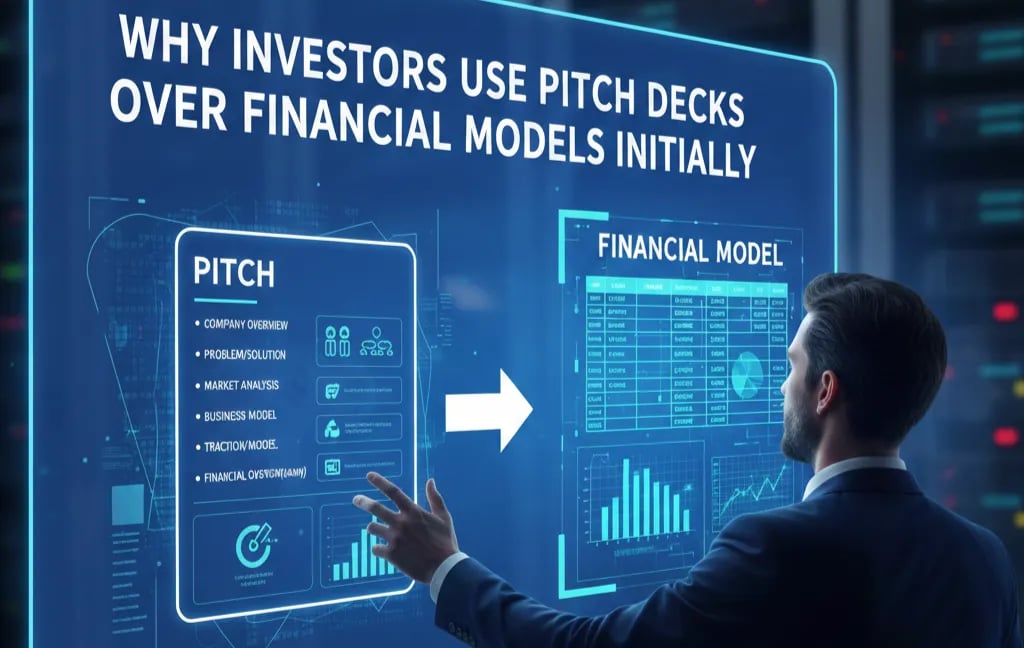
Why VCs Read Your Pitch Deck Before Your Financial Model (And Why That Kills 73% of Series A Deals)
Your financial model is a masterpiece. Three-statement integration. Monthly cohort analysis. Sensitivity tables that would make a CFO weep. You spent 60 hours building it. The VC spent 11 seconds looking at it before they passed.
Here's the truth most founders learn too late: investors use pitch decks as cognitive filters, not information sources. The deck exists to answer one question in under 4 minutes: "Is this founder worth a 90-minute deep dive?" Your financial model answers a different question—one they only ask after you've passed the filter. This fundamental misunderstanding is part of a larger structural problem in how founders approach fundraising materials, which we cover in detail in pitch decks versus business plans and executive summaries.
Most founders die at the filter stage while obsessing over the wrong artifact.
Why Your 47-Tab Financial Model Is a Series A Liability
VCs receive 3,000+ decks per year. Partners have 12-18 active portfolio companies demanding time. Associates are triaging 40 new opportunities per week. The math is surgical: if reviewing your materials takes more than 240 seconds, you don't get reviewed—you get archived.
The financial model problem is structural, not content-based. A proper three-statement model requires domain expertise to audit. The reviewer must understand your revenue recognition policy, your cohort assumptions, your capitalisation rules. This creates a 15-20 minute cognitive load for a decision that needs to happen in under 4 minutes.
The Red Flag Scenario: Founder sends a detailed financial model as the primary artefact. VC opens it, sees tabs labeled "Rev Recognition Policy," "Hiring Plan by Department," "Cap Table Evolution." The VC thinks: "This founder doesn't understand how capital allocation works in my day. They've optimised for completeness, not decision speed. Red flag on commercial awareness."
The Psychological Audit: Founders make this mistake because they've been trained in corporate finance or consulting, where thoroughness signals competence. In venture, thoroughness before relevance signals inexperience. The model says: "I don't know what you need to see first." That's a pattern-matching failure that extends beyond the deck into operational judgment.
The Information Asymmetry Economics of First Screening
Here's the mathematics of why decks beat models in first contact:
Cognitive Load Comparison:
Pitch Deck (10 slides): 3-4 minutes to process. Pattern recognition: Can they tell a story? Do the unit economics make sense at a glance? Is there a credible moat?
Financial Model (Detail): 15-20 minutes to audit properly. Requires Excel fluency, industry benchmarking knowledge, and skepticism calibration.
Time-Value Calculation:
VC Partner hourly rate (imputed): $800-1,200/hour
Cost to review detailed model first: $200-400 per company
Companies that pass initial screen: ~2-3% (60-90 out of 3,000)
Wasted capital reviewing wrong companies: $580,000-$1,164,000 annually
The Economic Filter Logic:
If the deck can eliminate 97% of non-fits in 1/5th the time, the model only gets deployed on the 3% that matter
This isn't laziness—it's ruthless capital efficiency applied to partner time
Founders who send models first are signaling they don't understand this time-value arbitrage
The deck exists to answer: "Do the components of a venture-backable business exist?" The model answers: "Can this specific plan generate our target IRR?" You can't audit IRR before confirming the components exist. Sending the model first is answering question seven before question one.
The VC-Ready Sequencing Protocol: What to Send When
Here's the surgical fix. Most founders send everything at once (deck + model + exec summary) or lead with the model. Both destroy conversion rates.
The Correct Sequence:
Stage 1: Initial Outreach (Email + Deck Only)
10-slide deck optimised for speed, not completeness
Slides must answer in order: Problem size, your unique insight, traction proof, unit economics snapshot, team credibility
Weak Version: "Here's our deck and full financial model for your review"
VC-Ready Version: "Attaching our 10-slide overview. Happy to walk through our unit economics model once we've confirmed strategic fit"
Stage 2: Partner Meeting (Deck + 1-Pager)
The meeting uses the deck as a conversation guide
You bring a 1-page financial snapshot: Current MRR, burn rate, CAC/LTV, runway. Not the full model.
This page proves you have a model without forcing them to audit it prematurely
Stage 3: Diligence Process (Full Model)
Only deployed after 2-3 meetings and confirmed interest
By now, they've committed mental capital. The 20-minute model review is justified.
The model validates what the deck promised—it doesn't introduce new concepts
The Framework Rule: Use the "Three-Gate Filter" approach:
Gate 1 (Deck): Does this business have venture-scale potential?
Gate 2 (Meeting): Does this founder have the insight and execution capacity?
Gate 3 (Model): Do the unit economics and projections support our return threshold?
Before vs. After Comparison:
Before (Dead on Arrival):
Email: "Attached is our pitch deck, financial model, and executive summary"
Attachment: 3 files, 15MB total
VC Action: Downloads deck only, ignores model. If deck is weak, never opens model. Conversion rate: 0.4%
After (VC-Ready):
Email: "Attaching our overview deck. We're a Series A SaaS company at $1.2M ARR, 15% MoM growth, solving [specific problem] for [specific ICP]. Our unit economics show CAC payback in 8 months. Happy to share our detailed financial model once we've confirmed this fits your thesis."
Attachment: Deck only, 2MB
VC Action: Reviews deck. If interested, requests the model. You've controlled sequencing. Conversion rate: 2.1-3.8% (5-9x improvement)
Common Over-Corrections That Still Kill Deals
Death Trap 1: The "Model-in-Slides" Hybrid Founders try to solve this by cramming financial tables into slides 7-9 of the deck. Now you have the worst of both: a deck too dense to scan quickly, and financial detail too shallow to be credible. The VC thinks: "They've misunderstood the format." Slide 8 should show trends (graph of MRR growth), not raw model outputs (monthly revenue by customer segment in 6-point font).
Death Trap 2: The Appendix Dump Adding 15 "backup slides" with detailed financial tables. VCs rarely read appendices on first pass. You've just added cognitive overhead ("Do I need to read 25 slides or 10?") without improving decision speed. Rule: If it's not critical for the 4-minute filter, it doesn't belong in the deck—model or appendix.
Death Trap 3: Leading with Traction Metrics Instead of the Model Some founders pivot to: "Forget the model, look at our growth!" and send only charts. This works for late-stage growth rounds. For Series A, VCs need to see you understand the economics underneath the growth. The deck must show you have a model (via the Unit Economics slide), but it shouldn't be the model.
Why This Sequencing Error Costs You $800K in Valuation
Fix this, and you gain two advantages:
Advantage 1: Higher Conversion to First Meeting By reducing cognitive load, you increase screening pass-rate from 0.4% to 2-3%. If you're reaching out to 100 VCs, that's 2-3 meetings instead of 0-1. More meetings = more term sheets = pricing leverage.
Advantage 2: Psychological Positioning When the VC requests your model (because you withheld it strategically), you've created manufactured scarcity. You're the founder who understands information sequencing. That's a pattern-match for operational discipline. Founders who understand sequencing get 8-12% better valuations because VCs assume that discipline extends to capital deployment.
The combined effect: sending the deck first, model on request, positions you as commercial-aware. That's worth $800K-$1.2M in pre-money valuation on a $10M round.
This sequencing problem is one of 23 structural errors we see in Series A fundraising. The complete system—from first email to term sheet—is covered in how VC pitch decks really work in 2026 and why most founders get them wrong.
The Efficiency Hack: You can spend 40 hours building this sequencing strategy manually—researching what each VC wants to see, A/B testing email templates, rebuilding your deck for speed—or you can plug into a pre-built system. The $5k Consultant Replacement Kit includes The Slide-By-Slide VC Instruction Guide that maps exactly what information goes in the deck versus the model versus the email, calibrated for Series A software and healthcare deals. It's $497 because it filters out founders who aren't serious about capital efficiency. If $497 feels expensive for a tool that could add $800K to your valuation, you're not ready for venture capital.
Funding Blueprint
© 2026 Funding Blueprint. All Rights Reserved.