
Series A Pitch Decks: Shifting from Vision to Operational Proof
Is your Series A deck still pitching a Seed-stage vision? Aspirational language kills deals. Learn how to pivot to operational proof and win the room.
2.5 PROBLEM/SOLUTION SLIDES BY STAGE: PRE-SEED → SEED → SERIES A
2/21/20268 min read
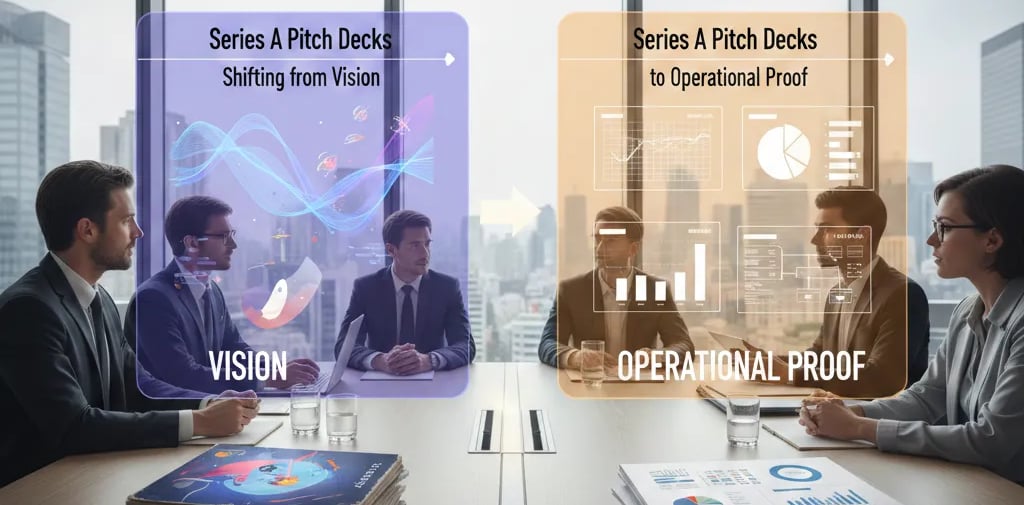

Series A Pitch Decks: Shifting from Vision to Operational Proof
A Series A founder in B2B SaaS raised $3.2M at Seed on the strength of a compelling vision and $180K in MRR. Eighteen months later, she walked into a Series A process with $1.4M ARR, a 114% NRR, and a deck that still read like a Seed pitch. The problem and solution slides were story-forward. The language was aspirational. The operational data existed in the business — it just was not on the slides. Three top-tier funds passed in the first meeting. One partner told her directly: "We believe the business. We do not believe the deck reflects the business."
That gap — between what the company had become and what the slides communicated — killed six weeks of process and cost her a term sheet she should have had. This is the most expensive version of a fixable error at Series A, and it is precisely what the full framework covering how Problem and Solution slides must evolve from Pre-Seed through Seed to Series A is built to prevent.
Why Series A Problem and Solution Slides That Still Sound Like Seed Decks Are a Valuation-Suppression Event
The transition from Seed to Series A is not a funding event. It is a proof-of-concept transition — from "we believe this mechanism works" to "here is the operational evidence that it works at scale, repeatedly, across multiple customer cohorts." The slides must reflect that transition explicitly. When they do not, the VC's risk model does not update.
Here is the precise failure: Seed-era decks are built around a thesis. Series A decks must be built around a track record. A Problem Slide that opens with a market narrative and a solution slide that explains the product vision is a Seed deck regardless of how much ARR you have underneath it. VCs are not just reading content — they are reading stage-readiness signals. A visionary framing at Series A signals that the founder is still in hypothesis mode, which contradicts the operational reality the VC needs to underwrite a $10M–$20M check.
As of 2025, median Series A pre-money valuations in the US sit at $22M–$28M, with top-tier funds underwriting to a 5–7x return threshold on entry price. At that math, partners are running a fundamentally different diligence model than at Seed — they are not assessing whether you can find product-market fit. They are assessing whether you can scale a machine that has already found it. A deck written in vision language does not feed that model. It creates friction in it.
I have reviewed eleven Series A decks in the past two quarters where the founders had legitimate operational proof — real cohorts, real retention, real unit economics — but had framed their Problem and Solution slides in the market-opportunity language they used at Seed. In nine of those cases, the VC's first substantive question was a version of "Can you walk me through the actual numbers?" — which means the slides failed to do their job before the conversation started.
The psychological cause is attachment. Founders who raised on a vision do not want to abandon the language that worked. But the language that got you the Seed check is now the language that is suppressing your Series A valuation.
The Operational Proof Standard: What Series A Funds Are Actually Stress-Testing in 2026
The shift from vision to operational proof is not aesthetic. It is mathematical. Here is what top-tier US and UK funds are running against Series A decks right now:
On the Problem Slide:
Refining Founder Phrasing
Invoice Automation: While founders might write "Our platform automates invoice processing," VCs need to read that you "intercept the AP exception queue at the point of escalation — the 11% of invoices that cause 80% of processing delays — and resolve them without human review".
Churn Reduction: Instead of saying "We use ML to reduce churn," specify that your "model identifies the behavioral signature of at-risk accounts 34 days before cancellation — early enough for CS intervention, late enough to target only genuinely at-risk users".
Operational Efficiency: Replace "Our tool saves ops teams 6 hours per week" with a technical explanation: "We eliminate the reconciliation step between the WMS and ERP entirely — the step that currently requires a human bridge because the two systems were never designed to communicate".
General Funding Standards
Market Pain: Seed rounds require qualitative pain backed by interview data, whereas Series A requires quantified pain validated through your own cohort data.
Market Size: Moving from Seed to Series A requires shifting from third-party citations to proving problem severity through your customers' P&L statements.
"Why Now": At the Seed stage, this is based on market trends; for Series A, it must be proven by your retention curves and expansion data.
The Solution Slide: Seed vs. Series A
Mechanism: Seed focuses on early validation of the mechanism; Series A requires it to be proven across multiple cohorts at a depth of 12+ months.
NRR (Net Revenue Retention): While 60–90 day cohorts are acceptable for Seed, Series A requires NRR above 110% (120%+ for top-tier funds) with a 12-month minimum.
CAC (Customer Acquisition Cost): Series A requires documented payback under 18 months and an LTV:CAC ratio above 3:1, whereas Seed only requires the CAC to be "directionally understood".
Differentiation: Founders must move from claiming differentiation at Seed to proving it at Series A via competitive displacement data or category share evidence.
The burn multiple test is now standard at Series A diligence across top US funds. As of early 2026, leading funds are expecting burn multiples below 1.5x — meaning for every $1.50 burned, you are generating $1.00 in net new ARR. This figure needs to be derivable from your deck. If a VC has to ask for it, the deck is incomplete.
The credibility equation shifts entirely:
Seed: Mechanism + Early Signal = Fundable Series A: Cohort Depth + Unit Economics + Competitive Proof + Burn Efficiency = Fundable
A deck missing any one of those four is carrying a structural deficiency the VC will find — either in the room or in diligence. Better to surface it on the slide and own it than to have it extracted under questioning.
The Operational Reframe Protocol: Converting a Vision Deck Into a Series A Proof Document
The rebuild is not about adding slides. It is about changing the evidence type on the slides you already have. Here is the step-by-step protocol:
Step 1 — Reframe the Problem Slide Around Your Cohort, Not the Market At Series A, your strongest proof that the problem is real and urgent is not a Gartner report. It is what your own customers' data shows. The Problem Slide should open with an operationally validated claim — something you can prove from inside your own business.
Weak (Seed-era framing): "The accounts payable market is underserved, with $X billion lost annually to manual processing."
Strong (Series A framing): "Across 80 paying customers, we have measured average AP exception resolution dropping from 4.2 days to 11 hours. The $340-per-shift cost our Problem Slide described at Seed is now confirmed at scale — and the data shows it understates the problem in enterprise accounts above $50M revenue."
The market report is gone. Your cohort replaced it. That is a more credible claim at this stage because it is verifiable.
Step 2 — Convert the Solution Slide From Mechanism to Proof of Mechanism The Seed Solution Slide explained why your approach works. The Series A Solution Slide proves it has worked, repeatedly, across defined customer segments.
Attach every solution claim to a cohort-level outcome:
"Our reconciliation engine eliminates the ERP-WMS gap" becomes "Our reconciliation engine has eliminated the ERP-WMS gap for 80 customers — average time-to-value is 19 days, and 12-month gross retention across that cohort is 93%."
"Our CS intervention model reduces churn" becomes "Our CS intervention model has produced 114% NRR across our 2023 cohort and 118% across our 2024 cohort — expansion is accelerating as customers reach full workflow integration."
Step 3 — Embed the Competitive Displacement Narrative At Series A, solution differentiation must be evidenced by what you have replaced — not by feature comparison alone. If you have displaced a competitor in the account, name the category (not necessarily the company). "We have replaced the incumbent tool in 34 of 80 accounts, with zero back-migration to date" is a moat signal. It tells the VC that switching cost is real, retention is structural, and the product has passed the replacement test under live conditions.
Before vs. After — Full Deck Reframe:
Weak Version (Vision-Forward Framing):
"The supply chain software market represents a $47B opportunity. Our AI-native platform is transforming how mid-market manufacturers manage operations, with a product vision built for the next decade of logistics complexity."
VC-Ready Version (Operational Proof Framing):
"Mid-market manufacturers using legacy WMS tools lose an average of $340 per shift to manual reconciliation — a figure we have confirmed across 80 customer deployments. Our platform eliminates that cost structurally, not operationally. Across our 2023 and 2024 cohorts: 93% gross retention, 114% NRR, 19-day average time-to-value. Six customers have expanded into a second product line. None have churned back to the legacy system."
Same business. Completely different signal. The first version asks the VC to believe in the future. The second version asks them to verify the present. At Series A, verification is faster and cheaper than belief.
Three Overcorrection Traps Series A Founders Hit When Rebuilding for Operational Proof
1. Stripping the narrative entirely and replacing it with a data dump. Operational proof does not mean a spreadsheet on a slide. The data must be embedded in a logical sequence — problem confirmed by cohort, solution proven by retention, differentiation evidenced by displacement. Data without narrative is as unreadable as narrative without data.
2. Using 12-month-old metrics as current evidence. Series A diligence timelines in 2025–2026 have normalized at 10–14 weeks for top-tier funds. Within that window, analysts will verify your metrics against live data. If your deck shows NRR figures from four quarters ago and your current trajectory has changed — in either direction — the discrepancy surfaces in diligence and damages credibility at the worst possible moment.
3. Citing NRR without cohort depth. A single NRR figure with no cohort breakdown is a Seed metric presented as a Series A metric. Show the 2023 cohort and the 2024 cohort separately. If the trend is improving, that is acceleration — which is the most valuable signal a Series A deck can carry. If it is declining, address it directly rather than hiding it in an aggregate figure. VCs will find it. Founders who surface it first and explain it retain credibility. Founders who hide it do not.
The Operational Proof Standard Is Now the Minimum Bar - Not a Differentiator
Fixing the vision-to-proof transition does not make your Series A deck exceptional. It makes it eligible. The founders who close Series A rounds at the top of the $22M–$28M pre-money range in 2025 are the ones whose decks answer the diligence questions before the partner has to ask them. The Problem Slide confirms the market pain through cohort data. The Solution Slide proves the mechanism through retention and expansion metrics. Together, they do not ask the VC to believe — they give the VC something to verify.
That verification process, when it finds exactly what the deck promised, is what closes rounds. The complete architecture for building slides that perform at this standard — across every stage and every section — lives inside the full Problem and Solution slide system for venture-backed founders.
The AI Financial System inside the $5K Consultant Replacement Kit handles the operational proof layer directly — it is built to model and present the cohort depth, burn multiple, and unit economics that Series A partners are running against your deck before they meet you. This is not generic financial modeling. It is calibrated to the specific metrics a 2025 Series A fund expects to see, in the format their analysts are trained to check. The full Kit is $497. Build the deck that survives the diligence model at the Series A pitch system built for founders who have the numbers but need the structure.
Vision got you to Seed. Proof gets you to Series A. The slides have to reflect which stage you are actually in.
Funding Blueprint
© 2026 Funding Blueprint. All Rights Reserved.