
Reducing VC Risk: How Your Pitch Deck Mitigates Investor Uncertainty
Your pitch deck isn't a story; it's a risk transfer instrument. Learn the 4 uncertainty loops you must close to prevent VCs from killing your Series A.
2.8 INVESTOR PSYCHOLOGY BEHIND PROBLEM & SOLUTION SLIDES
3/1/20266 min read
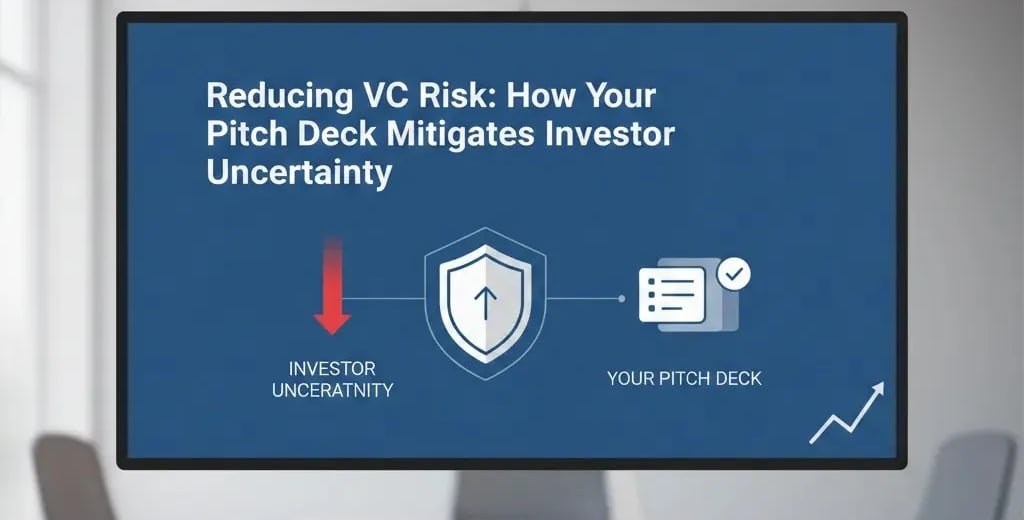
Reducing VC Risk: How Your Pitch Deck Mitigates Investor Uncertainty
$47M. That is the average amount a US Series A fund deploys per partner seat annually across their active portfolio. Every check written against that number requires a partner to stand in front of an LP committee and justify why this founder, this market, this deck warranted the allocation. Your pitch deck is not a sales document. It is a risk transfer instrument — and if it does not systematically dismantle the four categories of uncertainty a VC carries into every first meeting, you are asking them to absorb risk they have no mechanism to price.
The founders who close Series A rounds in 2025 and 2026 are not the ones with the best products. They are the ones whose decks make the VC's risk model easier to close. That is a structural discipline, and it starts on your Problem slide and runs through every slide that follows. It is the operating principle behind the investor psychology framework built for high-conversion Problem and Solution slides.
Why Your Pitch Deck Is a Risk Transfer Document, Not a Story
Every VC enters a first meeting carrying a four-part uncertainty stack. Market risk — is this problem real and large enough? Execution risk — can this team build and sell? Timing risk — is now the right moment for this solution? Dilution risk — will this round structure still make sense at exit? Your deck does not need to eliminate these risks. It needs to transfer them from the "unknown" column to the "modelled and priced" column.
The failure pattern that kills most Series A pitches is not weak traction or an underdeveloped product. It is a deck that leaves one or more of these risk categories unaddressed — not because the founder lacks the answer, but because they organised their slides around telling their story rather than closing the VC's uncertainty loops.
A Problem slide that describes a broken market without citing the mechanism of failure leaves market risk open. A Solution slide that explains the product's features without demonstrating a defensible wedge leaves execution risk open. Both failures compound: a VC holding two open uncertainty categories does not ask clarifying questions in the meeting. They mentally table the deal and move to their next scheduled call.
I have seen this structure across nine decks reviewed in the past two quarters — founders with genuinely strong businesses who lost the room because their deck sequence answered the questions they found interesting rather than the ones the VC needed closed before committing to diligence.
The psychological mechanics are straightforward. VCs are professional pattern matchers operating under time compression. When a deck does not close an uncertainty loop the VC is running, their brain does not pause and wait for the next slide. It flags the open loop as a risk signal and begins discounting the overall thesis. By the time you reach your traction slide, you are already recovering ground rather than building conviction.
Quantifying the Cost of an Open Uncertainty Loop
The financial impact of unresolved VC uncertainty is not speculative. It has direct expression in three measurable deal outcomes.
As of early 2026, top-tier US funds are running average diligence cycles of 10–14 weeks for Series A deals — a normalisation from the compressed 4–6 week timelines of 2021. Within that cycle, deals that enter diligence with open uncertainty loops require 2–3 additional founder-side deliverables before a term sheet is issued. Each deliverable round adds 10–18 days to close. In a fundraising environment where runway is the primary negotiating variable, 30 extra days is not a scheduling inconvenience. It is a leverage shift toward the fund.
Here is what open uncertainty loops cost across the deal lifecycle:
Market Risk
Left Open: VC cannot size the opportunity
Consequence: TAM discount applied to pre-money model
Execution Risk
Left Open: No evidence of repeatable motion
Consequence: Milestone-heavy term sheet with tranched capital
Timing Risk
Left Open: No external trigger cited
Consequence: "Come back in 6 months" — deal deferred
Dilution Risk
Left Open: Cap table or exit math unclear
Consequence: Heavier protective provisions at term sheet
The benchmark that matters here: a deck that closes all four uncertainty categories before the Q&A reduces average time-to-term-sheet by an estimated 3–4 weeks based on founder reporting across 2024–2025 vintage deals. In a $22M–$28M pre-money environment, that timeline compression is also a valuation compression mechanism — the longer the process runs with open loops, the more the VC's internal model drifts toward the conservative end of their range.
The Four-Loop Closure Protocol for Your Problem and Solution Slides
This is the mechanical fix applied at the slide level. Each loop has a specific closure mechanism.
Loop 1 — Market Risk Closure (Problem Slide) The Problem slide must answer: Why is this market failing, how large is the failure, and why is the failure measurable? The closure mechanism is a bottom-up market sizing embedded in or directly adjacent to the problem framing — not a TAM slide isolated at the back of the deck. When market risk is closed on the Problem slide, the VC enters your Solution slide already holding a sized opportunity.
Weak Version: "Supply chain inefficiency costs businesses billions annually." Market risk: wide open. "Billions" is not a model. It is a gesture.
VC-Ready Version: "US mid-market manufacturers lose an average of 11.4% of gross margin annually to unplanned downtime — $220B in aggregate across the 42,000 facilities in our target segment (Deloitte Operations Survey, 2024). Our entry point is the 8,000 facilities running legacy CMMS platforms with no predictive layer." Market risk: closed. The VC has a sized problem, a cited source, and a defined entry segment before the Solution slide appears.
Loop 2 — Execution Risk Closure (Solution Slide) The Solution slide must demonstrate repeatable commercial motion, not product capability. Features do not close execution risk. Metrics do. Specifically: the number of customers who have paid for the specific outcome you deliver, the average contract value, and the average time-to-value. These three data points, embedded in your Solution framing, transfer execution risk from "unknown" to "evidenced."
Loop 3 — Timing Risk Closure (Problem or Transition Slide) Every Series A deck needs a single "why now" signal that is external, verifiable, and specific. A regulatory shift, a technology cost curve that crossed a viability threshold, a demographic cohort that has reached buying age. This is not a trend. A trend is a direction. A timing signal is a threshold event — the specific moment at which the old solution became structurally inadequate. State it in one sentence, cite it, and move on.
Loop 4 — Dilution Risk Closure (Solution or Traction Slide) This loop is the most frequently ignored. Dilution risk is the VC's concern that the current round structure will leave insufficient equity for future rounds to function correctly. Close it by embedding a brief capital efficiency signal in your solution framing: your burn multiple, your payback period, or your current ARR-to-burn ratio. As of 2025, top-tier funds flag burn multiples above 1.5x at Series A as an execution risk signal. A single line showing you are operating at 1.1x or below closes this loop before the VC's analyst raises it in the pre-meeting brief.
The Framework: Problem Slide closes Market + Timing Risk. Solution Slide closes Execution + Dilution Risk. Every slide that does not contribute to closing one of these four loops is using screen time it has not earned.
Three Overcorrections That Reopen Closed Loops
1. Over-citing to the point of density collapse. Founders who respond to the evidence requirement by loading every slide with footnotes and data tables create a new problem: cognitive overload. A VC who cannot process your Problem slide in 20 seconds has not had their risk loop closed — it has been buried. One cited data point per claim. No more.
2. Closing loops in the wrong sequence. Addressing timing risk before market risk is established forces the VC to evaluate when before they have accepted what. The four-loop closure sequence is not arbitrary. Market → Timing → Execution → Dilution is the order in which a VC's risk model builds. Disrupting that sequence does not make you stand out. It makes the argument harder to follow.
3. Treating traction as a substitute for loop closure. Strong revenue numbers do not automatically close market or timing risk. A founder with $1.4M ARR who has not explained why now and how large has traction in an unverified container. The VC holds the revenue fact and the open uncertainty loop simultaneously — and the loop discounts the revenue more than founders expect.
What Systematic Risk Reduction Is Worth at the Negotiating Table
Every uncertainty loop you close before the meeting transfers negotiating leverage from the VC's risk model to your traction evidence. In a market where the difference between the conservative and aggressive end of a Series A pre-money range is $5M–$8M, the deck that walks into the room with all four loops pre-closed is not just a better pitch. It is a better opening bid.
Investors do not fund certainty — certainty does not exist at Series A. They fund structured uncertainty: risk they can model, price, and defend to an LP committee. A deck that gives them that structure is not easier to like. It is easier to approve. For the complete system that governs how every slide in your deck contributes to or undermines this architecture, the full Problem and Solution Slides framework covers the entire sequence.
Every week this four-loop structure is absent from your deck is a week you are walking into meetings where the VC is managing uncertainty you handed them rather than conviction you built. The Slide-By-Slide VC Instruction Guide inside the $5K Consultant Replacement Kit is built to close this gap — each slide instruction maps directly to the uncertainty category it needs to neutralise before the next one loads. The full Kit is $497. You can access it at the pitch deck system built to pre-close VC uncertainty before the first meeting.
A VC who leaves your pitch with open uncertainty loops did not fail to understand your vision. You failed to give them the structure to price it. That is a fixable problem — but only if you treat the deck as a risk instrument first and a story second.
Funding Blueprint
© 2026 Funding Blueprint. All Rights Reserved.