
How Associates, Principals & Partners Review Decks Differently
You aren't pitching one firm; you are pitching 3 conflicting auditors. A forensic audit on why Associates reject you to save "Political Capital" and the "Tri-Layer Architecture" to beat them.
1.2: HOW INVESTORS USE PITCH DECKS INTERNALLY
1/18/20265 min read
The Internal Hierarchy of Rejection
Most founders treat a Venture Capital firm as a monolithic entity, a singular "brain" that accepts or rejects their startup. This is a fatal calculation error. When you email your deck, it enters a tiered filtration system where incentives are misaligned, and risk profiles vary wildly depending on the job title of the reader. To navigate this, you must understand How Investors Use Pitch Decks Internally. If you optimize your deck for a Partner but it hits an Associate’s inbox first, you will be archived before you ever get a meeting.
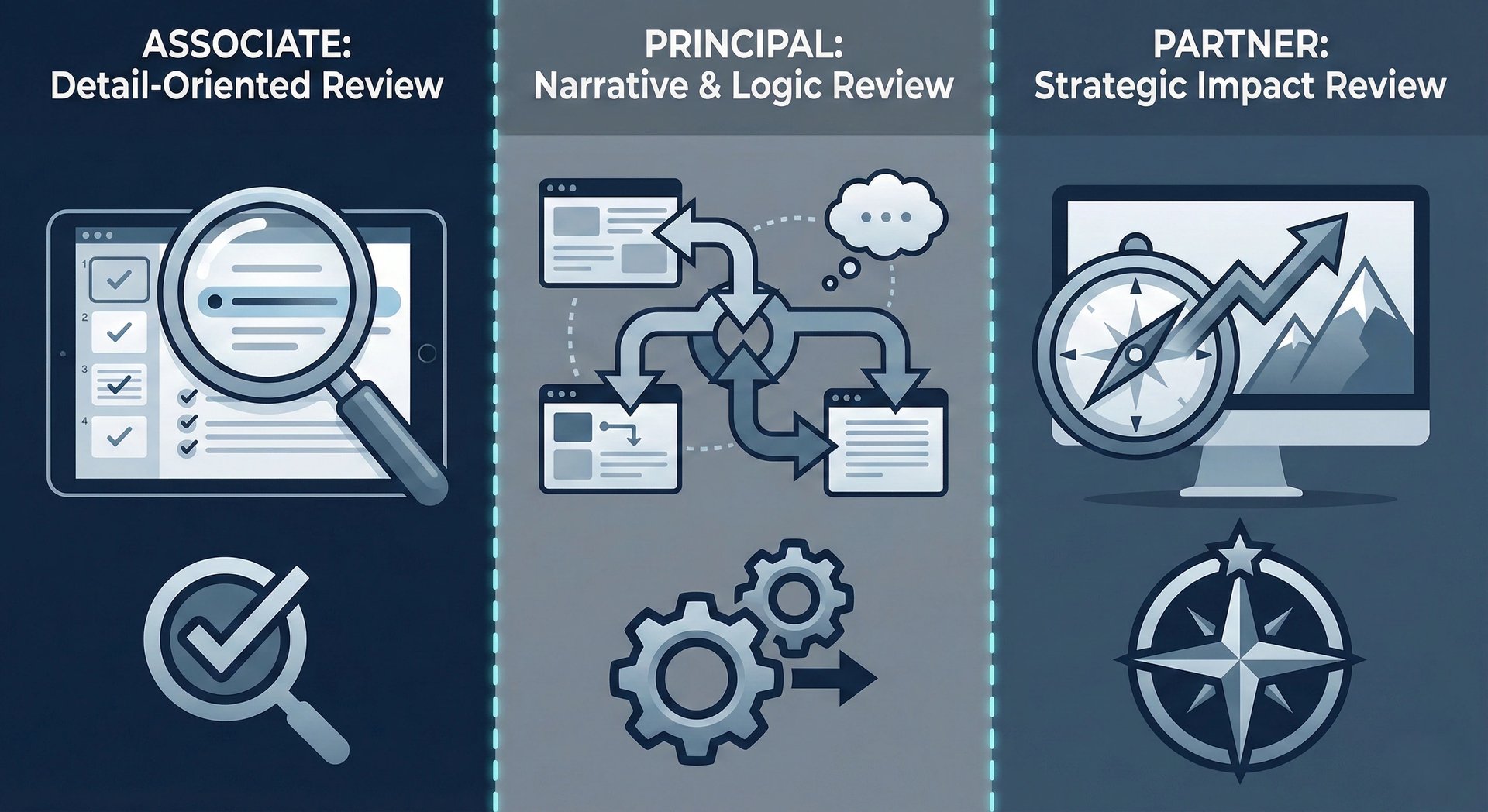
The counter-intuitive truth is that you are not pitching one company; you are pitching three distinct auditors with conflicting psychological mandates. The Associate is paid to find reasons to say "no" to protect their reputation. The Principal is paid to find execution risks. The Partner is paid to find the one asset that returns the entire fund. Your deck must satisfy the Associate’s forensic checklist without boring the Partner’s pattern-matching brain. Failure to thread this needle is why 90% of Series A processes stall at the "we're passing" email, usually sent by someone who has been at the firm for less than two years.
Misaligned Incentives & Career Risk
The "Red Flag" scenario is remarkably consistent. A founder sends a visionary, high-concept deck—heavy on narrative, light on granular metrics—to a general firm inbox or a junior Associate.
The Associate's reaction is not inspiration; it is irritation.
When an Associate sees a slide labeled "Growth" with a cumulative revenue chart (a vanity metric) and no breakdown of CAC payback periods, they do not think, "Wow, what a vision." They think, "This founder is hiding something," or worse, "This founder doesn't know their own unit economics."
The Associate’s primary career incentive is risk mitigation. They are the first line of defense. If they pass a bad deal up to a Principal or Partner, they lose political capital. Therefore, they review decks with a "Forensic Auditor" mindset, looking for:
Arithmetic errors in market sizing.
Inconsistencies between the P&L and the traction slide.
Broken links or formatting sloppiness (which signals operational incompetence).
Why Founders Fail Here:
Founders operate on ego and vision. They believe their job is to sell the "dream." They assume the person reading the deck has the authority to write a check. In reality, the first set of eyes belongs to someone heavily incentivized to find a flaw in your logic so they can clear their inbox and move to the next deal. If your deck requires a PhD to decipher your retention cohorts, the Associate will simply mark it as "Pass - Unclear Metrics" to save cognitive load.
The Cost of Cognitive Load
The variance in deck review styles is not a matter of preference; it is a function of time allocation and the "Power Law" of returns. We can quantify this difference through the lens of Cognitive Load and Risk Assessment time.
Let’s break down the mathematical logic of the internal review funnel:
The Associate (The Screen):
Metric: False Positives. An Associate is terrified of recommending a "bad" startup.
Time Allocation: ~2 minutes per deck.
Review Vector: Checklist Compliance. They are looking for specific integers: MoM growth > 15%, LTV:CAC > 3:1, Burn Multiple < 2x.
The Principal (The Diligence):
Metric: Execution Risk.
Time Allocation: ~20 minutes per deck (if passed by Associate).
Review Vector: Feasibility. They audit your GTM motion and financial model assumptions.
The Math: They calculate the probability of hitting your Year 3 projections. They run the "Sensitivity Analysis" in their head: "If CAC doubles, does this business break?"
The Partner (The Check Writer):
Metric: Fund Return Potential (Power Law).
Time Allocation: ~5 minutes (focused on 3 specific slides).
Review Vector: Asymmetry. They don't care about a 3x return. They need a 100x return to return the fund.
The Math: Exit Value = (Entry Ownership%) X (Projected Market Cap). If the resulting number isn't $>$25% of the total fund size, the deal is dead, regardless of how good the unit economics are.
The Cognitive Load Cost:
If you force a Partner to do an Associate's math (digging for basic numbers), they disengage. If you force an Associate to interpret a Partner's vision (abstract market theory without data), they reject. Your deck incurs a "tax" every time it fails to serve the specific data needs of the viewer instantly.
The Tri-Layer Deck Architecture
You cannot create three different decks. You must engineer a single asset that functions as a Trojan Horse, satisfying all three layers of the VC hierarchy simultaneously. This requires the Tri-Layer Deck Architecture.
Layer 1: The Partner’s "Skim Path" (Slides 1, 2, and Last)
Target: General Partners (GPs).
Requirement: Narrative clarity and Market size.
The Fix: Your headlines alone must tell the story. If a GP reads only the headlines of your 12 slides, they should understand the entire business, the problem, and the massive opportunity.
VC-Ready Version: The "Team" slide must highlight not just logos, but relevant exits and technical unfair advantages. The "Vision" slide must articulate a multi-billion dollar outcome. Do not bury the lede.
Layer 2: The Principal’s "Logic Layer" (The Body)
Target: Principals and VPs.
Requirement: Go-to-Market (GTM) logic and competitive defense.
The Fix: Use the "CAC Arbitrage" Framework. Don't just show a marketing slide. Show why your acquisition channel is underpriced and scalable.
VC-Ready Version:
Weak: "We will use SEO and Ads."
VC-Ready: "We leverage programmatic SEO to acquire leads at $12 CPA (vs $50 industry avg), converting at 4%." Show the logic engine of the business.
Layer 3: The Associate’s "Audit Vault" (The Appendix)
Target: Analysts and Associates.
Requirement: Raw, verifiable data.
The Fix: Move the dense data tables to the Appendix. This keeps the main narrative clean for the Partner while giving the Associate the ammunition they need to fight for you in the investment committee meeting.
The Protocol: Include a slide explicitly titled "Unit Economics & KPI Dictionary."
List exactly how you calculate LTV (e.g., "3-year cap, gross margin basis").
Show retention cohorts (net dollar retention).
Show a bridge of your last 12 months' burn rate.
The Insider Equation:
Your deck is successful when:
(Partner Excitement X Principal Logic}) /Associate Friction} > Investment Threshold
By sequestering the complex math in the Appendix, you reduce friction for the Partner. By including it at all, you arm the Associate.
The "Death Traps"
In attempting to optimize for this hierarchy, founders often fall into specific traps that signal "Junior Operator."
The "Appendix Dump": Do not put 40 slides in your appendix. An Associate will view a 60-page PDF as a lack of focus. Keep the appendix to the "Vital Five": Financials, Cap Table Summary, Detailed Cohorts, Technical Architecture, and Full Competitive Matrix.
The "False Precision" Error: Showing projected revenue of $14,234,112 in Year 5. This flags you as naive to Principals. Round your numbers. We know your projections are wrong; we want to see if your assumptions are right.
Ignoring the Analyst: Never be rude or dismissive to an Analyst on a call. They control the CRM entry. If they tag you as "Arrogant/Difficult," that note survives longer than your startup. They are the gatekeepers of the deal flow meeting.
The "High-Ticket" Conclusion
The difference between a "Pass" and a "Term Sheet" often isn't the business itself—it's the translation layer between your raw data and the VC's internal audit process. By structuring your deck to satisfy the Associate’s checklist, the Principal’s risk model, and the Partner’s greed, you remove the friction that kills deals. Fixing this structural flaw doesn't just get you a second meeting; it frames your startup as a high-competence asset, potentially adding $1M+ to your pre-money valuation by creating competitive tension.
For the complete system on structuring your narrative and data room, refer to How VC Pitch Decks Really Work in 2026 — And Why Most Founders Get Them Wrong.
You can build this manually, or use "The Slide-By-Slide VC Instruction Guide" included in our $5k Consultant Replacement Kit ($497) available on the home page. This toolkit forces you to answer the specific audit questions Associates and Partners ask before you ever hit "send."
Funding Blueprint
© 2026 Funding Blueprint. All Rights Reserved.