
Pitch Deck Value Prop: Explaining Solutions Without Marketing Fluff
Stop using "empowering" in your deck. Marketing fluff is a Series A disqualifier. Learn why VCs reject aspirational copy and how to write investment logic.
2.3 HOW TO FRAME THE SOLUTION SLIDE (WITHOUT OVERCLAIMING)
2/18/20266 min read
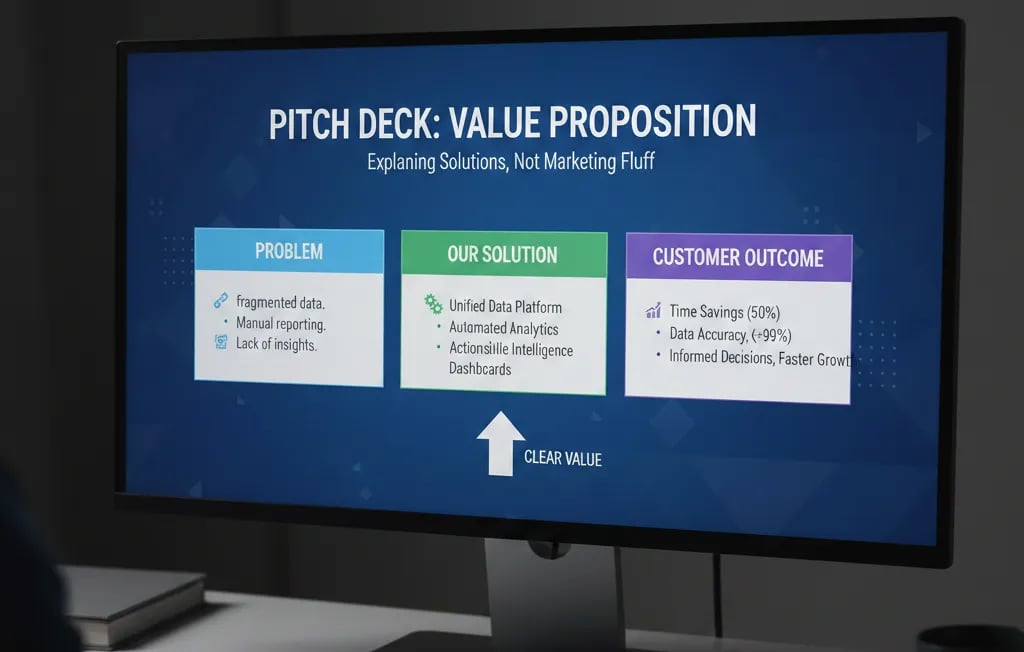
Pitch Deck Value Prop: Explaining Solutions Without Marketing Fluff
A Series A founder in B2B SaaS raised $2.8M in pre-seed, had 14 paying customers, and still could not close a single Series A meeting past the first call. The product worked. The retention was there. What killed the raise was a Value Proposition statement that read like a landing page headline — aspirational, smooth, and completely empty of information a VC could use to build a thesis. Marketing language in a pitch deck does not just fail to help. It actively signals that the founder does not understand the difference between selling to customers and making a capital allocation argument to investors. If your Solution Slide is still carrying brand-voice copy rather than investment-grade logic, what makes a real Problem Slide and how investors actually judge it is the diagnostic layer that sits underneath everything covered here.
Why "Customer-Friendly" Value Prop Language Is a Series A Disqualifier
The error is structural, not cosmetic. A value proposition written for a buyer and a value proposition written for an investor are solving two entirely different communication problems. The buyer needs to feel that the product will make their life easier. The investor needs to understand, with precision, what specific friction is being removed, for which customer segment, at what economic magnitude, and why this team is the one that captures the margin.
Marketing copy collapses these two requirements into one sentence and satisfies neither. Phrases like "empowering teams to do more with less" or "transforming how businesses manage X" are not wrong because they are optimistic — they are wrong because they contain no falsifiable claim. A VC cannot stress-test them, model them, or defend them to a co-investor. They slide off the slide without leaving a mark.
The psychological origin is understandable. Most founders, especially those with a commercial background, have spent 12–18 months in go-to-market mode before approaching Series A. The language of their pitch deck gets contaminated by their sales motion. They have been rewarded for messaging that converts — so that is the register they default to when describing their solution. In a deck reviewed last month, a founder with $900K ARR opened their Value Prop with "the future of intelligent workforce management" — a phrase that describes at least 200 companies. The VC's analyst flagged it as "category-generic" before it reached the partner.
The mechanism of failure is consistent: marketing language forces the VC into a subtraction exercise. They have to strip away the positioning and try to find the actual product underneath. Most won't do that work. They will note "unclear differentiation" and move on.
The Specificity Deficit: Quantifying What Vague Value Props Cost at the Pre-Money Stage
Vagueness is not neutral. It has a direct valuation consequence.
Consider what a VC needs to justify a $22M–$28M pre-money valuation — the current median range for Series A in the US as of early 2026. They need to construct an internal investment memo that answers three questions with precision:
What does this company do, in one sentence that a non-expert LP can repeat?
What is the quantified customer outcome that justifies the price point?
Why is this defensible against the next-best alternative?
Marketing language fails all three tests simultaneously. Here is the cost breakdown:
"Empowering finance teams to work smarter" — LP Repeatability Fails, Quantified Outcome is Absent, and there is No Defensibility Signal.
"Cutting month-end close from 14 days to 48 hrs for mid-market CFOs" — LP Repeatability Passes, Quantified Outcome is Explicit, and the Defensibility Signal implies switching cost.
When a VC cannot answer those three memo questions from your slide alone, they carry the gap into their internal discussion. Unresolved gaps do not sit quietly — they attract skepticism from partners who were not in the room. Your Value Prop must survive a meeting you are not present for. Marketing language guarantees it will not.
A deck that forces the VC to do interpretive work on your core value statement is not just less compelling — it is perceived as a diligence risk. If you cannot articulate the value with precision, the implicit read is that you do not yet have clarity on what you are actually selling and to whom.
The Investment-Grade Value Prop Protocol: Replacing Fluff With a Claim a VC Can Model
The framework is SQAD: Segment, Quantified Outcome, Against What Alternative, Defensibility Clause.
Every investment-grade value proposition must contain all four components. If any one is missing, the statement is not ready for a partner meeting.
S — Segment: Name the customer with enough specificity to imply a go-to-market motion. Not "enterprise companies." — "Head-count-150–500 CFO offices in professional services."
Q — Quantified Outcome: State the result in a number the customer actually tracks. Not "saves time" — "reduces close cycle from 14 days to 48 hours."
A — Against What Alternative: Identify the current state or competitor being displaced. Not "better than existing tools" — "without replacing their existing ERP."
D — Defensibility Clause: One phrase that signals why this is not trivially replicable. Not "proprietary technology" — "trained on 4.2M reconciliation edge cases from 60 enterprise clients."
Weak Version: "We help finance teams close faster with AI-powered automation that eliminates manual errors and drives operational efficiency."
Segment: absent ("finance teams" is not a segment)
Quantified outcome: absent ("faster" is not a number)
Alternative: absent
Defensibility: absent ("AI-powered" is a feature description, not a moat signal)
VC interpretation: this could describe 300 companies in the market right now
VC-Ready Version: "We cut month-end close from 14 days to 48 hours for mid-market CFO offices — without an ERP migration — using a reconciliation engine trained on 4.2M historical edge cases."
Segment: mid-market CFO offices ✓
Quantified outcome: 14 days → 48 hours ✓
Alternative: no ERP migration required (displacement of the incumbent's switching cost argument) ✓
Defensibility: 4.2M edge cases (data moat signal) ✓
VC interpretation: I can model this. I can defend this to my partners.
The stress test: Replace your company name in the value prop with a competitor's name. If it still reads as true, your statement is not differentiated — it is a category description. Rewrite until the swap breaks the sentence.
One additional rule on overclaiming: the SQAD framework only works if your numbers are defensible under diligence. Do not use a quantified outcome you cannot produce customer evidence for. A VC who asks for the case study behind "48 hours" and receives a vague answer will apply a credibility discount to every subsequent slide. The number must be real, sourced, and documentable.
Three Credibility Killers Triggered by Removing Marketing Language From Your Value Prop
1. Replacing fluff with feature descriptions. "An AI reconciliation engine with real-time data matching" is not an investment-grade value prop. It is a product spec. Features are not outcomes. Investors fund outcomes.
2. Quantifying the wrong metric. Founders often reach for a number to appear specific, but select a metric that does not map to customer value — "processes 10,000 invoices per hour" tells the VC nothing about why a CFO would pay for it. The number must be a metric the buyer tracks in their own KPIs.
3. Writing the SQAD for your best customer, not your median customer. If your 48-hour close figure comes from one enterprise pilot and your median client achieves 6 days, using 48 hours without qualification is a claim that will collapse in diligence. Use the median with the outlier noted, not the outlier as the headline.
What an Investment-Grade Value Prop Does to Your Pre-Money Negotiation
A value proposition that a VC can repeat, model, and defend to their LPs is not just a communication win — it is a negotiating asset. It compresses the ambiguity discount that partners apply when they cannot independently articulate why a company is defensible. Founders who arrive at partner meetings with SQAD-complete value props spend less time re-explaining and more time discussing expansion multiples and competitive moat — which is where pre-money valuations are actually argued. For the full architecture connecting your Problem Slide logic to a Value Prop that survives LP-level scrutiny, the complete Problem and Solution Slides framework for Series A covers the system end to end.
Every week your Value Prop slide carries marketing language instead of investment logic is a week you are entering VC meetings with a gap the partner will find — and you will not know when they found it. The Slide-By-Slide VC Instruction Guide inside the $5K Consultant Replacement Kit includes the SQAD framework applied across eight verticals, with annotated before/after rewrites showing exactly which phrases triggered analyst flags and what replaced them. The full Kit is $497. Get the guide that closes the gap between a value prop that sells and one that raises.
A VC is not a buyer. Stop writing for one.
Funding Blueprint
© 2026 Funding Blueprint. All Rights Reserved.