
How to Update Decks Between Funding Rounds (Series A Audit)
Recycling your Seed deck is a death sentence. A forensic audit of the 'Frankenstein Deck': Why 'patched' narratives signal operational laziness and how to refactor for the Rule of 40.
1.4 HOW PITCH DECKS FIT INTO DIFFERENT FUNDRAISING STAGES?
1/26/20264 min read
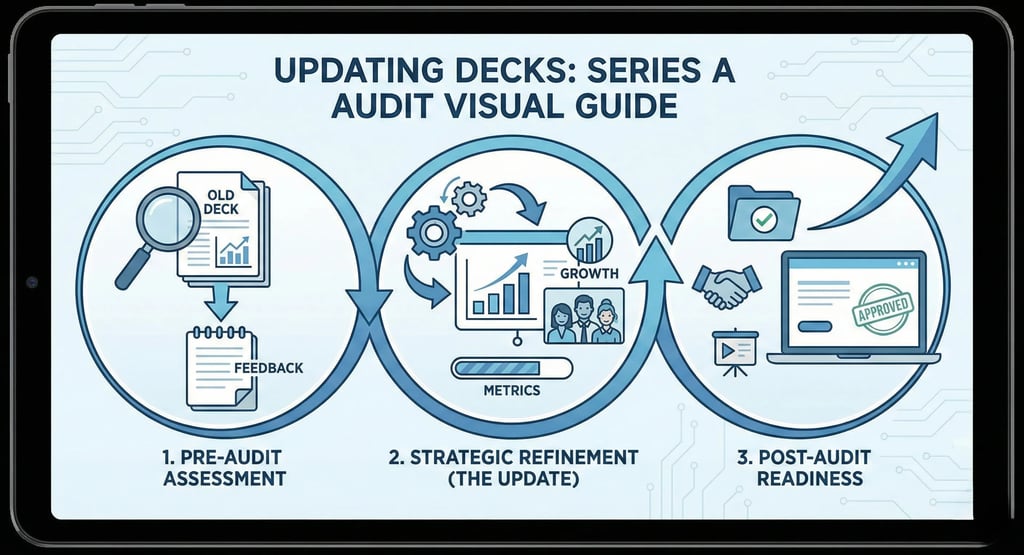
The Vintage Deck: Why Recycling Your Seed Narrative Is Sabotaging Your Series A
If you are sending your Seed deck to Series A partners with only the "Traction" and "Financials" slides updated, you are already dead.
You haven't updated your narrative; you have merely updated the timestamps on your failure.
The counter-intuitive truth of venture capital is that traction does not validate the deck; the deck validates the quality of the traction. A Seed deck sells "Hope" and "Team." A Series A deck sells "Economics" and "Engine." If you use a "Hope" wrapper for an "Economics" product, you look mathematically illiterate. To understand exactly where you sit in the capital stack and why the requirements shift so violently, review How Pitch Decks Fit Into Different Fundraising Stages before reading another word.
The "Frankenstein" Red Flag
When a General Partner (GP) opens a deck that has been "patched" rather than "re-engineered," they see a Frankenstein Deck.
The Red Flag Scenario:
The design language of Slide 4 (The Solution) feels outdated compared to Slide 12 (Current Metrics). The narrative arc promises a "revolution" (Seed language), but the data shows a "good business" (Series A reality). The cognitive dissonance is immediate.
The VC interpretation is brutal:
"This founder is operationally lazy. They do not understand that a $5M check requires a fundamentally different risk analysis than a $500k check. They are still trying to sell me a dream when I am here to buy a machine."
The Psychological Audit:
Why do founders do this?
Sunk Cost Bias: You spent $5,000 or 50 hours on the original design. You are emotionally attached to the slides that got you your first check.
Fear of Churn: You believe the original "Vision" is sacrosanct. You are terrified that if you change the "Why," you admit the original plan was wrong. Newsflash: We know the original plan was wrong. We want to know if you fixed it.
The Cost of Cognitive Load
A recycled deck destroys your conversion rate because it forces the investor to perform "Translation Math" in their head.
Every second a VC spends trying to reconcile your Seed-stage "Problem Statement" with your Series A "Unit Economics" increases your Cognitive Load Cost.
The Logic of the Down-Round:
Seed Risk = Product Risk. Can you build it? (Qualitative).
Series A Risk = Execution Risk. Can you scale it at a declining marginal cost? (Quantitative).
The Delta: If your deck emphasizes "Features" (Seed) over "CAC Payback Periods" (Series A), you are answering a question nobody asked.
The Equation of value destruction:
Valuation = (Growth Rate \times Retention) / (CAC \times Burn Multiple)
In Seed: The denominator (CAC/Burn) is ignored because it’s theoretical.
In Series A: The denominator is the only thing that matters.
If your deck structure doesn't prioritize the denominator, you are signaling that you don't track it. If you don't track it, you will burn the $8M Series A check in 12 months with nothing to show for it.
The Narrative Refactor
Stop "updating" your deck. You must refactor it. This requires a "Zero-Based" approach. Start with a blank file.
Step 1: The "Metric Maturity" Audit
You must shift the focal point of your slides from Activity to Efficiency.
The Before vs. After Comparison:
Weak Version (Recycled Seed):
Headline: "We are growing 20% MoM."
Content: A chart showing user signups going up and to the right.
VC Reaction: "Vanity metrics. How much did they pay for those users?"
VC-Ready Version (Series A Refactor):
Headline: "Contribution Margins expanded to 45% while tripling Ad Spend."
Content: A cohort analysis showing LTV expansion over 6, 12, and 18 months against a flat CAC.
VC Reaction: "This is a scalable machine. I can pour fuel on this."
Step 2: The Framework Shift (Rule of 40)
Your narrative must pivot to the Rule of 40 (Growth Rate + Profit Margin > 40%).
The Problem Slide: Change from "People have this pain" to "The market is fragmenting, creating an arbitrage opportunity for our solution."
The Solution Slide: Change from "Look at these features" to "Look at this moat."
The Ask: Change from "We need 18 months of runway" to "We need $8M to acquire 10,000 customers at a 4:1 LTV/CAC ratio."
The "Death Traps"
While refactoring, avoid these lethal errors often seen in 2026:
The Valuation Time Machine: Do not reference 2021 revenue multiples. If you try to justify a valuation based on a 50x ARR multiple in the current high-interest environment, you will be laughed out of the room.
The "Pivot Hiding": If you pivoted between Seed and Series A, own it. Do not try to retcon your history to make it look like a straight line. VCs do due diligence. If they find you erased your failed B2C attempt to present a "clean" B2B history, you fail the integrity audit.
Data Dumping: Do not confuse "transparency" with "noise." Do not paste your raw Excel spread into Slide 14. Synthesize the data into insights.
Conclusion
The difference between a "Recycled Seed Deck" and a "Series A Institutional Deck" is not design—it is financial literacy. A properly updated deck signals that the CEO has graduated from "Builder" to "Capital Allocator." This shift alone can add $1M - $2M to your pre-money valuation by reducing the perceived execution risk.
For the complete architectural breakdown of how to structure the rest of your narrative, read How VC Pitch Decks Really Work in 2026 — And Why Most Founders Get Them Wrong.
The Filter Plug:
You can attempt to restructure your narrative manually, or you can use The Slide-By-Slide VC Instruction Guide included in our $5k Consultant Replacement Kit ($497) available on the home page. It contains the exact structural templates for every funding stage, ensuring you never present a Seed narrative to a Series A investor.
Funding Blueprint
© 2026 Funding Blueprint. All Rights Reserved.