
Solving Real Market Pain: The Pitch Deck Pattern VCs Look For
Stop pitching "tolerated pain." VCs fund emergencies, not inconveniences. Learn the Urgency Signal Architecture to survive the Series A partner filter.
2.4 CONNECTING PROBLEM → SOLUTION LIKE A VC (NARRATIVE LOGIC MODEL)
2/20/20268 min read
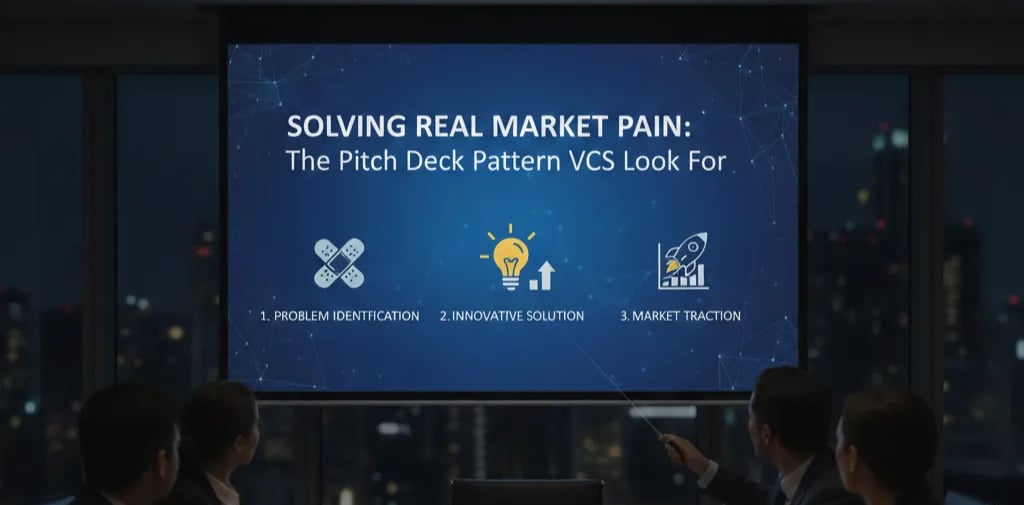

Solving Real Market Pain: The Pitch Deck Pattern VCs Look For
A Series A founder in B2B SaaS raised $1.8M in seed, built a product with eleven paying customers, and walked into four partner meetings in a single quarter. She received four passes. Not because her numbers were weak — her burn multiple was clean and her NRR was above 110%. She lost those meetings because every VC who read her deck reached the same private conclusion: this solves a problem customers tolerate, not one they are desperate to escape.
The distinction between tolerated pain and urgent pain is the pattern filter every experienced investor applies before they evaluate your market size, your team, or your financials. It is the first binary in the deal funnel: real market pain, or market inconvenience? And it is the filter most founders — including technically strong ones — do not know they are failing.
This post is part of the VC Narrative Logic Model for connecting Problem and Solution slides — the architecture that determines whether your pitch reads as a response to genuine market pressure or a product looking for permission to exist.
Why "We Solve a Real Problem" Is the Most Expensive Assumption in a Series A Deck
Every founder believes they are solving a real problem. That belief is not the issue. The issue is that "real problem" and "venture-scale urgent pain" are not the same category — and the pitch deck pattern that distinguishes them is specific, learnable, and almost universally absent from decks that fail at the partner level.
Here is what a VC actually sees when they read a Problem slide built around tolerated pain: a market that has already reached equilibrium with its own dysfunction. Customers are living with it. They have built workarounds. They have absorbed the cost into their operating model. The pain is real in the sense that it exists — but it is not urgent in the sense that it is driving active buying behaviour. A market in equilibrium with its own pain does not need a new product. It needs a significantly better product than the workarounds it has already adopted — and that is a fundamentally different, and harder, investment thesis.
The VC's internal risk calculation shifts immediately: if customers have survived this problem for three years without urgently seeking a solution, what is the trigger event that makes them urgently seek one now? If the deck does not answer that question before it is asked, the pitch has already lost the room.
In three decks reviewed in the past quarter, this exact framing failure appeared in companies with genuine traction — one with $400K ARR — and all three were passed at the partner stage with feedback citing "unclear urgency of the underlying problem." The product worked. The pain framing did not.
The psychological origin of this mistake is founder proximity. When you are inside the problem daily — through customer calls, support tickets, and churn analysis — the urgency feels self-evident. You have seen it from every angle. The VC is seeing it for the first time, cold, and they need the urgency demonstrated, not assumed.
The Urgency Signal Architecture: How a VC Scores Market Pain in Under 90 Seconds
A Series A investor is not asking "is this a problem?" They are asking a three-part diagnostic question simultaneously:
1. Is the pain acute enough that customers are actively spending money or time to manage it right now? 2. Is the pain growing — driven by a regulatory, technological, or structural market shift that makes existing workarounds increasingly inadequate? 3. Is the pain concentrated in a segment large enough to support a venture return?
All three must be answerable from your Problem slide alone. If the VC reaches your Solution slide still uncertain on any one of the three, the pitch is structurally broken.
Here is how that diagnostic maps to slide-level evidence requirements:
Acute spending evidence
Weak Version: "Companies lose time on manual reporting"
VC-Ready Version: "Mid-market finance teams spend an average of 22 hours per month on manual consolidation — at a fully-loaded cost of $3,100 per cycle, per entity"
Growing urgency trigger
Weak Version: "The market is shifting toward automation"
VC-Ready Version: "SEC climate disclosure requirements effective Q1 2026 require multi-entity reporting that current ERP configurations cannot produce without manual intervention"
Concentrated segment proof
Weak Version: "This affects thousands of companies"
VC-Ready Version: "14,800 US companies between $10M–$150M revenue operate multi-entity structures with no compliant consolidated reporting solution — a segment generating $2.1B in annual workaround spend"
As of 2025, US Series A funds in the $100M–$300M vintage range — particularly those that rebuilt their screening criteria post-2023 — are explicitly filtering for what internal analyst frameworks at several top-tier funds now call "trigger-driven pain": market pain with an identifiable, dateable event or structural shift that converts latent demand into active buying urgency. Decks that present chronic pain without a trigger event are increasingly categorized as "nice market, wrong timing" and passed without a follow-up call.
The urgency arithmetic is direct: chronic pain without a trigger = a product that will always be competing against inertia. Trigger-driven pain = a market where the status quo becomes structurally untenable at a specific, foreseeable point. The second thesis is fundable. The first requires exceptional traction to overcome.
The Real Market Pain Protocol: Building a Problem Slide That Passes the Urgency Filter
The four-step sequence below does not require new market research. It requires reframing what you already know into the pattern a VC's diagnostic model is designed to confirm.
Step 1 — Separate Symptom, Pain, and Urgency Trigger These are three distinct layers that most Problem slides collapse into one vague statement. Map them explicitly before touching slide software.
Format: Symptom (what is observable) → Pain (the financial or operational cost) → Urgency Trigger (the event or structural shift that makes the pain acute now)
Applied example: Symptom: "Multi-entity finance teams produce consolidated reports manually." Pain: "Each manual consolidation cycle costs $3,100 in labour and introduces a 7–14 day reporting lag that blocks timely executive decision-making." Urgency Trigger: "SEC climate disclosure rules effective Q1 2026 require consolidated multi-entity environmental reporting — a format no current ERP natively produces."
Once all three layers are isolated, your Problem slide has a beginning (symptom), a middle (pain cost), and an end (urgency trigger). It tells a complete story in the time a VC spends on a single slide.
Step 2 — Dollar-Denominate the Pain Before You Quantify the Market TAM figures are the most overused and least convincing data point in a Series A deck. A dollar-denominated pain statement — how much this specific problem costs a specific customer segment in measurable, verifiable terms — carries more conviction at the problem layer than a $4B market size claim. The market size belongs on your Market slide. The pain cost belongs on your Problem slide.
Weak: "The invoice management market is worth $3.2B." VC-Ready: "The average 50-person professional services firm absorbs $187K annually in write-offs, late payment penalties, and finance team overtime directly attributable to manual invoice reconciliation — a cost that scales linearly with headcount."
Step 3 — Name the Structural Reason Existing Solutions Have Failed This is the sentence that elevates your Problem slide from market commentary to investment thesis. If your problem is real and urgent, the implicit question is: why has no one solved it? Your Problem slide must answer that preemptively.
Format: "Existing solutions fail to resolve [pain] because they are architected for [structural assumption that no longer holds], not for [current market reality]." Applied: "Existing ERP consolidation tools are architected for same-currency, single-jurisdiction entities — not for the multi-currency, multi-jurisdiction structures that now represent 60% of mid-market company formations post-2020."
This single sentence accomplishes three things: it explains why the market pain persists, it establishes a structural moat for your solution before you introduce it, and it positions incumbent tools as fundamentally misaligned rather than merely inferior.
Step 4 — Close the Problem Slide With the Consequence of Inaction, Not a Summary of the Problem The final line of your Problem slide is the logical trigger for your Solution slide. It should not summarise what you have already said — it should name what happens to your target customer if they do nothing. This is the pressure that makes your Solution feel inevitable rather than optional.
Weak: "This is a widespread and growing problem across the mid-market." VC-Ready: "For every quarter a mid-market CFO delays resolving multi-entity reporting gaps, their exposure to SEC non-compliance penalties — up to $500K per filing period — compounds against a manual process that cannot scale to meet the new disclosure standard."
The governing framework:
Symptom → Dollar-Denominated Pain → Structural Failure of Existing Solutions → Consequence of Inaction = Urgency-Complete Problem Slide
All four components must be present. A Problem slide missing any one of them presents pain without urgency, and urgency is the variable that converts a VC's interest into a partner meeting.
Before vs. After:
Weak version: "Mid-market finance teams struggle with consolidated reporting across multiple entities. This is a time-consuming and error-prone process that affects hundreds of companies."
VC-Ready version: "Mid-market CFOs managing multi-entity structures spend $3,100 per manual consolidation cycle — a process that existing ERPs cannot automate for multi-currency, multi-jurisdiction structures. With SEC climate disclosure requirements taking effect Q1 2026, companies using manual consolidation face up to $500K per period in non-compliance exposure. Every quarter of inaction compounds that risk."
The second version passes all three parts of the VC's diagnostic. The first passes none of them.
Three Market Pain Framing Traps That Surface During Revision
Trap 1 — Substituting market size for pain evidence. Founders who recognise their Problem slide is weak often respond by adding TAM data. A large market does not evidence urgent pain — it evidences market existence. A $6B TAM figure with no dollar-denominated pain statement tells a VC the market is big and the problem is vague. These are not equivalent signals.
Trap 2 — Using customer quotes as the primary pain evidence. Testimonials belong in your traction section. A customer saying "this is really painful for us" on your Problem slide is anecdote, not evidence. Replace or supplement it with verifiable, dollar-denominated data — industry research, regulatory filings, or aggregated customer operational data — that a VC's analyst can independently confirm.
Trap 3 — Selecting a trigger event that is already priced into the market. GDPR in 2018 was a legitimate urgency trigger. Referencing GDPR as a trigger in 2026 tells a VC that the market has already had eight years to adapt, and the urgency window has closed. Your trigger event must be forward-facing or actively emerging — a regulation not yet in full effect, a structural market shift still in early adoption, or a technological change creating new incompatibilities in existing workflows. Historical trigger events signal a missed window, not an open one.
The Revenue Impact of Getting Market Pain Framing Right at Series A
A Problem slide that passes the urgency filter does not just improve your meeting conversion rate. It changes the nature of the conversation you have inside that meeting. A VC who enters a partner meeting already convinced of the pain's urgency is evaluating your solution's quality, your team's execution capacity, and your unit economics — the variables that determine valuation. A VC who enters that meeting still uncertain about pain urgency is evaluating your thesis — and thesis-level debates compress valuations because they signal early-stage risk that should have been resolved before the deck was sent.
In a 2025 fundraising environment where the median US Series A pre-money sits at $22M–$28M for B2B software, the difference between a founder who walks in with an urgency-complete Problem slide and one who does not is not a marginal negotiating edge. It is the difference between opening at the median and opening below it.
Urgency framing is not pitch polish. It is pre-money infrastructure.
For the complete system covering every component of Problem and Solution slide construction at this level of precision — including the bridge protocol, root cause framing, and solution positioning — the full architecture is in the Problem and Solution slide framework built for Series A investor readiness.
You can build this urgency framework manually across weeks of iteration and investor feedback loops, or you can use the AI Financial System inside the $5K Consultant Replacement Kit to stress-test your pain framing, trigger identification, and dollar-denominated evidence structure in a single working session — before a VC's analyst does it against you. The full Kit is $497. Build a Problem slide that passes the Series A urgency filter before your next deck goes out.
Funding Blueprint
© 2026 Funding Blueprint. All Rights Reserved.