
Wrong Problem, Wrong Company: Pitch Deck Targeting Mistakes
VCs pass on "broad" pitch decks in 15 seconds. Learn why generic Problem slides destroy your CAC and erase your Series A raise.
2.9 EXAMPLES: GOOD VS BAD PROBLEM & SOLUTION SLIDES (VC ANALYSIS)
3/3/20265 min read
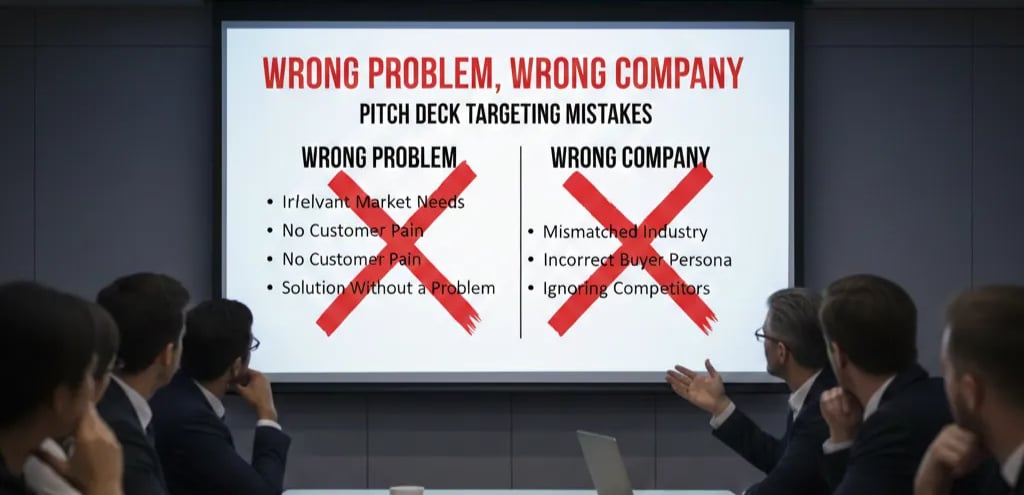
Wrong Problem, Wrong Company: Pitch Deck Targeting Mistakes That Erase Your Raise
You will not get a second meeting. Not because your product is broken, not because your team is weak — but because your Problem Slide described a pain that does not belong to the company you are building. Pitch deck targeting mistakes are not framing errors; they are strategic errors, and VCs treat them as evidence of a founder who does not yet understand their own business. This failure pattern appears consistently across the VC-analysed breakdowns of good versus bad Problem and Solution Slides that separate funded decks from archived ones. If your last meeting ended with "we'd love to stay in touch," this is the diagnosis.
How Targeting the Wrong Problem in Your Pitch Deck Destroys Investor Confidence in Your Market Judgment
A Problem Slide with a targeting mistake does not look broken on the surface. It looks generic. The tell is specificity of ownership: the problem described could belong to any of twelve companies, none of which is yours. A VC reads it and cannot draw a straight line from the problem to your specific solution, your specific customer, and your specific right to win. That line must be visible in under fifteen seconds. If it is not, the mental tab closes.
Here is what a targeting mistake looks like in practice. A B2B SaaS founder building compliance automation for community banks writes: "Businesses face increasing regulatory pressure and spend too much time on compliance." That sentence describes a $200B addressable problem — and it describes absolutely no one in particular. The VC sitting across from you funds vertical software. They know the difference between a real problem and a category description. I have seen this exact framing in seventeen decks reviewed this year; twelve of them did not receive a follow-up request for financials. The founder in each case believed they were being inclusive. They were actually being invisible.
The psychological root is fear of narrowing. Founders are told repeatedly that small TAMs kill deals, so they overcorrect by describing the problem at the category level to appear larger. The result is the opposite of what they intend: a problem so broad it implies no defensible wedge, no specific customer, and no proprietary insight.
As of 2025, top-tier US funds at the Series A stage are underwriting to specific ICP (Ideal Customer Profile) precision as a baseline diligence requirement — not a bonus. A Problem Slide that cannot identify a named customer archetype within two sentences fails that filter before the deck reaches a partner.
The Financial Cost of a Misaligned Problem Statement: What Wrong Targeting Does to Your Valuation Math
Targeting mistakes are not just narrative failures. They have a direct mathematical consequence on how your raise is priced and whether it closes at all. Here is the logic chain:
Step 1 — Wrong problem → wrong customer definition If your Problem Slide targets "mid-market companies struggling with data silos," your ICP has no boundary. A VC cannot model CAC without a bounded customer segment.
Step 2 — Wrong customer definition → unvalidatable CAC Without a specific customer, your CAC figure is a guess dressed as a data point. If your deck states a CAC of $2,400 but your problem statement includes everyone from 50-person startups to 5,000-person enterprises, that number is meaningless. The range of actual acquisition costs across that segment could span 10x.
Step 3 — Unvalidatable CAC → broken LTV:CAC ratio A standard Series A benchmark is LTV:CAC of 3:1 minimum, with top-quartile funds expecting 4:1 or above in SaaS. If your CAC is unvalidatable, your LTV:CAC ratio is unauditable. That is not a metric — it is a liability.
Step 4 — Broken unit economics → compressed pre-money valuation A VC cannot justify a $22M pre-money on a business with unresolvable unit economics. They will either pass or re-anchor the conversation to a much lower entry point.
The targeting error on slide 2 does not stay on slide 2. It contaminates your financial model, your market sizing, and your negotiating position.
The Problem Targeting Correction Protocol: How to Rebuild Your Problem Slide Around the Right Company
This is the fix. It is surgical and it requires you to make decisions you have probably been avoiding.
Step 1: Define the Bleed Before You Define the Problem
A correctly targeted Problem Slide answers one question first: who is bleeding, and what does the wound cost them in dollars or hours per month? Not "businesses struggle with X." Specifically: "Operations managers at regional insurance carriers with 100–500 employees spend an average of 14 hours per week manually reconciling audit trails across three legacy systems — at an average fully-loaded labor cost of $3,200 per month per manager."
That sentence contains a job title, a company size, a sector, a time cost, and a dollar cost. A VC can build a model off that sentence.
Step 2: Apply the "Wrong Door" Test
Read your Problem Slide aloud and ask: could a competitor use this exact slide? If the answer is yes, your targeting is wrong. The problem statement must be so specific to your wedge that a competitor using it would be misrepresenting their own product.
Weak Version vs. VC-Ready Version
Weak Version: "Healthcare organizations struggle with inefficient patient communication, leading to missed appointments and revenue loss."
This describes a problem owned by Epic, Salesforce Health Cloud, five well-funded startups, and seventeen legacy vendors. It signals that the founder has not chosen their lane.
VC-Ready Version: "Independent behavioral health practices with 3–10 providers lose an average of $18,000 per month in no-show revenue. Existing EHR reminder tools were built for primary care workflows and do not account for the 72-hour pre-appointment window critical to behavioral health patient compliance."
That version identifies the customer (independent behavioral health practices), the size (3–10 providers), the dollar loss ($18K/month), and the reason existing solutions fail (workflow mismatch). A VC can now stress-test your TAM, your ICP, and your wedge from a single paragraph.
The Targeting Equation
Use this as a structural filter before finalizing your Problem Slide:
Targeted Problem = [Specific Job Title or Buyer] + [Company Size/Sector] + [Quantified Cost of Problem] + [Why Current Solutions Fail for This Specific Segment]
If any of the four variables is missing, the slide is not ready.
Three Pitch Deck Targeting Mistakes Founders Make While Trying to Fix This
1. Narrowing the problem but keeping the TAM inflated. You cannot write a hyper-specific Problem Slide and then claim a $40B TAM on the next slide. The VC will flag the arithmetic inconsistency immediately. Narrow the problem, then narrow the TAM to match — and add a SAM and SOM that are defensible.
2. Targeting by pain without targeting by buyer. "CFOs hate manual reconciliation" is a pain point, not a target. CFOs at which companies, at which revenue threshold, in which sectors, using which current tools? Pain without buyer profile is still a generic slide.
3. Switching ICP mid-deck. Your Problem Slide targets one customer. Your Traction Slide references a different one. This happens more than it should, and it tells the VC that your go-to-market is still unresolved — which is fatal at Series A.
Fixing Your Problem Targeting Is Worth More Than Your Next Design Revision
A correctly targeted Problem Slide does not just improve your deck — it restructures the entire investor conversation. When your problem is specific, your customer is credible, your unit economics become auditable, and your pre-money negotiation starts from a position of strength rather than ambiguity. Founders who fix this before outreach do not just get more meetings; they get meetings with the right investors who have already bought into the premise before the second slide. Build the complete system using the Problem and Solution Slide framework built specifically for US, UK, and Canadian founders raising from pre-seed through Series A.
Founders who have used the Slide-By-Slide VC Instruction Guide inside the $5K Consultant Replacement Kit go into partner meetings with a Problem Slide that already passes the ICP precision filter a VC analyst will run before the deck reaches a partner. That is not a marginal improvement — it is the difference between a screening call and a term sheet conversation. The full Kit is $497. Get the slide-by-slide system that eliminates pitch deck targeting errors before your next investor meeting.
Funding Blueprint
© 2026 Funding Blueprint. All Rights Reserved.