
Perfect Stage Fit: Pitch Deck Examples for Pre-Seed to Series A
Pitching a Series A with a Pre-Seed deck signals founder inexperience. Learn the exact metrics VCs demand at Pre-Seed, Seed, and Series A to get funded.
2.9 EXAMPLES: GOOD VS BAD PROBLEM & SOLUTION SLIDES (VC ANALYSIS)
3/3/20265 min read
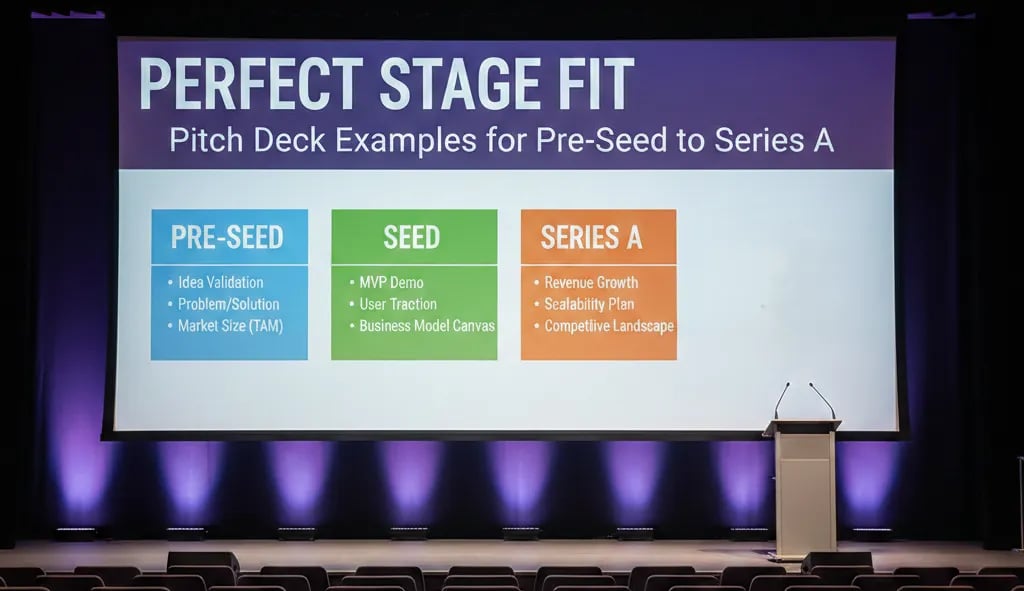
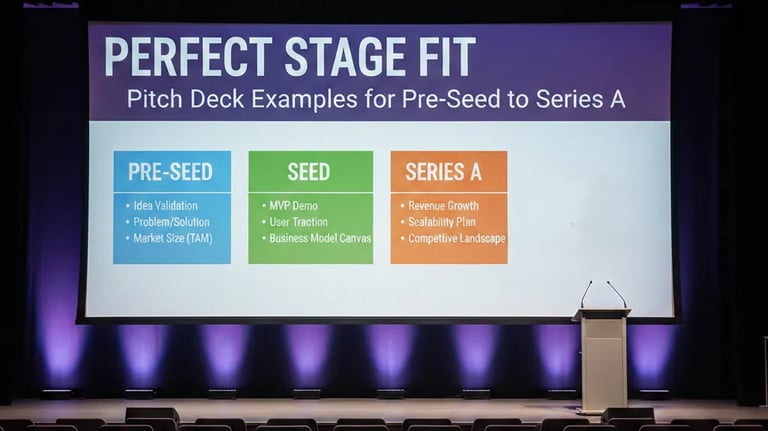
Perfect Stage Fit: Pitch Deck Examples for Pre-Seed to Series A
$0 in revenue and a $20M valuation ask. That is not ambition — that is a stage mismatch, and it is one of the fastest ways to end a fundraise before the Q&A begins. Pre-seed founders routinely submit decks structured like Series A companies, and Series A founders still present with the thin, hypothesis-heavy framing that belongs in a friends-and-family round. The examples that separate funded decks from rejected ones at each stage are analysed in detail through VC-reviewed Problem and Solution Slide breakdowns showing exactly what earns a second meeting. If you are raising and unsure whether your deck matches your stage, this diagnostic applies directly to you.
Why Stage-Mismatched Pitch Deck Examples Signal Founder Inexperience to Every VC in the Room
A deck is not just a document. It is a proof of judgment. When a pre-seed founder opens with a 5-year revenue projection built on unit economics they have not yet validated, the VC does not think "ambitious." They think: this person does not understand what they are selling me right now. What you are selling at pre-seed is a thesis and a team. What you are selling at Series A is a repeatable system with evidence. Conflating the two collapses your credibility on slide 2.
Here is what a stage-mismatched deck looks like in practice. A pre-seed founder includes a slide titled "Unit Economics" featuring a CAC of $180 and an LTV of $1,200 — numbers invented from industry benchmarks, not their own data. A VC analyst flags it immediately. The question they write in the margin is not "is this right?" It is "where did this come from?" That question, unanswered, becomes a pass. I have reviewed fourteen pre-seed decks in the past two quarters where fabricated unit economics appeared before the founder had a single paying customer — eleven did not advance past the screening call.
The psychological root of this mistake is mimicry. Founders study Series A decks from Notion, Figma, or Superhuman and reverse-engineer the structure without understanding that those decks were built after the evidence existed. They are copying the output without earning the inputs.
The Stage-by-Stage Financial Logic That Determines What Your Deck Must Prove
The math here is not complicated, but most founders ignore it entirely. Each funding stage requires a specific evidentiary burden. That burden scales with check size and valuation expectation. Here is the framework:
Startup Funding Benchmarks (US, 2025)
Pre-Seed
Median Pre-Money: $3M–$6M
Goal: Prove the problem is real and the team can execute.
Key Metrics: Qualitative validation and 10–30 customer interviews.
Seed
Median Pre-Money: $8M–$14M
Goal: Prove the solution has early market pull.
Key Metrics: Early MRR (Monthly Recurring Revenue), pilot data, and retention signals.
Series A
Median Pre-Money: $22M–$28M
Goal: Prove growth is repeatable and efficient.
Key Metrics: CAC:LTV ratio and a Burn Multiple under 1.5x.
As of 2025, the median Series A pre-money in the US sits at $22M–$28M — and top-tier funds are now requiring a Burn Multiple below 1.5x as a baseline filter, not a bonus point. That means if you are burning $200K/month and growing MRR by $100K/month, your Burn Multiple is 2.0x — and you will not pass the Series A screen regardless of your narrative.
The cognitive load implication for decks is direct: every slide must match the evidentiary weight your stage can support. A pre-seed deck that includes a Burn Multiple slide confuses investors because it implies data that should not exist yet. A Series A deck without one signals that the founder does not understand what they are being evaluated on.
The Stage-Fit Framework: Before and After Examples Across Pre-Seed, Seed, and Series A
This is where most pitch deck advice falls short — it tells you what to include without showing you how it changes by stage. Here is the structured fix.
Pre-Seed Problem Slide
Weak Version: "Small businesses struggle to manage their cash flow. The market is worth $50B."
This tells the VC nothing they do not already know. It is a Wikipedia sentence dressed as an insight. There is no specificity, no evidence of founder proximity to the problem, and no signal that you have spoken to a single human being who experiences this pain.
VC-Ready Version: "We interviewed 27 independent restaurant owners in Chicago and Austin. 22 of them said cash flow gaps between invoice and supplier payment forced them to delay staff wages at least once in the past six months. No current tool addresses the 7–10 day receivables window specific to food service."
That version proves problem existence, market specificity, and founder diligence — the only three things a pre-seed investor is buying.
Seed Solution Slide
Weak Version: "Our platform automates cash flow forecasting using AI."
VC-Ready Version: "We are live with 14 restaurants across two cities. Average time-to-value is 4 days. Net revenue retention at 60 days is 108%. Pilot cohort reduced manual reconciliation time by 6 hours per week per location."
At seed stage, the solution slide must carry early retention data. Without it, you are asking investors to fund a hypothesis you have already had the runway to test.
Series A Solution Slide
Apply the Rule of 40 directly on the slide: Growth Rate (MoM %) + Gross Margin (%) must exceed 40 for the business to be considered capital-efficient at this stage. If you are growing at 15% MoM and your gross margin is 68%, your Rule of 40 score is 83. That goes on the slide. That is the language a Series A fund speaks.
The structural rule: Each stage up requires you to replace one assumption with one data point. Pre-seed is all assumption. Series A should have almost none.
Three Stage-Fit Death Traps That Kill Decks During the Fix
1. Retrofitting Series A metrics onto a Seed deck. If you add a Burn Multiple slide before you have 6 months of consistent revenue, you are introducing a metric that invites scrutiny you cannot survive. Leave it out until the data is clean.
2. Stripping your Series A deck back to "story mode." Founders who have been told their deck is "too numbers-heavy" sometimes overcorrect into narrative. At Series A, a VC analyst will build a model off your deck before the partner meeting. If the numbers are not there, the meeting is not happening.
3. Using 2021 valuation anchors in a 2025–2026 raise. Citing comps from the zero-interest era is an instant credibility loss. The market re-priced. Your deck needs to reflect current multiples, not peak ones.
Stage Fit Is Not a Design Problem — It Is a $5M Valuation Problem
Getting your stage fit wrong does not just cost you a meeting. It costs you negotiating position. A deck that reads one stage below where you are raising signals inexperience, and that signal becomes leverage for a lower pre-money. Fixing your stage fit — specifically your Problem and Solution Slide — is one of the highest-leverage changes you can make before your next outreach. The full framework for building slides that match investor expectations at every stage lives inside the complete Problem and Solution Slide system for US, UK, and Canadian founders raising from pre-seed through Series A.
Every week your deck misrepresents your stage is a week of meetings you will not recover. The Slide-By-Slide VC Instruction Guide inside the $5K Consultant Replacement Kit is built specifically to close this gap — it tells you, slide by slide, what evidence is required at your exact funding stage before you walk into a partner meeting. The full Kit is $497. Build a stage-accurate pitch deck that VCs won't dismiss in the first five slides.
Funding Blueprint
© 2026 Funding Blueprint. All Rights Reserved.