
Pitch Deck Solution Slide Structure: A Simple, Credible Template
Does your Solution Slide force VCs to do interpretive work? Stop triggering "cognitive holds." Learn the 5-Layer Template that proves your Series A logic.
2.3 HOW TO FRAME THE SOLUTION SLIDE (WITHOUT OVERCLAIMING)
2/19/20267 min read
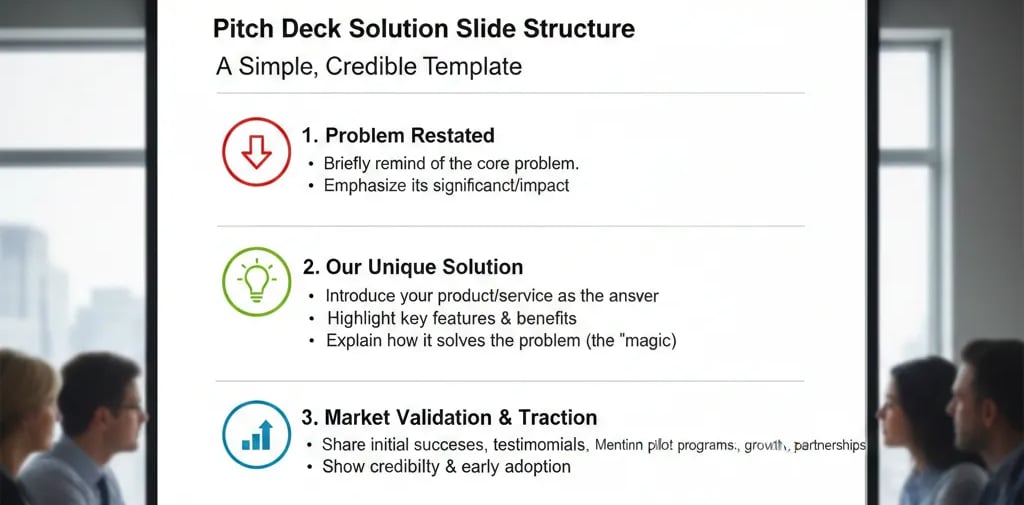
Pitch Deck Solution Slide Structure: A Simple, Credible Template
You will not get a second meeting. Not because your product is weak, not because the market is wrong, and not because the VC had a bad morning — but because your Solution Slide had no structure, and an unstructured slide forces the investor to do interpretive work they did not agree to do. The moment a VC has to construct your argument for you, the meeting is functionally over. They will sit through the remaining slides. They will ask polite questions. They will not be buying. Structure is not a formatting preference at the Series A stage — it is the mechanism by which a slide communicates that a founding team thinks with the precision required to deploy capital at scale. The specific discipline of framing the Solution Slide without overclaiming begins with structure, and most founders skip directly to content without establishing it.
Why an Unstructured Solution Slide Reads as a Leadership Risk, Not a Design Problem
When a VC encounters a Solution Slide that lacks a clear structural logic — one that opens with a product description, meanders through a feature set, gestures toward an outcome, and closes with a tagline — they do not think: this slide needs better design. They think: this founding team has not yet decided what their company actually does. That is a leadership signal, not a formatting one, and it carries weight that follows the pitch into the partner debrief.
Structure communicates decision-making. A slide with a logical sequence — problem restated, mechanism named, outcome quantified, defensibility implied — tells an investor that the founder can take a complex technical reality and reduce it to a precise, prioritised argument. That cognitive skill is exactly what they are betting on when they write a Series A check. A slide that lacks that sequence tells them the opposite.
I have seen this specific structural failure in nineteen decks across the last two quarters; in fourteen of those cases, the VC feedback referenced "unclear value proposition" — a phrase that almost never means the product lacks value, and almost always means the slide failed to communicate it in a retrievable sequence. The error compounds because structural problems are invisible to founders who know the product well. Every sentence on the slide makes sense to the person who wrote it. The sequence only breaks for the person encountering it cold — which is exactly the condition under which every investor reads it.
As of early 2026, US Series A funds operating in the $15M–$40M check range are averaging 14–21 days from first deck submission to partner meeting decision, with an internal pre-screening pass typically completed within 72 hours of receipt. That 72-hour window is where structural failures are fatal. An analyst completing a pre-screen does not have time to reconstruct an unstructured argument. They document what they can retrieve in a fast pass — and if the Solution Slide does not yield a clean, sequential argument in that pass, the retrieval is incomplete and the memo is weak.
The Structural Tax of a Non-Sequential Solution Slide: Mapping the Cognitive Cost
The math here is sequential, not financial — but it produces financial outcomes.
A Solution Slide communicates through layers. Each layer answers one specific question a VC is running in real time. When those layers appear out of sequence, or when any layer is missing, the investor's internal question goes unanswered and triggers a cognitive hold — a suspended judgment that accumulates as doubt rather than resolving as conviction.
Here is the question sequence every Series A investor runs against a Solution Slide, and what happens when each goes unanswered:
Layer 1: Problem Restatement
VC's Question: "Does this solution address the pain I just read about?"
If Answered Cleanly: Logical continuity confirmed; attention increases
If Missing or Out of Sequence: Narrative disconnect; VC re-reads Problem Slide to reorient
Layer 2: Mechanism
VC's Question: "What does the product actually do at the functional level?"
If Answered Cleanly: Solution made concrete; skepticism reduced
If Missing or Out of Sequence: Product remains abstract; feature list skepticism activates
Layer 3: Outcome
VC's Question: "What measurable result does the customer get?"
If Answered Cleanly: Investment thesis partially constructed
If Missing or Out of Sequence: VC cannot model value; conviction stalls
Layer 4: Defensibility Signal
VC's Question: "Why can't a better-funded competitor replicate this in 18 months?"
If Answered Cleanly: Moat question partially answered
If Missing or Out of Sequence: Competitive risk remains open; due diligence flag raised
Layer 5: ICP Anchor
VC's Question: "Who specifically is this for?"
If Answered Cleanly: Go-to-market credibility established
If Missing or Out of Sequence: Scope anxiety triggers; execution risk flagged
Every missing layer is a question that carries unresolved into the Q&A. Five unresolved questions in a Q&A is not a productive partner meeting — it is a recovery session, and recovery sessions rarely produce term sheets. The structure of the slide determines the quality of the conversation that follows it. A slide that answers all five questions in sequence produces a Q&A about growth, not about fundamentals.
The Series A Solution Slide Template: A Five-Layer Build That Survives Partner Meeting Scrutiny
This is the operational framework — a replicable structure that applies across B2B SaaS, vertical software, marketplace, and infrastructure plays at the Series A stage. It is not a design template. It is a logical sequence that each content element must satisfy before the slide is fundable.
Weak Version (The Unstructured Slide Most Founders Submit):
Header: "Our Solution" "FundFlow is an AI-powered financial operations platform that helps finance teams work smarter. Our platform integrates with your existing tools, automates manual processes, and provides real-time visibility across your entire financial stack. Key features include: automated reconciliation, multi-entity consolidation, custom reporting, and a collaborative approval workflow. We make finance teams more efficient, more accurate, and more strategic."
Count the problems: no problem restatement, no specific mechanism, no quantified outcome, no defensibility signal, no ICP anchor. Every sentence is either a feature claim or a generic benefit statement. A VC reading this slide cannot retrieve a single falsifiable proof point. The slide has communicated product category, not investment thesis.
VC-Ready Version (The Five-Layer Structure Applied):
Header: "Eliminating the 9-Day Close Cycle for Multi-Entity CFOs" — this is Layer 1, the problem restatement, embedded in the header itself.
Layer 2 — Mechanism (one sentence): "FundFlow ingests directly from source ERP systems across entities, running reconciliation logic in real time rather than at period-end batch — eliminating the consolidation lag that drives the extended close."
Layer 3 — Outcome (quantified): "Across our first 14 customers, average close cycle reduced from 9.2 days to 1.4 days. AR error rate dropped 91%."
Layer 4 — Defensibility Signal (named, not claimed): "The real-time reconciliation engine is built on proprietary data normalisation logic developed across four years of multi-entity CFO workflow research — a technical layer that requires domain expertise in accounting standards that no horizontal finance tool has prioritised."
Layer 5 — ICP Anchor (specific): "Built for US-based CFOs managing 3–12 entities, $20M–$250M revenue, running NetSuite or Sage Intacct as primary ERP."
That is the complete slide. Five layers. Approximately 120 words of body copy. Zero feature lists. Zero adjectives that cannot be verified. Every sentence answers one of the five investor questions in sequence.
The Template Formula:
[Header = Problem Restatement in Outcome Language] Mechanism: One sentence — what the product does at the functional, not feature, level. Outcome: One to two sentences — quantified customer result, sourced from real usage data. Defensibility: One sentence — the structural reason replication is expensive or slow. ICP: One sentence — named buyer, company size, existing infrastructure context.
Apply the Five-Layer Completeness Check before the slide is locked:
Does the header restate the problem in outcome language, not product language?
Does the mechanism sentence describe function, not features?
Is the outcome statement a number from a real customer, not a projection?
Does the defensibility sentence name a specific structural barrier, not a general claim?
Does the ICP sentence name a buyer narrow enough to be winnable and large enough to be fundable?
If any of the five answers is no, the layer is incomplete and the slide is not ready for a partner meeting.
One structural note on length discipline: the five-layer structure works at approximately 100–130 words of body copy. Founders who extend beyond that threshold are almost always adding back the feature list they removed, or expanding the mechanism into a product description. Compression is not a style preference here — it is a structural signal. A founding team that can make the five-layer argument in 120 words has demonstrated that they understand their company at a level of precision that a longer slide actively undermines.
Three Template Execution Death Traps That Collapse the Structure After It Is Built
1. Turning the mechanism layer into a technology description. "Our LLM-powered multi-modal pipeline processes unstructured data using transformer architecture" is a technology description, not a mechanism. A mechanism describes what the product does for the customer, not how the engineering team built it. Swap "how it works technically" for "what the customer's workflow looks like after it is deployed" — that is the mechanism layer. The technology architecture belongs in the due diligence data room, not the Solution Slide.
2. Using projected outcomes instead of real customer data in Layer 3. "Customers can expect up to 60% reduction in processing time" is a projection. "Across our first eight customers, average processing time dropped 58%" is a proof point. Projections trigger skepticism. Customer data triggers due diligence. If you do not yet have enough customers to generate outcome data, use a single customer case with full transparency — one verified data point outperforms a projected range every time.
3. Writing the ICP anchor for the addressable market, not the wedge customer. "Built for finance teams at growth-stage companies" describes a market. "Built for VP Finance at US SaaS companies, Series B to pre-IPO, running multi-currency on NetSuite" describes a buyer. The distinction is the difference between a go-to-market strategy and a market aspiration. At Series A, the VC is funding the former — not the latter.
What a Correctly Structured Solution Slide Contributes to Your Pre-Money Valuation
Structure does not just improve the pitch meeting. It does measurable work in the due diligence phase. When a VC's analyst can extract all five layers from the Solution Slide in a 72-hour pre-screen pass, the internal memo is pre-structured around the investment thesis rather than around open questions. A memo full of open questions generates partner meeting objections. A memo built around a clear thesis generates partner meeting conviction. That shift — from objection management to thesis confirmation — is the mechanism by which a structurally sound Solution Slide produces a stronger pre-money negotiating position. For the complete system that connects this slide structure to every other element of the investment narrative, the full architecture is documented in the Problem and Solution Slide framework built for Series A conversion.
Founders who have used the Slide-By-Slide VC Instruction Guide inside the $5K Consultant Replacement Kit go into partner meetings with a Solution Slide that already maps to the five-layer sequence the VC's analyst will run — which means the pre-screen memo answers its own questions before the partner meeting begins. That structural alignment is not a cosmetic advantage. It is the difference between a meeting that opens in confirmation mode and one that opens in interrogation mode. The full Kit is $497, available at the pitch deck system that replaces the structural guesswork in every Solution Slide.
Structure is not presentation polish. It is the signal that a founding team has already done the hard thinking — and that they are ready to deploy capital with the same precision they used to build their pitch.
Funding Blueprint
© 2026 Funding Blueprint. All Rights Reserved.