
The "One-Line Solution" Test: How VCs Grade Pitch Deck Clarity
Clarity is a thinking skill. Master the CWOR Framework (Customer, Wound, Outcome, Relief) to turn a "precise" solution into a fundable Series A thesis.
2.3 HOW TO FRAME THE SOLUTION SLIDE (WITHOUT OVERCLAIMING)
2/18/20264 min read
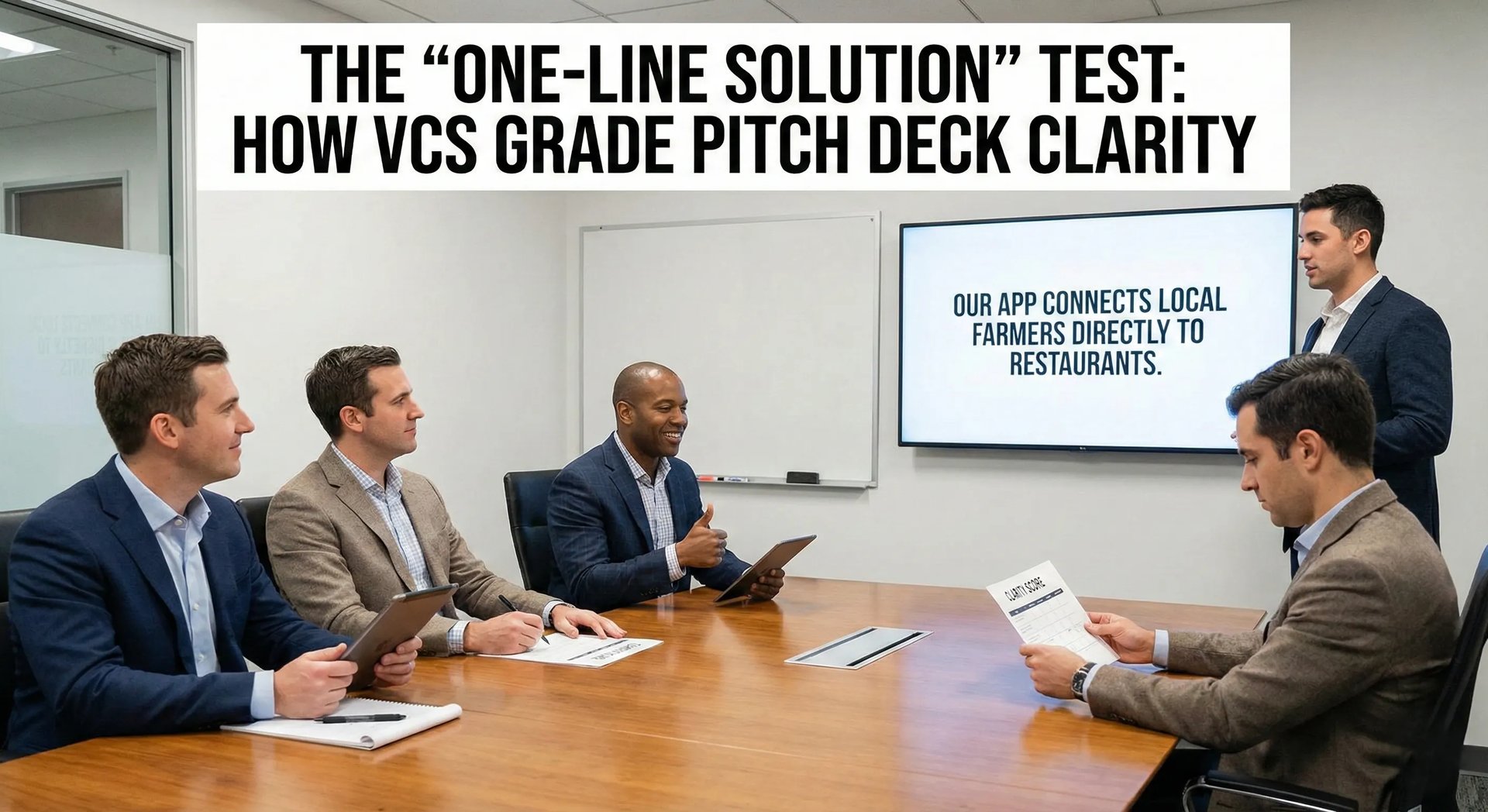
The "One-Line Solution" Test: How VCs Grade Pitch Deck Clarity
Most founders think a more detailed Solution Slide proves they've done the work. It proves the opposite. The moment a partner has to re-read your solution statement to understand what you actually do, you've already lost the room. This is the single most common clarity failure in early-stage decks — and it's costing founders term sheets they don't even know they're close to getting. If you're building toward Series A and haven't stress-tested your solution framing against the one-line standard, start with how to frame the Solution Slide without overclaiming before you send another deck.
Why a Bloated Solution Statement Kills Series A Deals Before the Q&A Starts
The failure pattern is consistent: a founder who has lived inside their product for 18 months writes a solution statement for someone who understands it just as deeply. The VC does not. What reads as "precise" to the founding team reads as "evasive" to a partner who is processing 40 decks a month.
Here's what a bad Solution Slide looks like in practice: "Our proprietary AI-native platform leverages real-time data orchestration to deliver contextual workflow automation across enterprise environments." That sentence contains zero information. It names no customer, solves no specific problem, and produces no mental image of the product in action. In a deck reviewed last quarter, a B2B SaaS founder used nearly identical language — the VC passed before reaching slide 6.
The psychological cause is almost always ego-adjacent: founders conflate complexity with credibility. They've been told to "show sophistication," so they load the Solution Slide with architecture language and feature lists. The actual sophistication a VC wants to see is not technical — it's cognitive. Can you make me understand, in one sentence, who is in pain, what you do about it, and why it works? If your answer requires a paragraph, your thinking isn't clear enough to back with $5M.
What Happens in the First 8 Seconds on Your Solution Slide
Clarity is not a soft skill. It has a measurable cost.
Eye-tracking research on investor reading behaviour consistently shows that a VC analyst spends 8–12 seconds on a Solution Slide before forming a preliminary judgment. That judgment is binary: I understand this or I don't. There is no partial credit.
Here's the math on what unclear framing costs you:
Scenario A — Unclear Solution Statement:
VC reads it twice: 6 seconds lost
VC forms a question they now need answered: cognitive debt added
VC attention during your verbal pitch is now split: they're still solving your slide while you're explaining traction
Net result: you're pitching into a deficit before you've said a word about revenue
Scenario B — One-Line Solution that passes the test:
VC reads it once: 3 seconds
VC moves to the next slide with a resolved mental model
VC's full attention is available for your differentiation argument
Net result: you're pitching into a surplus
As of early 2026, top-tier US funds — particularly those deploying from 2024–2026 vintage vehicles — are reporting faster pass decisions at the deck stage, with many partners citing "narrative clarity" as the primary filter before financials are even reviewed. At median Series A pre-money valuations sitting between $22M–$28M in the US, the competition for that check is too tight to donate 6 seconds of a partner's attention to a slide they have to decode.
The One-Line Solution Protocol: How to Build a Statement That Passes VC Scrutiny
The framework is called CWOR: Customer, Wound, Outcome, Relief mechanism.
Every VC-ready solution statement answers four questions in one sentence:
Who is the customer? (Named, specific)
What wound are you closing? (The specific friction from your Problem Slide)
What outcome do they get? (Measurable, not aspirational)
How do you deliver it? (One clause — no feature lists)
Weak Version: "We help companies streamline their operations using intelligent automation technology."
Customer: undefined ("companies")
Wound: absent ("streamline" is not a pain point)
Outcome: absent
Relief mechanism: generic ("intelligent automation")
VC interpretation: pass, or ask for a resubmit
VC-Ready Version: "We help mid-market logistics operators eliminate invoice reconciliation delays — cutting close cycles from 14 days to 48 hours — through a rules engine that sits on top of their existing ERP."
Customer: mid-market logistics operators ✓
Wound: invoice reconciliation delays ✓
Outcome: 14 days → 48 hours ✓
Relief mechanism: rules engine on existing ERP (no rip-and-replace risk) ✓
VC interpretation: I understand this. Next slide.
The stress test: Read your solution statement to someone outside your industry. If they cannot explain your product back to you in their own words within 30 seconds, rewrite it. That is not a creativity exercise — it's a diligence simulation.
The overclaiming trap is the second variable. Your solution statement must be falsifiable. "We are the only platform that..." or "We eliminate X entirely" are red flags. VCs will probe these in the first five minutes and the moment your claim fractures under mild pressure, credibility on every subsequent slide degrades.
Three Fatal Mistakes Founders Make While Fixing Their Solution Slide
1. Swapping jargon for buzzwords. Replacing "AI-native orchestration" with "machine learning-powered insights" is not a fix. Both fail the CWOR test.
2. Writing for the press release, not the partner meeting. Your solution statement is not a tagline. It is a diagnostic tool the VC uses to filter whether your problem-solution logic is coherent.
3. Mismatching the solution to the Problem Slide. If your Problem Slide identifies pain point A and your Solution Slide addresses pain point B, you've signalled a fundamental gap in your own thinking. This is more common than it should be.
What One Sentence of Clarity Is Actually Worth at the Term Sheet Stage
A solution statement that passes the one-line test doesn't just improve your deck. It compresses the VC's due diligence timeline by eliminating the first round of clarification questions. Founders who enter partner meetings with a resolved problem-solution narrative spend less time re-explaining and more time defending their moat — which is where term sheet decisions are actually made. For a full breakdown of how the Problem and Solution Slides function as a connected system, the complete guide to Problem and Solution Slides for Series A decks covers the entire architecture.
Every week your Solution Slide requires a verbal explanation to make sense is a week you're entering investor meetings with a structural disadvantage. The Slide-By-Slide VC Instruction Guide inside the $5K Consultant Replacement Kit includes the exact CWOR framework applied to the Solution Slide, with VC-annotated before/after examples across SaaS, Fintech, and HealthTech verticals. The full Kit is $497. If your next partner meeting is within 60 days, the time cost of building this manually is not recoverable. Get the Kit that closes the clarity gap before your next deck goes out.
Clarity is not a pitch skill. It is a thinking skill. The Solution Slide is where VCs test whether you have it.
Funding Blueprint
© 2026 Funding Blueprint. All Rights Reserved.