
Pitch Deck Scope: Why Broad Solutions Kill Investor Interest
Is your Solution Slide trying to serve everyone? Broad scope signals a broken CAC model. Learn why VCs pass on "multi-segment" products and how to fix it.
2.3 HOW TO FRAME THE SOLUTION SLIDE (WITHOUT OVERCLAIMING)
2/19/20266 min read
Pitch Deck Scope: Why Broad Solutions Kill Investor Interest
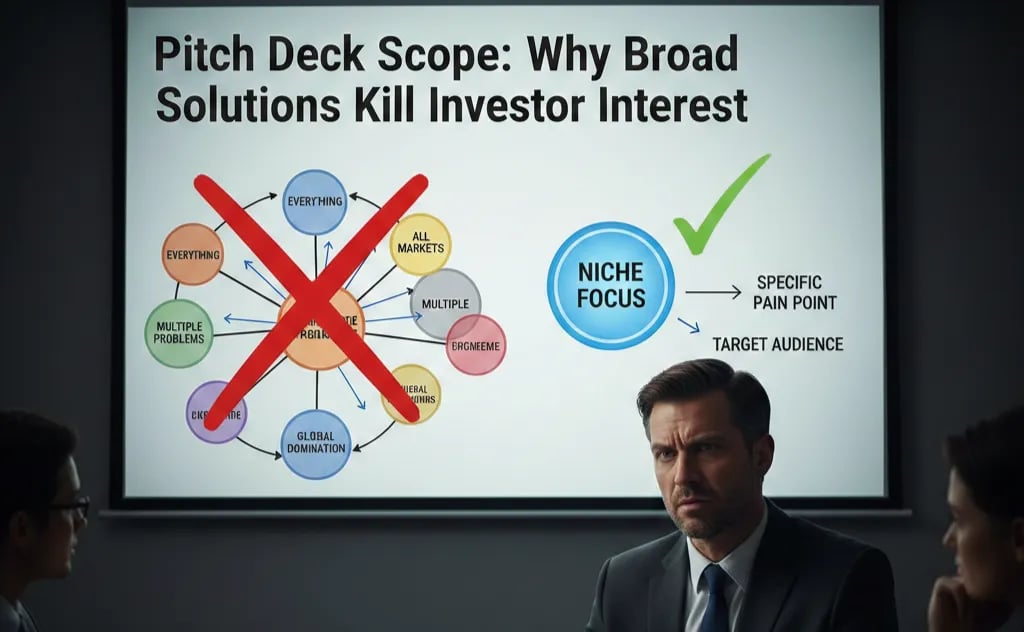
$180 billion is the size of the "global workforce management market" — and it is the number that ended one founder's Series A process in under four minutes. The TAM was real. The slide was formatted correctly. The problem was that the Solution Slide tried to address all of it. When your solution claims to serve every segment of a nine-figure market simultaneously, a VC does not see ambition. They see the absence of a go-to-market strategy, the absence of a prioritisation framework, and the presence of a founding team that has not yet made the hard decisions a Series A company must have already made. Narrowing your solution scope is not a concession — it is the argument. Understanding how to frame the Solution Slide without overclaiming is the technical skill that separates a fundable pitch from one that reads like a product vision document.
How Broad Solution Framing Signals Execution Risk Before the VC Asks a Single Question
The damage a wide-scope Solution Slide does is not aesthetic. It is structural — and it compounds through every subsequent slide in the deck.
Here is the sequence a VC runs internally when they encounter a solution that tries to solve too much: First, they question whether the founding team understands customer segmentation. Second, they question whether the product's roadmap is driven by customer pull or by the founder's conviction about what the market should need. Third — and this is the one that closes the door — they question whether the company has the operational capacity to execute against a multi-segment solution at Series A headcount and burn. None of these questions get asked out loud in the first meeting. They get documented in the analyst's memo after you leave.
In a deck reviewed last quarter, a founder pitching a vertical HR-tech solution described their product as serving "SMBs, mid-market, and enterprise HR teams across North America and the UK" — on the Solution Slide, not the vision slide. The firm passed within 48 hours. The feedback cited "unclear ICP and go-to-market prioritisation." The product had genuine enterprise traction. The slide erased it.
The psychological driver is fear of exclusion. Founders believe that narrowing the solution scope signals a small opportunity. The inverse is true. A precisely scoped solution signals that you understand which customer has the most acute pain, the highest willingness to pay, and the shortest sales cycle — and that you have chosen to win there first. That is not a small opportunity. That is a beachhead thesis, and it is exactly what early-stage investors need to see before they can model a return.
The Scope-Signal Equation: Why Breadth Mathematically Undermines Your Valuation Case
As of early 2026, top-tier US Series A funds are stress-testing a minimum 18-month runway assumption — up from 12 months during the 2021 deployment cycle. That shift has a direct implication for solution scope. A broader solution requires more engineering resources, more sales motion complexity, more customer success coverage, and a longer time-to-repeatability on the revenue model. All of that increases burn. All of that shortens runway. The fund's model breaks before the pitch meeting ends.
Here is the scope-to-burn multiplier logic, simplified:
Single ICP, single use case
Segments Served: 1
Sales Motion Complexity: Low — one playbook, one message
Burn Multiple Implication: Efficient; repeatable CAC model possible
Two segments, related use cases
Segments Served: 2–3
Sales Motion Complexity: Medium — bifurcated messaging, split CS effort
Burn Multiple Implication: Manageable with disciplined prioritisation
"SMB to Enterprise, multiple verticals"
Segments Served: 4+
Sales Motion Complexity: High — no single playbook scales
Burn Multiple Implication: CAC becomes unpredictable; LTV modelling breaks
The bottom row is not a growth strategy at Series A. It is a capital destruction schedule. Top-tier funds evaluating burn multiples — a metric that has replaced pure growth rate as the primary efficiency signal post-2023 — will immediately identify a wide-scope solution as a structural driver of unsustainable burn. The VC is not evaluating your ambition. They are running your unit economics forward 18 months and checking whether the model still works.
The counter-intuitive mathematics: a focused solution with a $400M serviceable addressable market and a clear wedge customer will outperform a broad solution claiming a $4B TAM — because the fund can model the former and cannot model the latter.
The Scope Reduction Protocol: Rebuilding Your Solution Slide Around a Defensible Beachhead
This is the operational fix. It is not about shrinking your vision. It is about sequencing your argument correctly.
Weak Version (What Kills the Meeting):
"Our platform helps businesses of all sizes streamline operations, reduce costs, and improve team productivity across HR, finance, and compliance workflows."
That sentence describes a category, not a company. It tells the VC nothing about who buys first, why they buy, what they pay, or how the company wins. It could describe forty products currently in the market.
VC-Ready Version (What Opens Due Diligence):
"We eliminate the compliance reporting bottleneck for US-based staffing agencies with 50–500 contractors — a segment where manual reconciliation costs an average of $34K per year in admin overhead and where no current SaaS product has built natively for the contractor classification complexity post-AB5."
Now the VC has a specific buyer, a quantified pain, a market context, and a structural reason the category has remained underserved. That is a beachhead thesis in two sentences. The vision slide — which comes later — can expand the frame to the broader market. The Solution Slide's only job is to prove you can win one fight before you pick three.
The Scope Reduction Protocol — four decision filters:
The Single Sentence ICP Test. Can you describe your primary customer in one sentence that includes: industry, company size, the specific role who buys, and the specific workflow they are trying to fix? If the sentence requires "or" or "and also," the scope is too wide.
The Acute Pain Filter. Of all the problems your solution addresses, which one causes the most measurable operational or financial pain for the most concentrated customer segment? That problem — not the broadest one, not the most impressive one — belongs on the Solution Slide.
The Repeatability Test. If you closed ten customers in the next six months using the same sales motion, the same messaging, and the same onboarding process, would they all be in the same segment? If the answer is no, your solution scope is funding two different companies simultaneously. Split them.
The "Why Now" Scope Check. Is the scope of your solution driven by a market condition that exists right now — a regulatory change, a technology unlock, a workflow breakdown — or by a general belief that the market will eventually need this? Scope driven by real-time market pressure is fundable. Scope driven by long-term conviction belongs in the vision section, not the Solution Slide.
Before vs. After applied to slide architecture:
Weak structure: Broad solution claim → long feature list → generic outcome statement for multiple buyer types
VC-ready structure: Named ICP with quantified pain → specific mechanism that solves that exact pain → evidence of repeatability in that segment → one sentence pointing toward the expansion path
The expansion path note matters. A scoped Solution Slide does not mean the investor believes you are building a small company. It means they believe you are building a company that knows how to win. Append one line — "Phase 1 wedge opens the $2.4B [adjacent category] as retention and upsell layer" — and you have signalled ambition without sacrificing precision.
Three Scope-Fixing Death Traps That Create New Problems
1. Narrowing the solution but widening the problem. If your Problem Slide describes a global, multi-industry crisis and your Solution Slide suddenly addresses one vertical, the logical mismatch is worse than broad scope on both slides. The problem and solution must operate at the same level of specificity — a mismatch reads as strategic incoherence, not focus.
2. Confusing "Phase 2 vision" with "current solution." Including future product modules or expansion markets on the Solution Slide to signal ambition destroys the precision you just built. Put the roadmap on a separate traction or vision slide. The Solution Slide covers what the product does today for the customer who is buying today.
3. Over-narrowing to the point of market size anxiety. A beachhead segment that serves 200 companies total is not a fundable Series A market, regardless of how precisely scoped it is. The focus must be tight enough to be winnable and large enough to be fundable. If your wedge segment cannot support $10M–$15M ARR at full penetration, the scope is too narrow in the opposite direction.
What a Correctly Scoped Solution Slide Does to Your Pre-Money Negotiation
Scope precision does financial work beyond the partner meeting. When a VC can model your go-to-market motion — because the customer is named, the pain is quantified, and the sales repeatability is implied — they can project revenue with lower uncertainty. Lower uncertainty in the model produces higher confidence in the valuation. That is not a philosophical observation. It is the mechanism by which a tighter Solution Slide produces a higher pre-money number. The complete architecture for building a Problem and Solution narrative that holds its logic from the first slide to the final term sheet is detailed in the Series A Problem and Solution Slide framework that converts at the partner meeting level.
The 16 VC-Quality AI Prompts inside the $5K Consultant Replacement Kit include a dedicated prompt sequence for solution scope stress-testing — it forces the ICP single-sentence test, the acute pain filter, and the repeatability check before you lock the slide, so you are not discovering the scope problem in a partner meeting. That is the gap between a pitch that generates follow-up questions and one that generates a polite pass. The full Kit is $497, available at the Series A pitch deck system built to replace five thousand dollars in consultant time.
A solution that solves everything for everyone has not made a single hard decision. That is exactly what a VC sees — and exactly why they pass.
Funding Blueprint
© 2026 Funding Blueprint. All Rights Reserved.