
Pitch Deck Solution Simplicity: Why VCs Prefer Uncomplicated Products
Does your Solution Slide look like a feature matrix? Complexity kills Series A deals. Learn why VCs prefer uncomplicated products and how to fix your deck.
2.4 CONNECTING PROBLEM → SOLUTION LIKE A VC (NARRATIVE LOGIC MODEL)
2/21/20265 min read
Pitch Deck Solution Simplicity: Why VCs Prefer Uncomplicated Products
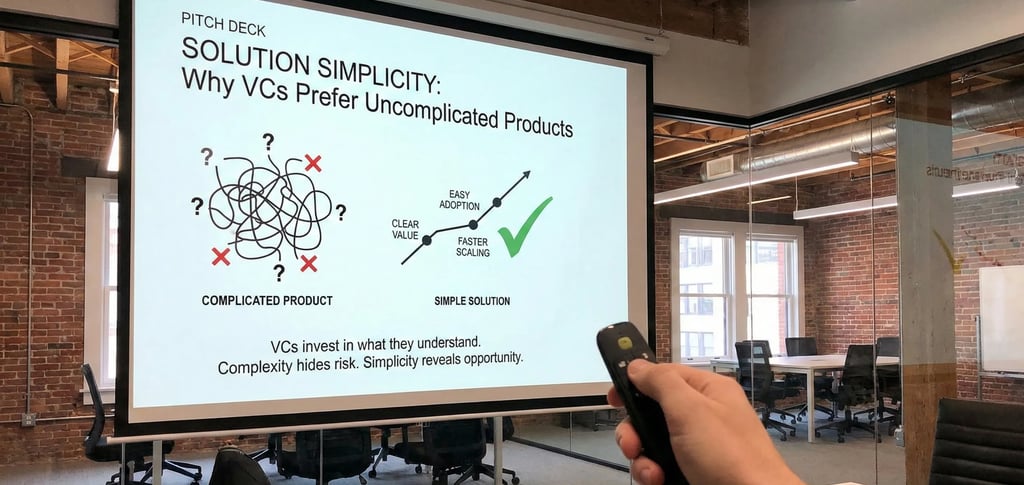
Most founders believe a more complex solution signals a deeper technical moat. It signals the opposite.
Complexity on your Solution Slide tells a VC one thing: you have not finished thinking. A sophisticated investor is not looking for the most elaborate answer to a problem — they are looking for the tightest one. This is part of the foundational narrative work covered in connecting your Problem to Solution slide using VC-grade narrative logic, and it is where more decks collapse than founders realise.
Why an Overcomplicated Solution Slide Kills Series A Deals Before Slide 8
The error is almost always architectural. A founder builds a product with genuine depth — multiple modules, layered integrations, configurable workflows — and then mirrors that complexity onto the Solution Slide because it feels like proof of work. It is not. To the VC reviewing your deck in eleven minutes, a slide packed with system diagrams, feature matrices, and technical sub-components reads as a signal that you cannot prioritise, which means you probably cannot allocate capital efficiently either.
Here is what the VC actually thinks: "If they can't simplify this for a slide, how are they going to simplify it for a sales rep?" That is not a design critique. That is a scalability concern.
I have reviewed fourteen Series A decks this year where the Solution Slide contained more than four distinct value propositions — eleven of them did not advance past the analyst screen. The mistake is almost never arrogance. It is usually bad advice from technical co-founders or early advisors who conflate product sophistication with pitch sophistication. Those are different skills applied to different audiences.
The psychological driver underneath this is fear of underselling. Founders who have spent eighteen months building something feel that simplifying it is a betrayal of what they built. It is not. Simplicity is the translation layer between your product and the investor's mental model — and if that layer fails, the product's real quality becomes irrelevant.
What Complexity Actually Costs You in Seconds
As of early 2026, top-tier US and UK funds are receiving between 2,000 and 4,000 inbound decks per quarter per partner. Analyst pre-screens are averaging 8–12 minutes per deck. That is not a complaint — it is a constraint you must engineer around.
Here is the cognitive load math:
A Solution Slide with one clear mechanism: The VC forms a mental model in ~15 seconds, continues to the Traction Slide, interest intact.
A Solution Slide with three mechanisms, two diagrams, and a feature list: Cognitive processing stalls. The VC either skips forward or disengages entirely. You have burned your 15-second window and replaced it with friction.
The formula that matters here is not technical — it is narrative:
Solution Clarity Score = (Number of Problems Addressed) ÷ (Number of Mechanisms Shown)
A score above 1.0 means you are showing more moving parts than problems you are solving. That is a red flag, not a feature.
Compare these two framings for the same B2B SaaS product:
Here is the breakdown of the information from the provided images into bullet points:
B2B SaaS Product Framing Comparison
Weak Framing:
Pitch Example: "Our platform combines AI-driven workflow automation, a CRM integration layer, real-time analytics dashboards, and a compliance module to address operational inefficiency across enterprise teams."
Analysis: Contains 4 mechanisms and 1 vague problem.
Coherence Score: 0.25
VC-Ready Framing:
Pitch Example: "We eliminate the manual reconciliation step that costs mid-market finance teams 11 hours per week — through a single automated sync between their ERP and approval workflow."
Analysis: Contains 1 mechanism and 1 specific problem.
Coherence Score: 1.0
The second version is not dumbed down. It is loaded. Every word earns its position.
The Simplicity Protocol: How to Build a VC-Ready Solution Slide
Step 1: Run the "One Sentence Stress Test." Write your solution in one sentence without conjunctions (no "and," "while," or "also"). If you cannot do it, you are pitching multiple solutions. Pick the primary one. The others belong in your product roadmap appendix, not your Solution Slide.
Step 2: Use the Mechanism-First Structure. Lead with what your product does, not what it contains. Features are not mechanisms. "We use machine learning" is a feature. "We cut procurement cycle time by 40% by auto-matching purchase orders to vendor invoices in real time" is a mechanism.
Step 3: Mirror the Problem Slide's Language Precisely. The VC's brain is running a pattern-match between your Problem Slide and your Solution Slide. If your Problem Slide says "procurement teams waste 6 hours per PO cycle," your Solution Slide must use the words "PO cycle" and "6 hours." Semantic drift breaks the logical chain and forces the investor to do extra cognitive work you should have done for them.
Step 4: Apply the "Single Protagonist" Rule. Every strong Solution Slide has one user doing one thing with one outcome. Not a persona matrix. Not "enterprise teams across verticals." One role. One action. One measurable result.
Weak Version: "Our solution helps operations, finance, and compliance teams reduce overhead and improve visibility across the organisation."
VC-Ready Version: "The VP of Finance at a 200-person SaaS company closes month-end in 3 days instead of 9, without touching a spreadsheet."
The equation: Specific Role + Specific Action + Specific Outcome = Investable Clarity.
What Founders Get Wrong When They Try to Simplify
1. Stripping the slide down to a tagline. "We make procurement easy" is not a simplified solution — it is an absence of information. Simplicity requires specificity. One precise claim is not the same as a vague one.
2. Moving complexity to the visual layer. Replacing a text-heavy slide with a complex architecture diagram achieves nothing. The cognitive load transfers; it does not disappear. If a VC needs a legend to read your Solution Slide, it is still overcomplicated.
3. Confusing the Solution Slide with the Product Demo. Your Solution Slide is not a feature walkthrough. It is a thesis statement. Founders who try to compress a demo into a slide end up with neither.
The Pre-Money Impact of Getting This Right
A clean Solution Slide does not just improve your deck — it compresses your diligence timeline. When a VC can articulate your solution back to you in one sentence after reading your deck, you have already passed the partner-meeting pre-qualification test. That translates directly to faster term sheet conversations and, in a market where median Series A pre-money in the US sits at $22M–$28M, a cleaner narrative supports a stronger valuation anchor from first principles.
The full architecture for engineering this across every slide in your deck is laid out in the Problem and Solution Slides system for Series A founders.
Every week your Solution Slide is carrying unnecessary complexity, it is filtering you out of meetings you were otherwise qualified for. The Slide-By-Slide VC Instruction Guide inside the $5K Consultant Replacement Kit is built specifically to solve this — it gives you the exact structural standard a VC analyst checks against, applied to your Solution Slide before you submit. The full Kit is $497. You can access it at the VC-standard pitch deck system at FundingBlueprint.
Funding Blueprint
© 2026 Funding Blueprint. All Rights Reserved.